Do Permanently Free Cloud Phones Exist? The Truth and Risks of Free Cloud Phones
Why a Truly Free Cloud Phone Is Nearly Impossible
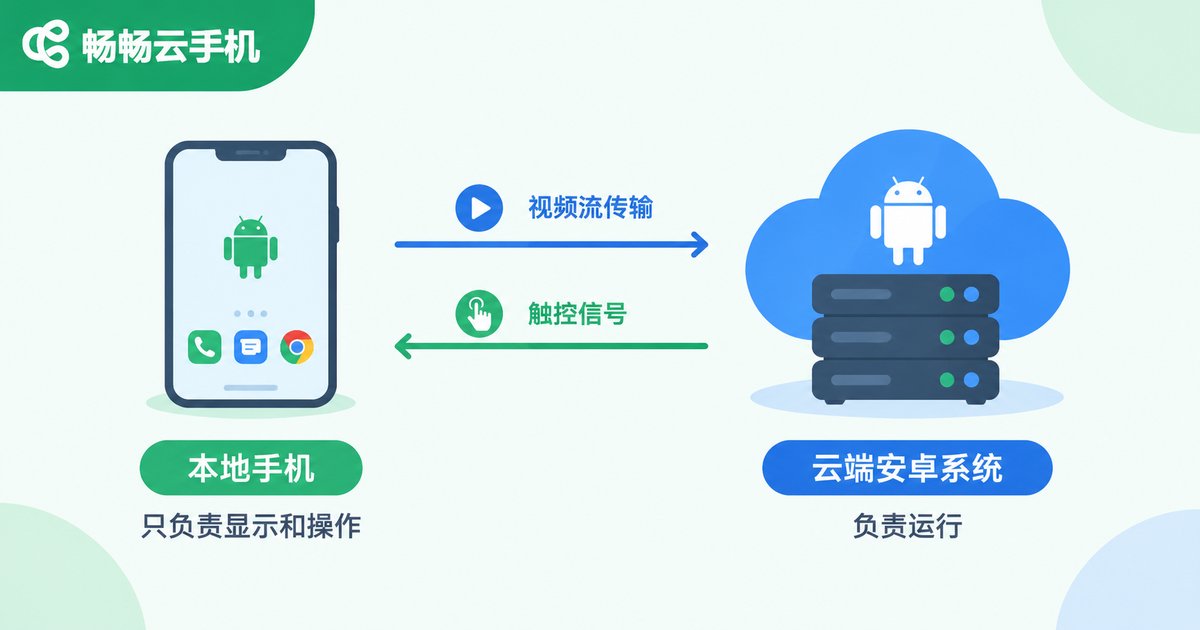
Here is the honest answer first: a cloud phone that is completely free and unlimited basically does not exist. A cloud phone is not just an app — it is a real Android device running in a data center, consuming server compute, storage and bandwidth, plus electricity and maintenance around the clock. The longer you use it and the more instances you run, the more the provider pays.
So behind every 'free forever' promise there is always a business model. Once you understand that model, you can tell whether the free offer is a genuine deal or just a different way of charging you.

The Three Real Models Behind 'Free Forever'
Model 1: Time-limited free trials. New users receive a few hours or days of free credit. Once it runs out, you are guided toward a paid plan. This is the most common and most transparent model — essentially a free sample.
Model 2: Watch ads or complete tasks to earn hours. You pay with your time and attention while ad revenue covers the provider's cost. It sounds fair, but the hours you earn are usually small — covering one day of normal use might require dozens of minutes of ads.
Model 3: A free tier that works as a funnel. A permanently free tier does exist, but with reduced resolution, limited hours, queues at peak times and no multi-instance support. Its real job is customer acquisition; the goal is to convert you into a paying user.
| Model | What it looks like | What it really is |
|---|---|---|
| Limited trial | Free experience | Paid conversion after expiry |
| Ads for hours | No money needed | You pay with time and attention |
| Free basic tier | Free forever | Restricted features, long queues |
Five Common Pitfalls of Free Cloud Phones
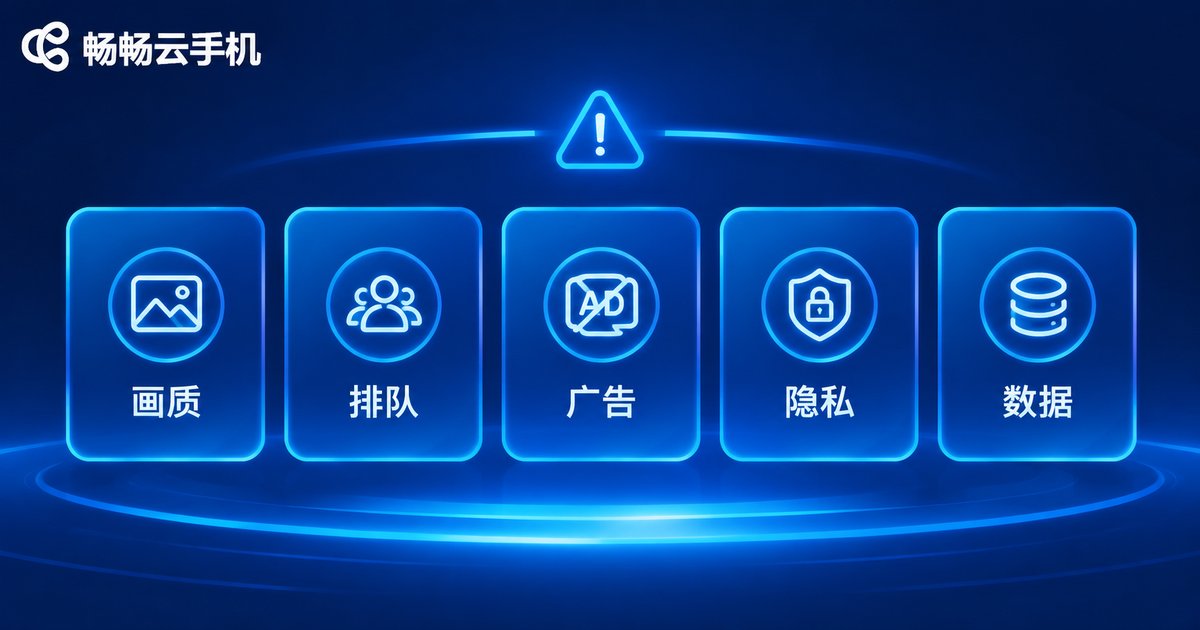
1. Downgraded quality and performance. Free tiers usually run on low-spec devices with low resolution and unstable frame rates, which ruins gaming and video.
2. Queues at peak hours. Free users have the lowest priority. In the evening rush you may wait dozens of minutes for a device, and background tasks can be cut off at any moment.
3. Forced ads and share-to-earn tricks. No ads, no usage; no sharing, no extra hours. A complete experience gets fragmented into tiny pieces.
4. Account and privacy risks. Some obscure tools request excessive permissions, and the game or social accounts you log into in the cloud may be recorded or misused.
5. Data loss and shutdown risk. Free services have no stable revenue. If the provider shuts down, your game progress and files stored in the cloud may disappear with it.
Four Steps to Judge Whether a Cloud Phone Is Worth Using
Step 1: Stability. Use it for several days in a row and watch for frequent disconnects and queues.
Step 2: Image quality and smoothness. Test the same game or app and check whether resolution and frame rate meet your expectations.
Step 3: Transparent billing. Check how hours are counted, what happens to your data after expiry, and whether there are hidden charges.
Step 4: Provider background. Prefer providers with a long operating history, a large user base and a registered company — your data is safer that way.
Want Stability? Consider ChangChang Cloud Phone
If you only want a casual taste, free trials and ad-based hours may be enough. But if you need long sessions, multiple accounts and stable, smooth gameplay, a reliable cloud phone is actually the cheaper choice — what you save is the time lost to queues, disconnects and starting over.
That is where ChangChang Cloud Phone (ccloudphone) comes in: an Android device living in the cloud and staying online around the clock, games hosted and running in the cloud, data stored in the cloud and synced in real time across devices — switching phones or networks never interrupts your cloud progress. For plans and the latest offers, please refer to the information published on the official ChangChang Cloud Phone website.
FAQ
Q: Do permanently free cloud phones really exist?
A free-forever cloud phone with a complete experience is practically nonexistent. What is marketed as permanent free is either feature-restricted or monetized through ads and tasks — one way or another, you always pay.
Q: Can free cloud phones steal my accounts?
Reputable providers are relatively safe, but obscure tools may collect excessive data or record your credentials. Avoid logging into important accounts on unknown cloud phone apps, and always enable two-factor authentication.
Q: Is the free tier enough? When should I consider paying?
For occasional logins and light testing, free credit is usually enough. If you need daily long sessions, multi-instance support, good graphics and stability, a paid plan delivers better value per hour.
Q: How do I get the most out of a free trial?
Treat the trial as a testing period and focus on what matters most to you: stability, image quality and latency. Pay only if the test convinces you, and switch quickly if it does not — do not keep using a bad service just to 'get your money's worth'.