Cloud Phone vs Virtual Machine: Understanding the Core Differences!
"Isn't a cloud phone just a kind of virtual machine?" — that statement is only half right. Cloud phones do use virtualization underneath, but as a product, they're almost a different species from traditional VMs like VMware or VirtualBox on your PC. One is a ready-to-use consumer service; the other is a hands-on technical tool.
This article skips the deep architecture theory (we covered that in Is a Cloud Phone a Real Device or a Virtual Machine?) and lays out the core differences from a purely practical perspective.
1. Core Differences Across Five Dimensions
Summary table first, details after:
| Dimension | Cloud Phone (ChangChang Cloud Phone) | Traditional VM (VMware etc.) |
|---|---|---|
| Where it runs | Cloud data center | Your own PC/server |
| Operating system | Android (native ARM) | Mainly Windows/Linux; Android requires extra work |
| Learning curve | Download the app, register, use | Requires knowledge of images, virtualization settings, resource allocation |
| Local resource usage | Nearly zero (just the video stream) | Directly consumes host CPU/RAM/disk |
| State after shutdown | Keeps running 24/7 | Stops with the host machine |
| Pricing | Subscription plans, from cents per day | Software licenses + your own hardware costs |
2. Difference One: Whose Hardware Does the Work
This is the most fundamental divide.
A VM borrows your computer's muscle: it carves CPU, RAM and GPU out of your physical machine. Spin up three VMs and the fans start screaming; if the hardware can't keep up, even the host system stutters.
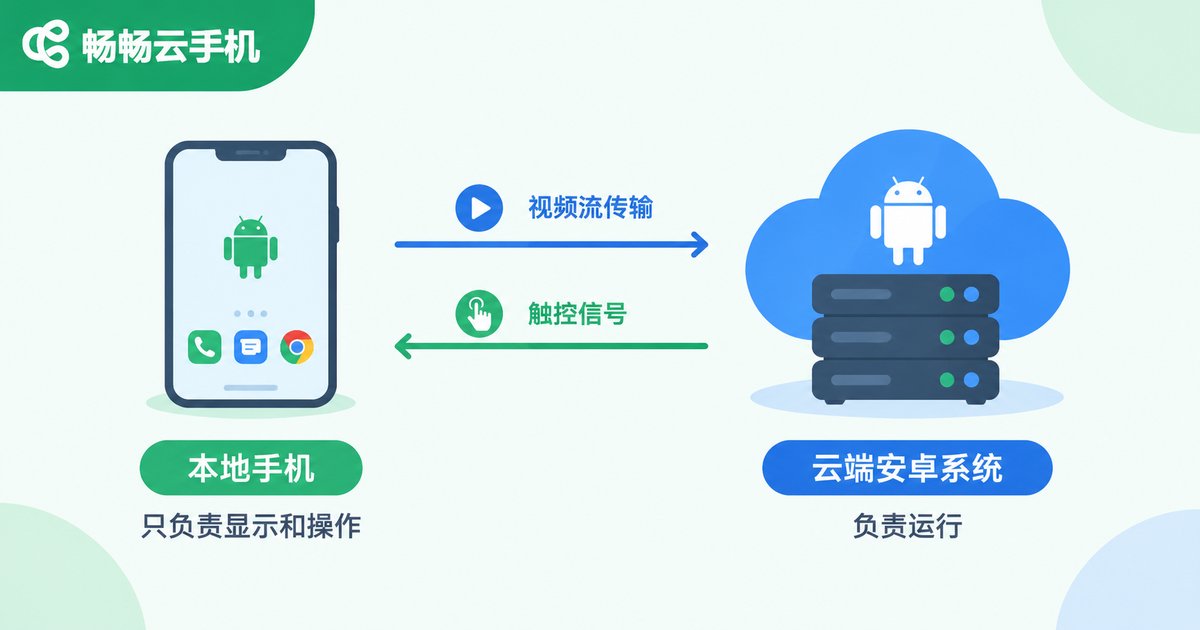
A cloud phone uses the data center's muscle: all computing happens on cloud ARM servers. Your phone or PC only receives the video stream and sends back input. Ten cloud phone windows on your device is about as demanding as watching ten video streams.
This single difference decides the use cases: to farm a game 24 hours a day with VMs, your PC must also stay on 24 hours. Cloud phones have no such constraint at all.
3. Difference Two: Completely Different OS Ecosystems
Traditional VMs own the desktop territory — virtualize a Windows box for legacy software, a Linux box for development. Want Android in a VM? You'll need an Android-x86 image or an emulator stack, plus a lot of fiddling, and you'll still face instruction-translation compatibility issues.
Cloud phones are born for the mobile ecosystem:
- Boot an instance and you get a complete Android system with an app store and virtual sensors;
- Native ARM architecture — mobile apps install and run with zero translation loss;
- Device fingerprints match real phones, so game anti-cheat and app environment checks pass at high rates.
In short: VMs excel at "building another computer inside your computer"; cloud phones excel at "handing you a phone in the cloud."
4. Difference Three: A World Apart in Onboarding
Compare the two typical setup journeys:
The VM path: download virtualization software → enable VT-x in BIOS → download a multi-GB system image → create the VM, allocate CPU/RAM/disk → install the OS → install guest additions → configure network sharing... One to two hours if everything goes smoothly.
The cloud phone path: download the ChangChang Cloud Phone app → register → tap "New Instance" → wait a dozen seconds, and an Android cloud phone appears on screen. No need to know what an image or hypervisor is.
That's not a knock on VMs — they're built for developers and sysadmins who need total freedom. But for everyday users who just want to farm a game or run multiple accounts, a cloud phone eliminates an entire learning curve.
5. Difference Four: Offline Capability — the Killer Feature
A VM is a parasite of its host: put the computer to sleep and the VM freezes; shut it down and the VM stops. Running a task overnight means your PC pulls an all-nighter too — electricity, noise and hardware wear included.
Cloud phone instances live in the cloud:
- Turn off your phone at night — the instance keeps grinding dungeons;
- Travel for a week without opening the client — tasks keep progressing;
- The client is just a "remote control": log in from another phone or PC and you see the same instance.
"Stays online when you're offline" is the cloud phone's most irreplaceable advantage over VMs, and the fundamental reason AFK gamers choose it.
6. Difference Five: Cost Structures Compared
| Cost Item | Cloud Phone | DIY VM Setup |
|---|---|---|
| Upfront investment | Zero (register and use) | Possibly RAM upgrades, hardware refresh |
| Ongoing cost | Plan subscription (daily/monthly) | Electricity (an always-on PC adds up) + hardware depreciation |
| Scaling | A few taps to add instances | Capped by your hardware ceiling |
| Maintenance | Handled by the platform | You troubleshoot, you fix |
For light use, VMs look "free." But once 24/7 operation and batch multi-opening enter the picture, power bills and hardware wear quickly overtake a cloud phone subscription.
7. Which to Choose: A Scenario Table
| Your Need | Better Choice | Why |
|---|---|---|
| Mobile game AFK farming, game multi-opening | Cloud phone | 24h online, zero local load, high anti-detection pass rate |
| Multi-account social media operations | Cloud phone | Independent IPs + device fingerprints keep accounts cleanly separated |
| Running a Linux dev environment on Windows | VM | Desktop virtualization is its home turf |
| Testing software across Windows versions | VM | Mature snapshot/rollback features |
| Trying overseas apps/games | Cloud phone | GMS support, selectable network regions |
| Learning operating systems, practicing ops | VM | Free and endlessly re-installable |
FAQ
Q1: Is the cloud phone backend just VMware? No. Cloud phones use mobile virtualization on ARM servers running native Android. VMware-style products are x86 desktop/server virtualization — a different stack and a different product form.
Q2: My PC is powerful. Why not just farm games in my own VMs? Technically feasible, but you inherit three headaches: Android-x86 compatibility issues, ban risk from being flagged as an emulator, and the electricity plus wear of a 24/7 PC. Most people do the math and pick a cloud phone.
Q3: Can a cloud phone take snapshots like a VM? ChangChang Cloud Phone supports instance backup and restore — effectively snapshots: roll back to a backup point with one tap instead of reinstalling.
Q4: Can VMs and cloud phones be used together? Absolutely. A common developer combo: a local VM for the build environment, cloud phones for real-device app testing. Each does its own job.
Q5: Is cloud phone performance worse than a local VM? On raw peak compute, a VM on a high-end PC may win. But cloud phones win on "always-on stability + mobile compatibility" — exactly the metrics that AFK and operations workloads care about most.
Wrapping Up
The relationship between cloud phones and virtual machines can be summed up as: same technical roots, divergent product paths. A VM slices your computer into several computers; a cloud phone turns data-center ARM silicon into your always-available Android device. Need multiple desktop environments? Choose a VM. Need mobile apps online around the clock? A cloud phone is the far less stressful answer.