What Does Cloud Phone AFK Mean? Automation Mechanics Explained
Browse any gaming community and you'll see phrases like "AFK farming on a cloud phone" or "cloud instance hosting." Newcomers are often puzzled: what exactly is AFK-ing? Where is the phone "hanging"? Do you need to watch it?
One sentence explains it all: cloud phone AFK means letting a phone in the cloud run your apps 24 hours a day, automatically performing repetitive tasks — no babysitting required. Below, we unpack the mechanics behind this layer by layer.
1. The Essence of AFK: Trading "Watching the Screen" for "Cloud Labor"
Picture the traditional manual grind: doing daily quests means an hour of tapping with your screen on. The phone heats up, the battery plummets, and you can't do anything else.
AFK thinking splits this chain apart:
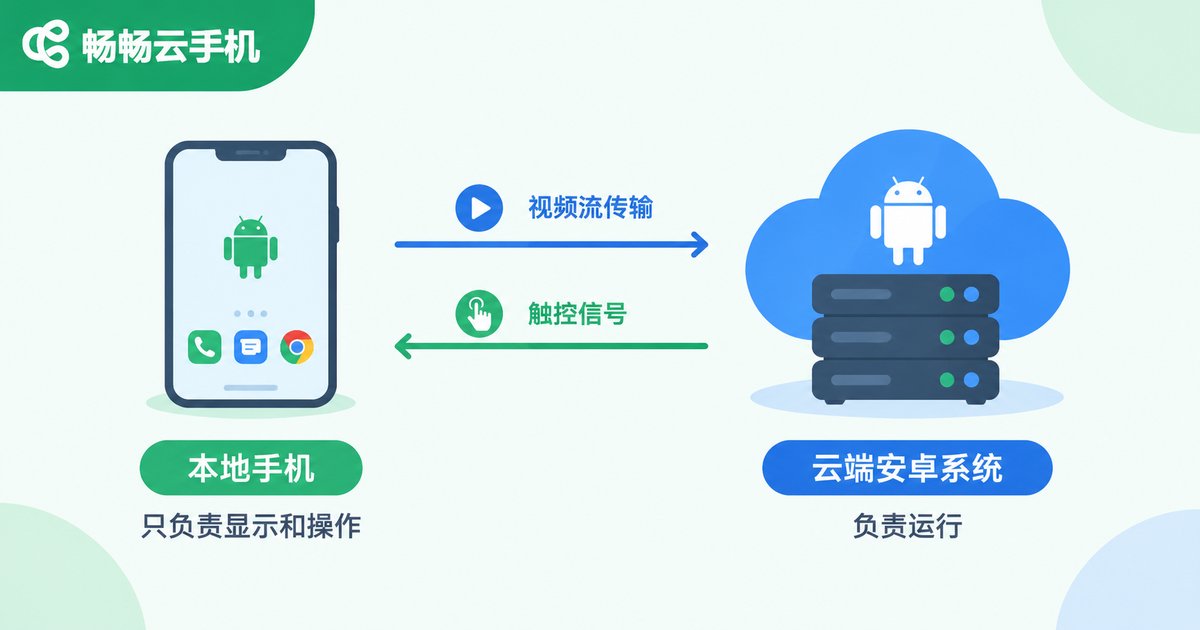
- The runtime environment moves from your phone to a cloud ARM server (the instance);
- Repetitive actions go to automation (the game's built-in auto-battle, or scripts);
- Your role shifts from "operator" to "inspector" — open the client whenever you feel like checking progress.
A cloud instance never gets tired, never runs out of battery, and never thermal-throttles. That's the premise that makes AFK possible at all.
2. The Three-Layer Automation Mechanism
A complete cloud phone AFK system works through three cooperating layers:
Layer 1: Always-On Cloud Runtime Your instance lives in a data center, powered from the moment you tap "Create." Disconnecting the client or shutting down your own phone doesn't affect app state inside the instance. This is the foundation — whether a task survives the night depends on the environment staying online, not on your phone.
Layer 2: Input Automation Being online isn't enough; something has to "tap the screen." Options ranked by difficulty:
| Method | How It Works | Best For | Difficulty |
|---|---|---|---|
| In-game auto features | The game's own auto-battle/sweep functions | Daily quests in most RPGs and card games | Zero — tick a checkbox |
| Built-in instance tools | Auto-clickers, scheduled tasks and similar helpers | Simple repeated taps, timed collection | Low — visual setup |
| Automation scripts | Recorded or written action sequences on loop | Complex multi-step workflows | Medium — slight learning curve |
Layer 3: Task Scheduling Go further and put tasks on a timetable: start dungeon runs at 2 AM, switch accounts at 4, collect resources when full. ChangChang Cloud Phone's scheduled-task features combined with scripts let multiple instances run like an assembly line.
3. The Full Lifecycle of an AFK Task
Take "auto-farming daily quests overnight" as an example:
- Evening: log into the game on your instance, enable auto-battle, or start a debugged script;
- Disconnect: exit the client and go live your life — the game keeps running inside the instance;
- Midnight: the instance loops through its tasks; power, thermals and network are all handled by the data center;
- Morning: open the client, find dailies completed and resources credited;
- Safety net: if a task breaks (say, a game maintenance disconnect), push notifications alert you, and you can resume manually or automatically after reconnecting.
Your local device participates for no more than five minutes total.
4. Local AFK vs Cloud AFK: How Big Is the Gap?
| Aspect | AFK on Your Own Phone | AFK on Cloud Phone (ChangChang) |
|---|---|---|
| Device availability | Phone unusable all night | Your phone stays completely free |
| Battery/heat | Hot even on the charger | Not your problem — data center handles it |
| Disconnection risk | Home Wi-Fi hiccups break tasks | Data-center-grade connectivity |
| Multi-opening | One phone, one account | Easy multi-instance, many accounts |
| Hardware wear | Accelerated battery aging | Zero |
| Interruptions | Calls and messages kick you out | The instance environment is undisturbed |
5. What AFK Can and Can't Do (Know the Boundaries)
Good at:
- Repetitive loops like dailies, dungeons and resource collection;
- App keep-alive (business apps that must stay online);
- Light scheduled tasks like sign-ins and timed claims;
- Parallel batch operations across multiple accounts.
Not good at, or shouldn't do:
- Real-time competitive play (stream latency rules out ranked matches);
- Anything violating a game's terms of service — whether AFK is acceptable depends on the game's rules. Scripts that wreck a game's economy can get accounts banned, so check the publisher's stance first;
- Payments and fund transfers should never be handed to automation.
6. Four Key Steps to Building Your First AFK Setup
- Pick the right instance tier: entry level is fine for light tasks; for big 3D games, choose mid-to-high specs and lower graphics for smoothness;
- Run the full flow manually first: perform the task you want to automate by hand, noting each step and its timing — automation needs this baseline;
- Debug in small increments: run automation for 10 supervised minutes before letting it run all night;
- Set up alerts: enable push notifications for instance-offline and task-completion events so problems never go unnoticed.
FAQ
Q1: Do I need to keep the client open while AFK-ing? Not at all. Tasks run in the cloud; the client is just a viewing window. Close the app or power off your phone — the instance keeps working.
Q2: Will AFK-ing overnight get my account flagged? A cloud phone is a genuine ARM environment and won't be identified as an emulator. But bans depend mainly on whether you use third-party scripts the game prohibits — unrelated to the cloud phone itself. Using the game's built-in auto features carries the lowest risk.
Q3: Does AFK consume my mobile data? Apps inside the instance use data-center bandwidth, not your phone's data plan. You only spend local data when you open the client to watch the stream (similar to watching video).
Q4: Can multiple instances AFK at the same time? Yes — that's home turf for cloud phones. Run several instances, each with a different account, all independent. The dashboard shows every instance's status at a glance.
Q5: What if the game updates mid-AFK? The instance preserves its state; the update prompt waits on screen for you. Build a habit of one morning check-in — tap the update and you're done in minutes.
Wrapping Up
AFK isn't mystique or black magic — it's a clean formula: always-on cloud runtime × automated input × task scheduling = unattended operation. ChangChang Cloud Phone takes care of the heaviest parts of that formula — uptime, hardware, networking. All that's left for you is deciding what your cloud phone should do on your behalf.