Is a Cloud Phone a Real Device or a Virtual Machine? A Deep Architecture Comparison
"Isn't a cloud phone just a virtual machine?" The question sounds simple, but the answer isn't binary. Strictly speaking, a cloud phone is neither a physical handset with a SIM card, nor anything like the Android emulator on your PC. It is a virtualized instance running on ARM servers — real mobile silicon at the bottom, instance isolation on top.
This "hybrid" identity is exactly what gives it the edge. Let's take the architecture apart.
1. The Physical Foundation: ARM Servers
Peel back the technical shell of a cloud phone and the bottom layer is rows of ARM-based servers in a data center. That is fundamentally different from ordinary cloud servers (x86):
| Dimension | ARM Server (Cloud Phone Base) | x86 Server (General Cloud Computing) |
|---|---|---|
| Instruction set | Same family as phone chips | PC/server standard |
| Running Android | Native execution, zero translation loss | Requires instruction translation, performance penalty |
| App compatibility | Identical to real devices | Some ARM-only apps crash |
| Typical use | Cloud phones, mobile app hosting | Websites, databases, general compute |
Your phone's chip (Snapdragon, Dimensity, etc.) is ARM architecture at its core. ChangChang Cloud Phone packs the same class of ARM silicon into data centers at scale, so Android runs on it with no "translation" layer at all — the first cornerstone of passing app environment checks.
2. The Virtualization Layer: How One Physical Machine Becomes Many
A single ARM chip has finite resources, so cloud phones use containerization/virtualization to slice a multi-core chip into mutually isolated instances:
- Resource partitioning: CPU cores, memory and storage are allocated by plan tier; each instance gets its dedicated quota;
- System-level isolation: every instance has its own system image, filesystem and device identifiers;
- Network isolation: instances can't see each other on the network, and each can be assigned an independent IP.
So the precise statement is: a cloud phone is a "virtualized instance running on real mobile hardware." The hardware is real; the instance is virtual.
3. The Essential Difference from x86 Android Emulators
Many people equate cloud phones with PC Android emulators — the biggest misconception of all. The gap shows up on four levels:
1. Instruction set An emulator runs Android on an x86 PC, translating ARM instructions into x86 in real time. Apps that ship ARM-only builds (and there are many) either won't install or crash mid-run on emulators. A cloud phone runs ARM on ARM — native execution.
2. Device fingerprint When an app checks its environment, it reads a "device fingerprint": chip model, baseband info, sensor list, kernel traits, and more. Emulator fingerprints have obvious tells (no baseband, sensors returning null). A cloud phone's fingerprint comes from real ARM silicon — nearly indistinguishable from a physical phone.
3. Sensors A real phone has a gyroscope, accelerometer, ambient light sensor and GPS. Emulators either lack these or return frozen values. Cloud phones use virtual sensor frameworks that produce physically plausible dynamic data, so step counters, shake gestures and AR apps all work.
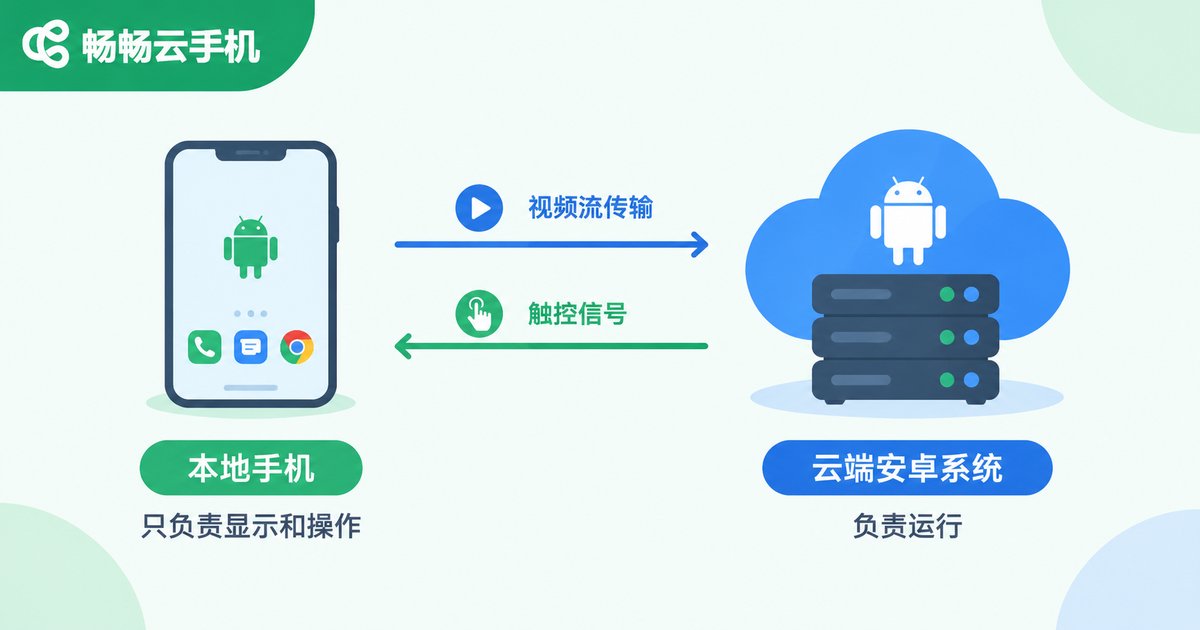
4. Where it runs An emulator eats your PC's CPU and RAM — shut the computer and it dies. A cloud phone lives in a data center, online 24/7; your device is merely a "display."
4. Three Form Factors at a Glance
| Dimension | Physical Phone | Cloud Phone (ARM Virtualization) | x86 Android Emulator |
|---|---|---|---|
| Hardware base | A standalone handset | ARM server silicon | PC x86 chip |
| How the OS runs | Directly on hardware | Virtualized instance, native instructions | Translated execution |
| Device fingerprint | Fully genuine | Essentially identical to real | Obvious flaws |
| App detection pass rate | 100% | Very high | Low — often flagged |
| 24/7 online | Battery drain, heat, wear | Built-in | Requires an always-on PC |
| Cost to scale | Very high (buy whole phones) | Low (spin up instances on demand) | Medium (limited by your PC) |
5. Practical Benefits of This Architecture
Once you understand the architecture, the cloud phone's "superpowers" all have explanations:
- Never powers off: data-center power plus cloud execution — local outages or shutdowns don't touch the instance;
- Never overheats: heat is generated in the data center; your phone only decodes a video stream, so no thermal throttling during long sessions;
- Clone in seconds: an instance is data — duplicating a fully configured cloud phone takes minutes, versus a trip to the store for hardware;
- Hardware-level compatibility: anti-cheat systems in games and environment checks in finance apps pass at far higher rates than on emulators.
6. Honest Limitations of the Architecture
To be objective, this architecture has boundaries:
- No physical SIM card: making calls or receiving SMS codes needs workarounds — binding a phone number or third-party verification services covers most cases;
- Stream latency: the streaming principle means tens of milliseconds of input delay — invisible for AFK gaming and operations, but competitive rhythm games are better played locally;
- Virtual camera: scanning QR codes works (via image upload recognition), but it can't photograph the real world — on-site scanning needs your physical phone.
FAQ
Q1: Can apps detect that they're running on a cloud phone? Most apps check for "emulator characteristics." Because cloud phones are built on real ARM chips with fingerprints matching physical devices, the pass rate is far higher than x86 emulators. A few banking-grade apps run deeper checks, so 100% can't be guaranteed.
Q2: How does cloud phone compute power compare with a real phone? At equivalent tiers, an instance matches a mid-range handset. And with no battery thermal throttling, the performance curve stays flatter under sustained load.
Q3: Do multiple instances interfere with each other? No. Instances are fully isolated at the system, storage and network levels. One instance crashing, lagging or rebooting never affects the others under the same account.
Q4: Can I install Google services on a cloud phone? ChangChang Cloud Phone supports installing the GMS suite, so overseas apps and games can sign in and run properly — crucial for users running international operations.
Q5: Is a cloud phone just a kind of cloud server? Related in technology, different in product positioning. Cloud servers run headless backend services for developers; cloud phones run a full graphical Android system for end users — the key differences are GPU rendering and streaming.
Wrapping Up
Back to the opening question: real device or virtual machine? The accurate answer is — real-device hardware, virtual-machine form. ARM servers provide a physical foundation from the same family as phone chips, while virtualization delivers flexibility and elasticity. This hybrid architecture dodges the compatibility traps of emulators and escapes the physical constraints of handsets — which is precisely why the cloud phone category exists.