
Static vs Dynamic IP on Cloud Phones: Real Test Data on Account Survival Rates
Why IP Type Can Decide an Account's Fate
Anyone who has farmed accounts at scale knows the harsh reality: with identical devices, identical profiles, and identical activity patterns, the IP alone can lead to completely different outcomes. When a platform's risk-control system judges whether an account is trustworthy, the IP is the first signal it sees and the easiest to cross-check — the IP's location, carrier, whether it is residential broadband or a data-center address, and how many people share it all go into the account's trust file.
A static IP means the account reaches the platform from one fixed, dedicated exit address from registration through daily activity, so risk control sees a long-time resident at a fixed address. A dynamic IP — especially one from a shared pool — may be in Guangdong today and Jiangsu tomorrow, and an hour earlier it may have been used by dozens of unknown accounts in the same data center, making the account look erratic and poorly connected. How big is the gap in real account farming? We ran a 30-day controlled test, and here is the full data.
First, the Basics: Static vs Dynamic IP on Cloud Phones
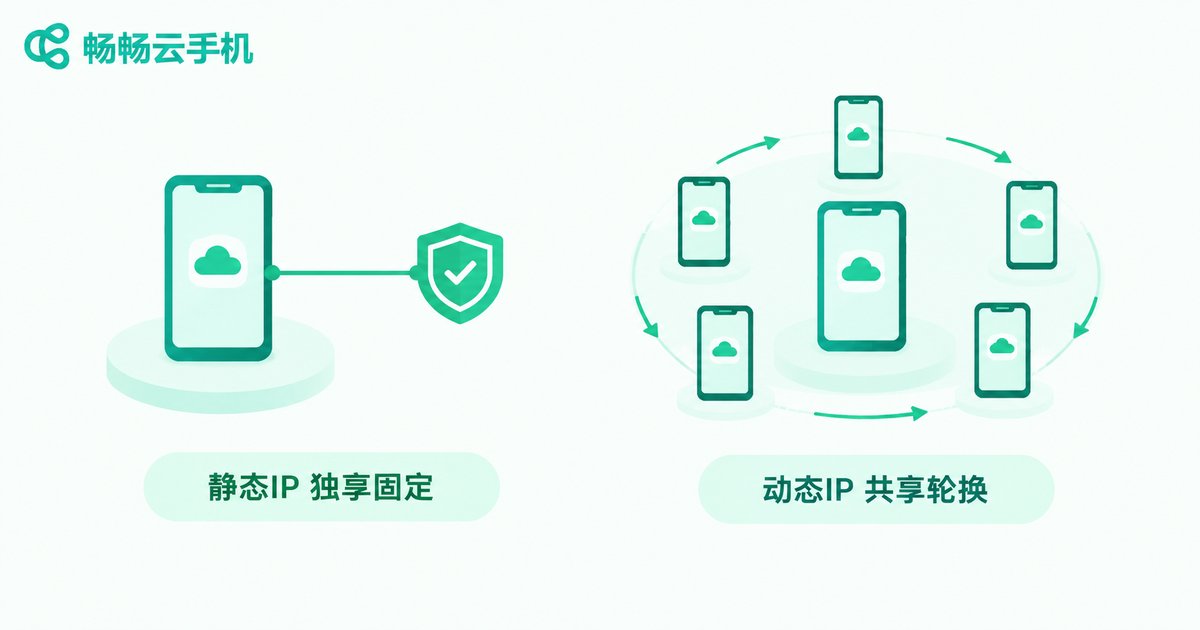
In the cloud phone context, the difference comes down to fixed and dedicated versus roaming and shared:
Static IP (dedicated fixed IP): each cloud phone is bound to one fixed exit IP that stays unchanged and is used only by you. Its location and carrier attributes remain stable, so the trust record on the platform side keeps compounding.
Dynamic IP (shared/rotating IP): the cloud phone switches exit IPs on every reconnect or on a cycle, and the IP usually comes from a shared pool where many unknown accounts may be hitting the platform through the same exit at the same time.
| Dimension | Static IP (dedicated) | Dynamic IP (shared/rotating) |
|---|---|---|
| Exit address | Fixed, never changes | Rotates on a cycle or randomly |
| Users per IP | Only your own environment | Many users share one exit |
| Risk-control profile | Stable, trust keeps building | Frequent jumps, easy to trigger location alerts |
| Linkage risk | Low | Higher, shared-exit association |
| Cost | Relatively higher | Lower, often included in plans |
Test Design: 400 Accounts, 30 Days, One Identical Workflow
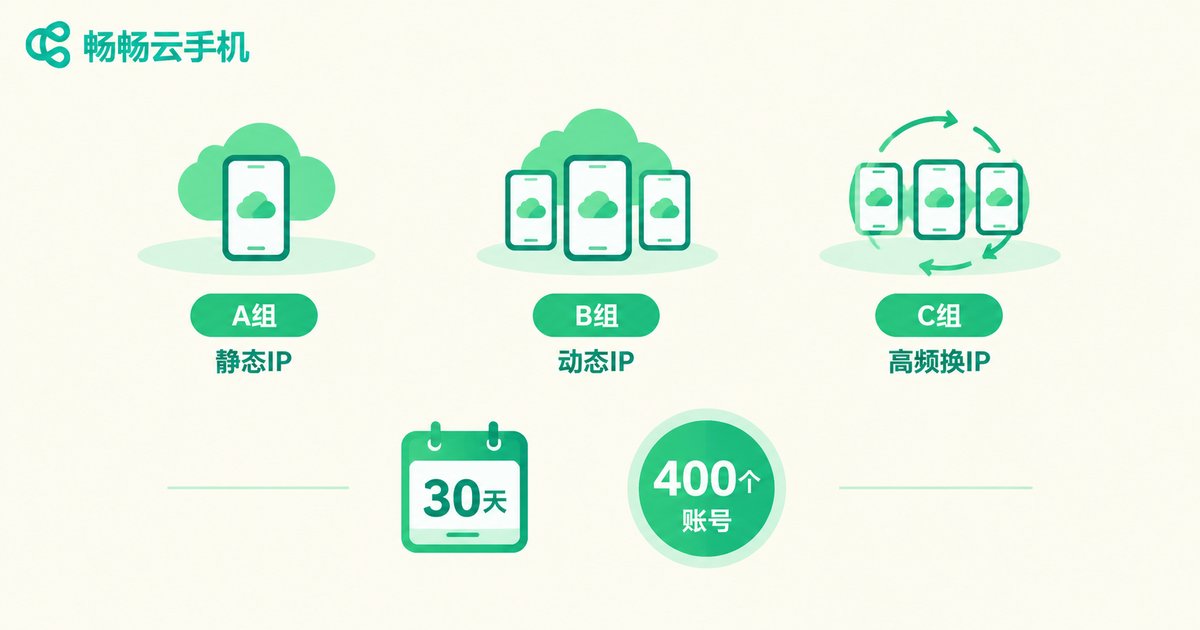
To make the data meaningful, we locked down every variable and kept only one difference — the IP type:
Test period: 30 days (day 1 to day 30 after registration).
Account volume: 400 freshly registered accounts in 3 groups.
Group A (dedicated static IP): 140 accounts, each cloud phone bound to one dedicated static IP, unchanged throughout.
Group B (dynamic IP): 140 accounts on the cloud phone's default dynamic IP, rotating naturally per the provider's policy.
Group C (high-frequency rotating IP): 120 accounts with the dynamic IP manually changed once a day, simulating constant network switching.
Controlled conditions: all groups used identically configured cloud phones, the same profile-generation rules, and the same daily routine (browsing, liking, following, and commenting in fixed proportions) at consistent hours.
Survival criterion: the account was not banned, not placed in restricted or abnormal states, and could still complete daily interactions normally by day 30.
The Results: A Survival Gap of Nearly 20 Percentage Points
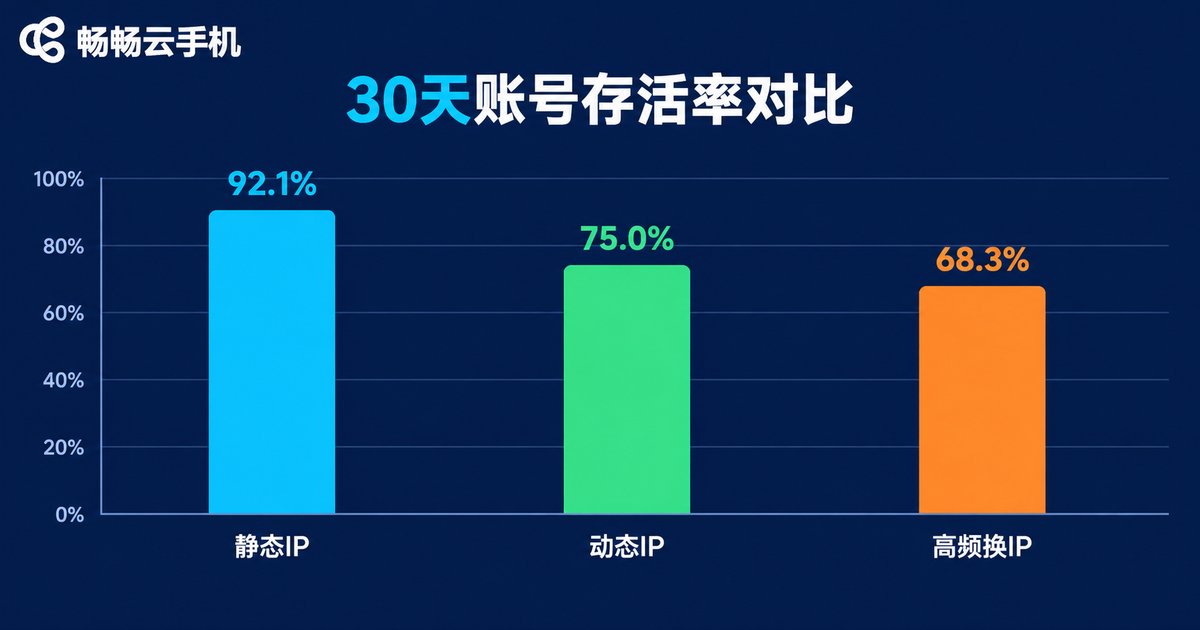
After 30 days, the numbers looked like this:
| Group | Accounts | Survived 30 days | Survival rate | First-week ban rate | Avg. risk checks per week |
|---|---|---|---|---|---|
| Group A: dedicated static IP | 140 | 129 | 92.1% | 3.6% | 0.7 |
| Group B: dynamic IP | 140 | 105 | 75.0% | 11.4% | 2.5 |
| Group C: high-frequency rotating IP | 120 | 82 | 68.3% | 15.8% | 3.4 |
Three details stand out:
1. The gap opened within the first 7 days. Group A lost only 5 accounts in week one, while Group B and Group C lost 16 and 19. The first 72 hours after registration are the strictest risk-control window, when IP stability matters most.
2. Losses in the dynamic IP group clustered around IP rotation points. When we reviewed the timestamps of Group B's abnormal events, more than 60% of risk-control verifications happened within 24 hours after an IP change — meaning IP jumping is an independent red flag by itself.
3. Changing IPs frequently is not safer; it is more suspicious. Many beginners believe frequent IP changes reduce linkage risk. The test showed the opposite — Group C had the lowest survival rate. Real users almost never switch networks every day, so the behavior pattern itself looks unnatural.
What Risk Control Is Really Watching
Translated into risk-control logic, the data comes down to three things:
First, IP stability equals a permanent home address. Platforms maintain a trust score for each account; a fixed IP reinforces the consistent-login-location record every single day, while an IP change can reset that accumulation.
Second, a shared exit means association risk. In a shared dynamic IP pool, one exit may carry accounts with wildly different behaviors. If any of them spams or violates the rules, your account on the same exit gets downgraded too.
Third, consistency between IP and profile. Long-term alignment among registration location, usual login location, and IP location is a key signal that a real person is using the account normally. Static IP satisfies this by nature; dynamic IP can hardly guarantee it.
Which IP for Which Farming Scenario?
| Scenario | Recommended IP | Why |
|---|---|---|
| Long-term core accounts | Dedicated static IP | Trust building must not be interrupted; bans are costly |
| New-account warm-up (first 30 days) | Dedicated static IP | Risk control is strictest here; stability first |
| Bulk matrix accounts | Multiple dedicated static IPs, one per account | Stable and free of internal linkage |
| Short-term or one-off task accounts | Dynamic IP is fine | Short life cycle; cost comes first |
| Platforms with loose risk control | Dynamic IP acceptable | Low sensitivity to IP changes |
One-line summary: the more valuable the account, the more it needs a static IP; the shorter the task, the more acceptable a dynamic IP becomes.
How to Implement This on Changchang Cloud Phone
If you are serious about account farming, go straight for a cloud phone plan that supports dedicated static IPs. Changchang Cloud Phone (ccloudphone) offers multiple device types and IP configurations, and you can choose a dedicated static IP option at activation. The exact IP types and package details are subject to what is currently displayed on the official Changchang Cloud Phone website.
Three practical tips:
One account, one IP, one device: bind each cloud phone to its own static IP to cut cross-account links at the source.
Let the IP settle before registering: run the static IP environment for half a day first, so the account carries a clean IP record from second one.
Minimize environment changes: keep device parameters, language, and time zone consistent as well — risk control evaluates the stability of the whole environment.
Five Details That Push Survival Rates Even Higher
Choosing the right IP is only the passing line. To keep accounts alive longer, also mind the following:
1. Localize registration data: keep IP location, phone number region, and profile details consistent.
2. Keep the first 3 days low-intensity: browse only, interact little, and mimic the caution of a real new user.
3. Humanize the activity rhythm: rigid scripts leave mechanical traces; add random intervals and natural swipes.
4. Never move accounts across devices: whatever cloud phone an account registers on should be the one it lives on.
5. Review abnormal events regularly: log the time and context of every risk-control verification; within two weeks you will know the platform's temper.
FAQ
Q: Is a static IP always better than a dynamic IP?
Not absolutely. For long-term farming and high-value accounts, static IP advantages are overwhelming. For short-term one-off tasks, dynamic IP is cheaper and good enough. The deciding factors are the account's life cycle and value.
Q: Does farming on a dynamic IP always end in bans?
No. Group B still reached a 75% survival rate, which shows dynamic IP is usable — it just triggers more verifications and demands finer operational discipline. If you must use dynamic IP, extend the warm-up period and lower activity intensity.
Q: How many accounts can run on one static IP?
The safe answer is one account per IP. Hosting several accounts on one static IP is safer than a shared dynamic pool, but internal linkage is still possible; fully isolate your important accounts.
Q: If I switch to a new static IP, does the old account need to readjust?
Yes. The account has a trust record tied to the old IP, and changing IPs is like moving house. Switch during a low-risk period, reduce activity for a few days afterward, and give risk control time to rebuild the profile.
Q: How do I activate a dedicated static IP on Changchang Cloud Phone?
Choose a device or plan that supports dedicated static IP on the official Changchang Cloud Phone website. Available IP types and pricing are subject to the site's real-time display, and after activation you can check the bound IP in the device details.