
ARM Physical Board Cloud Phones vs Containerized Cloud Phones: The Real Difference Between Hardware Isolation and Shared Kernel
First, Understand the Two Technical Routes Behind Cloud Phones
Open any cloud phone product page and you will see the same buzzwords: cloud Android, batch control, multi-instance, AFK farming. But beneath this unified shell, cloud phones on the market actually follow two completely different technical routes: ARM physical board cloud phones and containerized cloud phones.
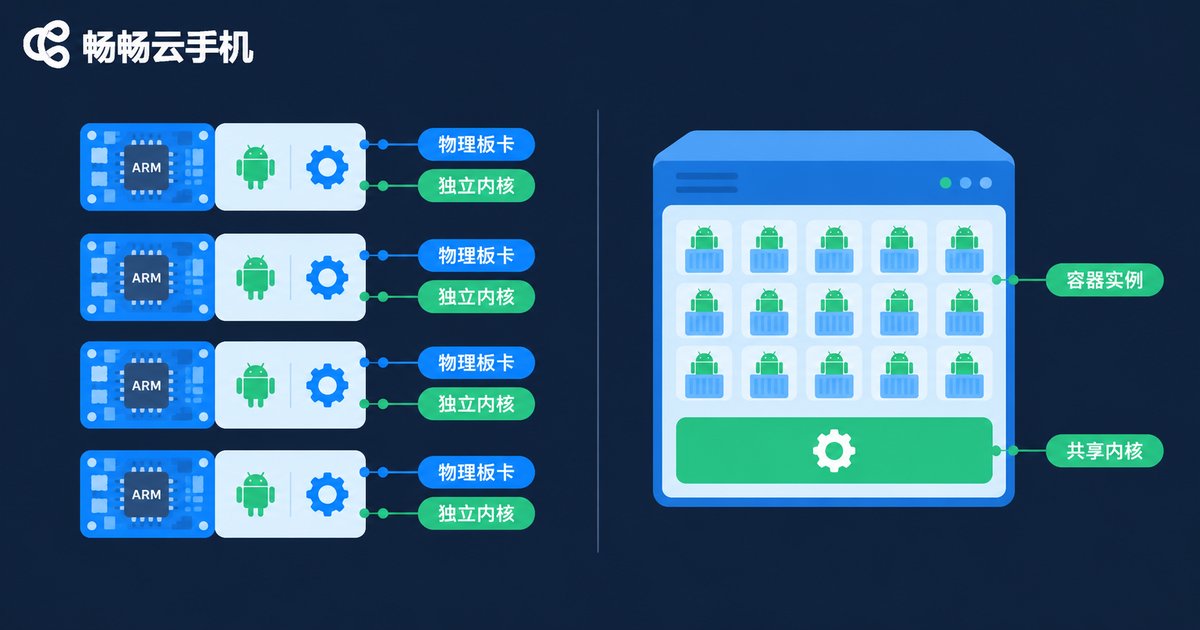
Here is an analogy: an ARM physical board cloud phone is like “everyone gets a detached house” — you use a real ARM hardware board running a complete, independent Android system. A containerized cloud phone is like “a furnished apartment in a high-rise” — one high-density server uses container technology to spin up hundreds or even thousands of Android instances that all share the same underlying hardware and system kernel.
Living in a house or an apartment, daily life goes on either way. But when the power goes out, the neighbor starts renovating, or the plumbing overloads, the difference shows. Cloud phones are no different — the underlying architecture determines the experience on top. Let's take it apart layer by layer.
ARM Physical Board Cloud Phones: One Board, One Independent System
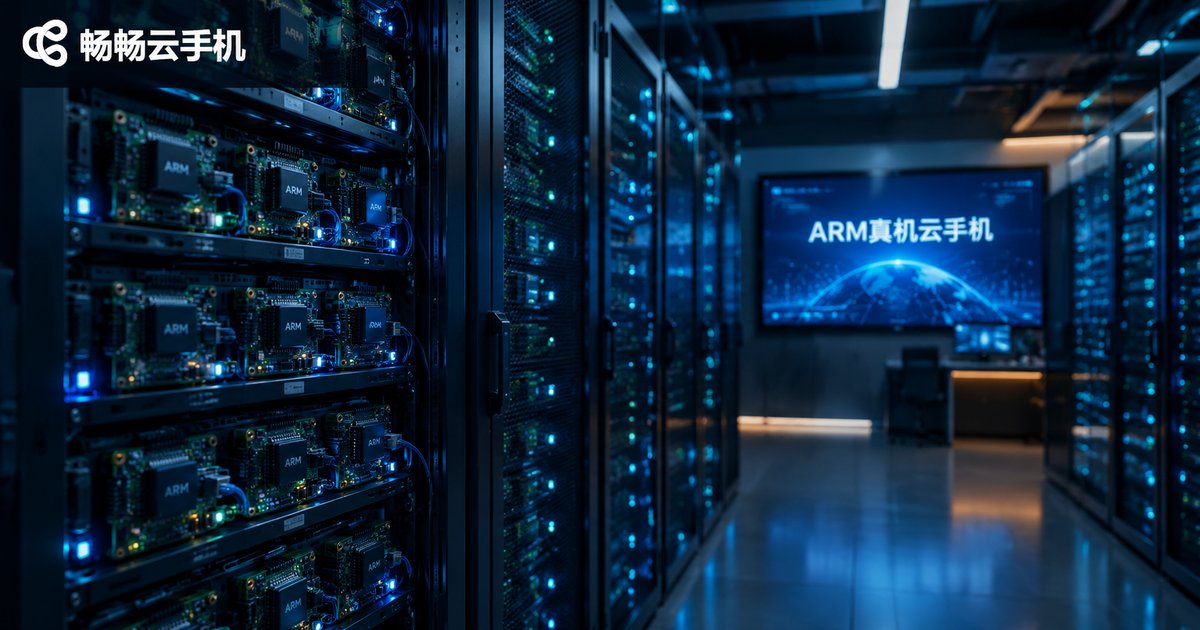
The ARM physical board approach does exactly what the name suggests: real ARM development boards or phone mainboards are slotted into racks in rows, and each board corresponds to one cloud phone. Its defining traits:
1. Independent kernel. Each board runs a complete, unmodified Android system with its own independent Linux kernel. Booting, process scheduling, and memory management all happen inside the board's own “territory”.
2. Hardware-level isolation. Boards are physically separate. If board A crashes, reboots, or its system collapses, board B never notices. There is simply no such thing as “neighbors fighting for resources”.
3. An authentic device form. Cameras, sensors, and the GPU rendering pipeline are real hardware. Device parameters are trustworthy by nature — to an app, this is a “real phone”.
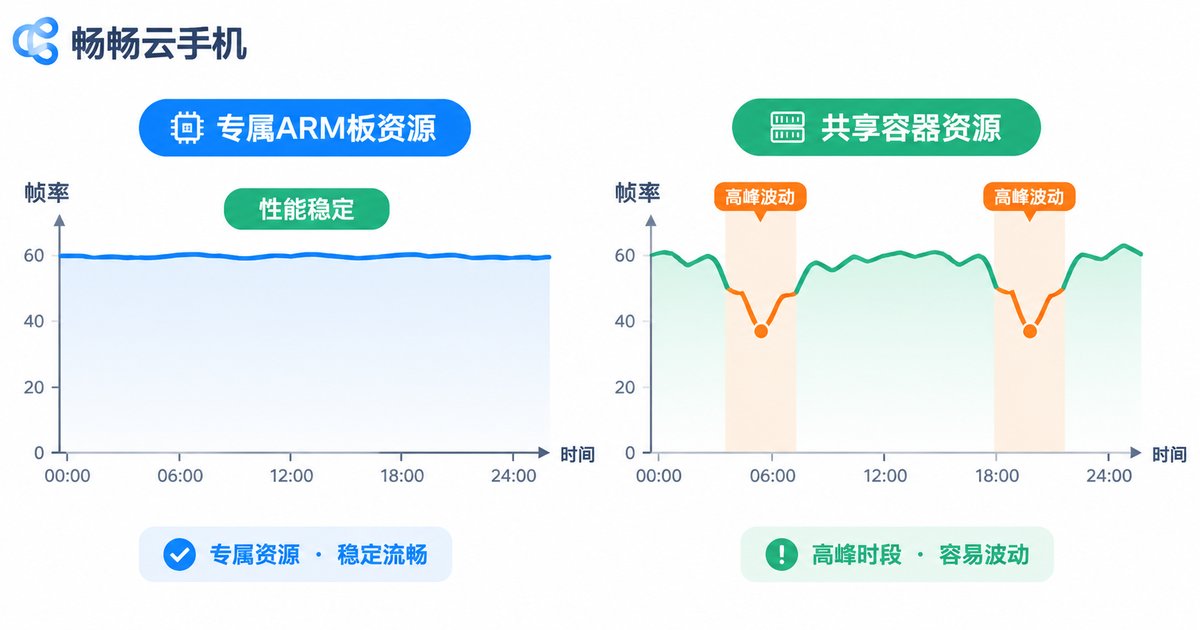
4. Dedicated resources. CPU, memory, and storage are fully exclusive, delivering a flat performance curve suitable for 24/7 operation.
Containerized Cloud Phones: One Server, Hundreds of Android Instances
The containerized approach takes the opposite path: on a single high-performance server, container technology packages Android into lightweight instances, and all instances share the same host kernel. Its traits are the mirror image of the physical board:
1. Shared kernel. All container instances share the host's Linux kernel; system calls and driver capabilities are routed through the same layer. It saves resources, but also means they rise and fall together.
2. High-density deployment. A single server can run dozens or even hundreds of Android instances at once, dramatically diluting the per-instance hardware cost.
3. Virtualized device parameters. Device model, sensor data, and similar parameters are generated by a virtualization layer. A few apps with strict risk-control checks may detect that this is not a real phone.
4. Elastic but interconnected. Resources can be allocated dynamically, but when one instance runs out of control, other instances on the same host may slow down.

Core Difference 1: Hardware Isolation vs Shared Kernel
This is the most fundamental watershed between the two approaches. View it from three angles:
Fault isolation. On physical boards, each cloud phone's system failures are locked inside its own board — one breaks, you replace that one, and cluster availability stays high. In containerized deployments, the kernel is the “common foundation” for every instance — a kernel-level failure can affect all instances on the server, and a single kernel panic can wipe out the entire fleet.
Resource contention. Physical boards have exclusive resources with zero contention. In containerized deployments, CPU, memory, and I/O bandwidth come from a shared pool. When one instance runs a heavy task (such as rendering a large 3D game at high quality), neighboring instances may suffer noticeable frame drops and latency spikes — the well-known Noisy Neighbor effect.
Security boundary. Hardware isolation has a naturally smaller attack surface; compromising one device does not affect the others. Containers share a kernel, and although modern container technology is heavily hardened, risks such as container escape and side channels still exist in theory. Logical isolation is simply weaker than a physical boundary.
| Dimension | ARM Physical Board | Containerized |
|---|---|---|
| Isolation level | Hardware-level physical isolation | Kernel-level logical isolation |
| Kernel | Independent kernel per device | Shared host kernel |
| Blast radius of failure | Limited to a single board | Potentially the whole server |
| Resource contention | None | Noisy neighbor effect exists |
| Security boundary | Physical boundary, small attack surface | Relies on container isolation mechanisms |
Core Difference 2: Device Authenticity and App Compatibility
The differences users notice most quickly actually come from this layer.
An ARM physical board cloud phone runs full Android on real hardware: GPU rendering goes through a real pipeline, sensor data comes from real components, and device fingerprints are naturally consistent. To an app, it is just an ordinary Android phone — large 3D games run with good compatibility, and even apps with strict risk control struggle to tell it apart from a real device.
On containerized cloud phones, device parameters are injected and simulated by a virtualization layer. The vast majority of everyday apps work perfectly fine, but compatibility challenges may appear in two scenarios: first, apps with strict device-environment verification may detect subtle anomalies in sensor or rendering characteristics; second, certain large games that are poorly adapted to virtualization may crash, show graphical glitches, or lose performance.
In short: containerization covers “it works”; physical boards guarantee “it works well, and keeps working”.
Core Difference 3: Long-Term Stability and the AFK Farming Experience
For 24/7 scenarios such as AFK farming and multi-account operation, stability matters more than peak performance.
With physical boards, each cloud phone's resources are constant. The frame rate you get today is the frame rate you will get a month later; any long-run performance decay mainly comes from software factors such as caches, and a reboot restores it.
With containerized deployments, your experience depends on “what the neighbors are doing”: during off-peak hours everything is fine, but at peak times, when many instances run heavy tasks simultaneously, your instance may suffer frame drops, higher latency, and laggy controls. Casual users will not notice, but for businesses that need stable online duration and consistent behavior patterns, it is a real risk.
| Scenario | Better Fit | Why |
|---|---|---|
| Multi-instance AFK gaming | ARM physical board | Dedicated resources, stable frame rate, long uptime |
| Multi-account daily operation | ARM physical board | Authentic device parameters, independent environments |
| Bulk app compatibility testing | Containerized | High density, low cost, easy batch scheduling |
| Short-term temporary tasks | Containerized | Instant provisioning, release when done |
How to Choose: Match the Route to Your Business
Neither route is absolutely better — only more or less suitable:
Choose an ARM physical board cloud phone if you: need long-term stable AFK operation, run multiple important accounts, care about device authenticity and environment independence, or use apps sensitive to performance fluctuations. Essentially, you are buying certainty.
Choose a containerized cloud phone if you: run large batches of short-term tasks, are budget-sensitive, and your tasks do not demand strict environment isolation. Essentially, you are buying cost efficiency and scale.
If you prefer a real-device-grade stable experience, take a close look at ChangChang Cloud Phone (ccloudphone). It is optimized for long-term AFK operation and multi-account management, with stable devices, convenient multi-instance management, and an intuitive batch-control interface that beginners can pick up quickly. For current device configurations and package details, visit the official ChangChang Cloud Phone website for the latest information, then choose a plan that matches your number of devices and business scale.
FAQ
Q: Is an ARM physical board cloud phone a real phone?
It is not a consumer-grade finished phone, but an industrial board built on a real ARM chipset running full Android. To an app, its hardware characteristics match a real device — think of it as “a real phone without the screen and battery”.
Q: Can containerized cloud phones be detected by apps?
The vast majority of everyday apps cannot and do not distinguish them. But for the few apps with strict device-environment checks, virtualized parameters carry a theoretical detection risk — one reason users with high authenticity demands lean toward physical boards.
Q: Does a shared kernel mean containerized cloud phones are insecure?
Not necessarily. Modern container isolation is mature and everyday risk is low. Architecturally, however, a physical security boundary is naturally stronger than a logical one, so businesses with extreme security requirements can rest easier with physical boards.
Q: Is there a big price gap between the two?
Containerized deployments usually offer a lower per-instance cost because one server hosts many instances; physical boards cost more since each cloud phone maps to real hardware, in exchange for stability and authenticity. Weigh the decision by how much your business values stability, and check current pricing on each provider's official website.
Q: Which approach does ChangChang Cloud Phone use?
ChangChang Cloud Phone (ccloudphone) delivers stable cloud Android services oriented toward long-term AFK operation and multi-account management, with an emphasis on device stability and user experience. For its specific technical architecture and package configurations, refer to the latest introduction on the official website.


