Self-Built ARM Boards vs. SaaS Cloud Phones: Which Has the Lower Total Cost? A Scale Inflection Point Analysis
Two Paths: Self-Built ARM Boards vs. Renting SaaS Cloud Phones
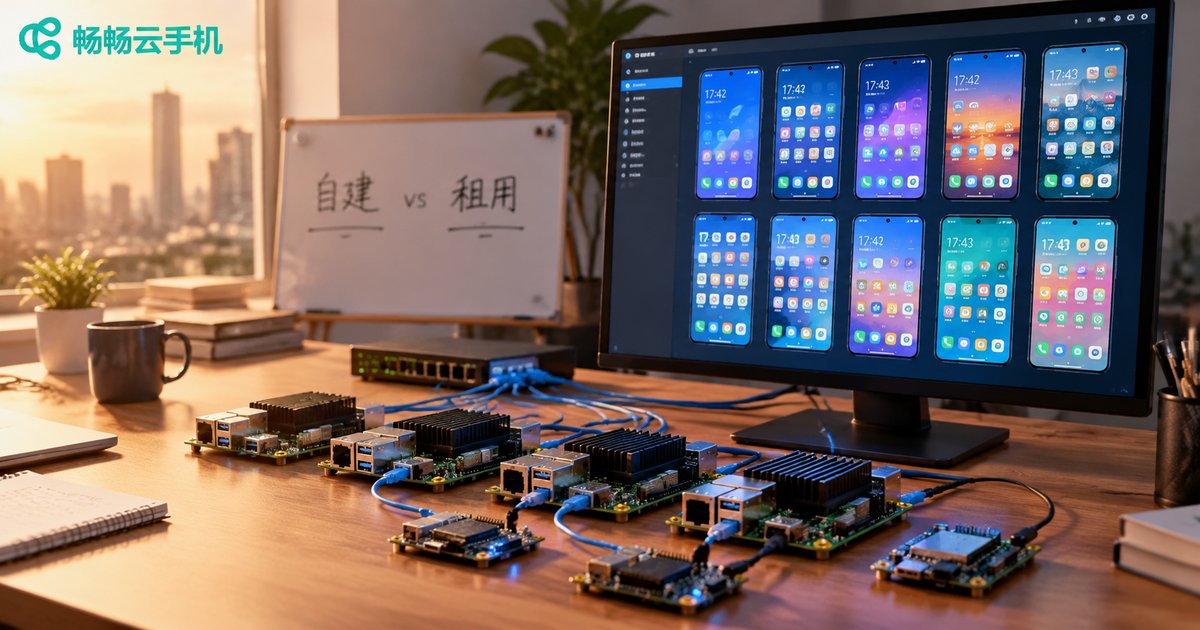
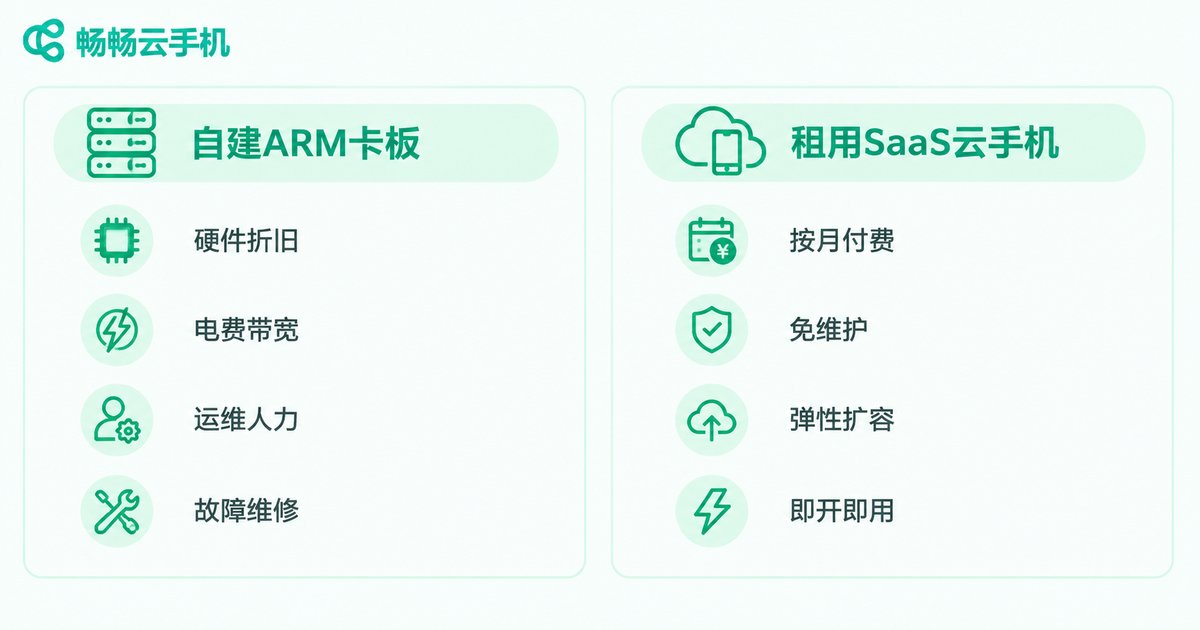
With the rise of cloud gaming, short-video account matrices, and bulk app testing, more and more teams need cloud phones at scale. There are only two paths: self-building ARM boards, buying ARM development boards or complete units, then building your own rack, bandwidth, and scheduling scripts — or renting a SaaS cloud phone platform, where you pay monthly and all hardware and maintenance are handled by the provider.
On the surface, self-building looks like 'pay once, use forever,' while renting feels like 'a monthly bill that never ends.' The real answer, however, lies in the Total Cost of Ownership (TCO): beyond the price of the boards, there is electricity, bandwidth, labor, repairs, idle depreciation, and even business losses caused by downtime. This article uses a reusable cost model to help you locate the scale inflection point between the two options.
The Real Cost Checklist of Self-Built ARM Boards
Many tutorials only tell you the price of a board and skip the long list of expenses that follow. Below is the true monthly cost per device (the following figures are illustrative assumptions used to demonstrate the calculation method; actual numbers depend on your purchase price, local electricity rates, and bandwidth fees):
| Cost Item | Example Assumption | Monthly Cost per Device |
|---|---|---|
| ARM board hardware | About RMB 400 per device, depreciated over 24 months | About RMB 17 |
| Electricity | About 12W per unit, running 24/7 | About RMB 5 |
| Bandwidth and public IP | One business broadband line serving 50 devices | About RMB 3-8 |
| Network gear and rack amortization | Switches, power supplies, racks | About RMB 2-3 |
| Repairs and spare parts | Provisioned at 8% of hardware cost per year | About RMB 3 |
| Operations labor | One ops engineer per 300 devices, RMB 8,000 per month | About RMB 27 |
Adding it all up: at a scale of 300 devices, the all-in cost of self-building is roughly RMB 50-60 per device per month — and that assumes you have a reliable ops engineer and devices that stay online 24/7. The smaller the scale, the thinner the labor and bandwidth are spread, and the higher the per-device cost: below 100 devices, it is not uncommon for the cost to exceed RMB 80 per device per month.
The Cost Structure of Renting a SaaS Platform
The pricing of the SaaS model is very simple: pay per device × duration, everything else included. Hardware depreciation, data-center power, bandwidth, system maintenance, and failure replacement are all borne by the platform. At typical market pricing, a cloud phone costs on the order of RMB 20-30 per month (prices vary by configuration and duration; see the official ChangChang Cloud Phone website for details).
Even more important are three 'hidden gains':
First, zero startup cost. No need to spend tens of thousands on boards upfront; sign up today and start tomorrow, with almost zero trial-and-error cost. Second, elastic scaling. Spin up dozens of extra devices for peak seasons and release them when the project ends — no idle depreciation. Third, zero maintenance. No hardware engineers on payroll; one person can manage hundreds or even thousands of devices.
The Scale Inflection Point: Where the Two Cost Curves Cross
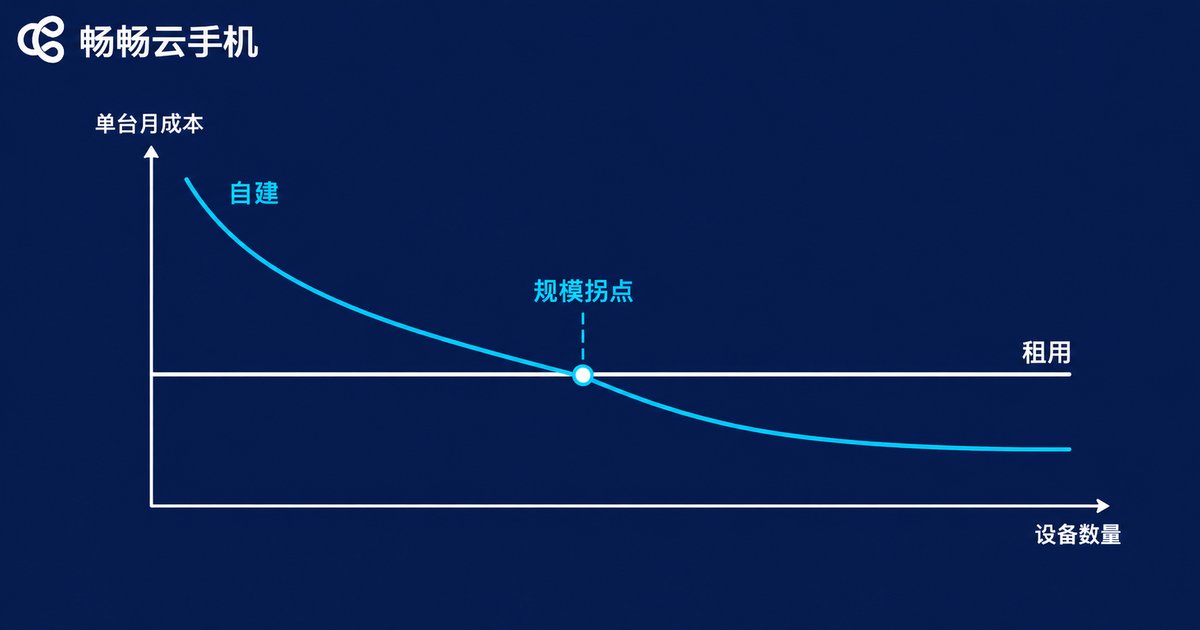
Plot both models on the same chart and you get two curves moving in opposite directions: the self-build cost per device falls as scale grows (labor and bandwidth get spread thin), while the rental cost is a flat horizontal line (the unit price barely changes with scale). The crossing point of the two lines is the scale inflection point.
Based on the example assumptions above, the inflection point falls roughly in this range:
| Device Scale | Self-Build Cost/Device/Month | Rental Cost/Device/Month | Which Wins |
|---|---|---|---|
| Under 50 devices | Over RMB 80 | RMB 20-30 range | Renting, by a wide margin |
| 100-300 devices | RMB 50-70 | RMB 20-30 range | Renting, still cheaper |
| 500-1,000 devices | RMB 30-45 | RMB 20-30 range | Roughly even; depends on ops quality |
| Over 2,000 devices | RMB 25-35 | RMB 20-30 range | Self-build may win slightly, risks included |
The conclusion is clear: for the vast majority of teams, whose scale sits to the left of the inflection point, renting SaaS delivers a lower total cost. Only when the device count stays stable above a thousand, with a dedicated ops team and near-full utilization, can self-building win on paper by a small margin.
Costlier Than Money: Four Hidden Costs of Self-Building
Even if the books break even, self-building carries four hard-to-quantify costs that quietly eat into profits:
1. Stability risk. In a self-built environment, one power cut, network outage, or board crash takes every device offline at once. For account nurturing and automation workloads, an hour of downtime is real money lost — and it almost never shows up in your cost sheet.
2. IP quality. Self-built setups usually rely on a handful of broadband exits, so IPs are concentrated and easily flagged by risk control. Mature cloud phone platforms have years of accumulated IP resources — a key reason many self-build teams eventually return to SaaS.
3. Technology iteration. ARM boards start depreciating the day you buy them; in two or three years performance lags and system updates stop, triggering another round of investment.
4. Opportunity cost. Spending your energy on assembling, wiring, and repairing boards instead of growing the business is the most easily overlooked cost of all.
How to Choose: Practical Advice by Scale
Under 100 devices: Just rent — no hesitation. The money and energy you save are worth far more when invested in the business itself.
100-500 devices: Still rent as the primary option. At this scale, self-building saves little while saddling you with all the operational responsibility.
Over 500 devices: First run your entire workflow and automation scripts on a SaaS platform to validate the profit model; only then consider partial self-building, and always keep a proportion of SaaS devices as disaster recovery.
If you are looking for a stable, hassle-free SaaS cloud phone platform, we recommend ChangChang Cloud Phone (ccloudphone). It provides cloud-based Android devices with batch management, multi-instance support, and flexible duration plans — pay as you go, ready out of the box, with no hardware purchase required. It suits short-video matrices, app testing, game idle farming, and similar scenarios. Run real workloads on a small number of devices for a week or two, judge by actual stability and management efficiency, and then decide your expansion pace; see the official website for exact device configurations and pricing.

FAQ
Q: Are self-built ARM boards always cheaper than renting cloud phones?
No. Only at scales of several hundred devices or more, with long-term full utilization and a dedicated ops engineer, can self-building beat renting on paper. At small scale, once you count labor, bandwidth, and repair losses, self-building is usually far more expensive.
Q: At what scale does the inflection point appear?
Based on the model in this article, the inflection point sits roughly around the thousand-device mark. Below that, renting SaaS is almost always cheaper in total cost; even at the inflection point, self-building still bears extra downtime and IP-quality risks.
Q: What should I look for when choosing a cloud phone platform?
Four things: device uptime stability, batch management and automation capabilities, network quality, and after-sales responsiveness. Start with a small paid trial, validate with real workloads, then scale up.
Q: I already bought boards. Do I still need SaaS?
A hybrid approach works well. Keep revenue-critical workloads on a SaaS platform for guaranteed uptime, and use self-built devices for stability-insensitive testing tasks, with each side backing the other up.
Q: What scenarios is ChangChang Cloud Phone suitable for?
It fits short-video matrix operations, multi-instance app testing, game idle farming, bulk account management, and any scenario that needs many Android devices — activated on demand, maintenance-free, with no server room to build.