

How Marginal Cost Changes as You Scale Cloud Phone Multi-Opening: Instance Fees, Proxy Fees, and Management Costs Breakdown
Do the Math First: What 'Marginal Cost' Means for Multi-Opening
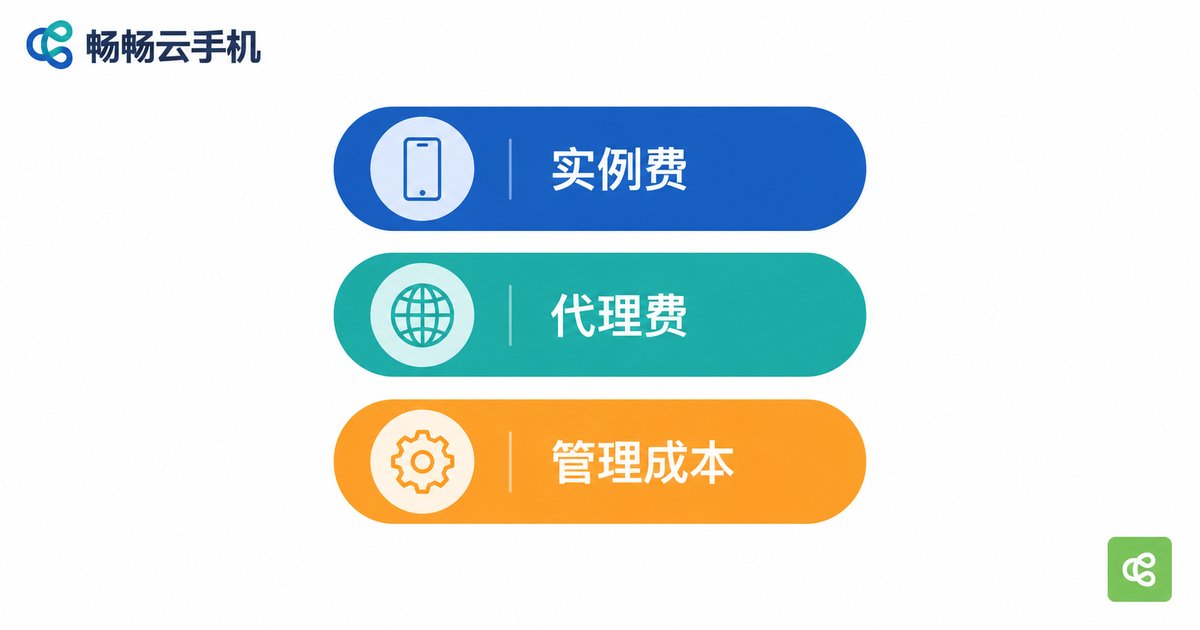
Many teams only look at total price when scaling: what 10 instances cost per month, what 100 cost. But what actually decides whether to keep adding is marginal cost — the extra cost of each additional cloud phone instance. Break it down and there are only three parts: instance fees, proxy fees, and management costs.
The formula is simple: marginal cost = (total cost at the new scale − total cost at the old scale) ÷ number of added instances. These three components move very differently as you scale: one barely moves, one climbs linearly, and one can be diluted. Let's take them one by one.
Instance Fees: Linear by Default, Volume Tiers Are the Only Lever
Instance fees are what you pay for each cloud phone itself. Most providers bill per instance, so by default this part is purely linear: 100 instances cost roughly 10 times what 10 do, and marginal cost stays flat.
Two levers can push it down. First, volume tiers: many providers discount unit prices at larger scales — the bigger the tier, the lower the unit price — so marginal instance cost declines slowly with scale. The table below shows the structure (numbers are illustrative only; actual pricing varies by provider):
| Scale tier | Illustrative unit price | Marginal cost per added instance |
|---|---|---|
| 10-instance tier | $6.0 | $6.0 |
| 50-instance tier | $5.0 | $5.0 |
| 100-instance tier | $4.5 | $4.5 |
Second, billing cycle: monthly, quarterly and annual price gaps are essentially trading certainty for discounts. But watch out for idle instances — if you commit to 100 instances for a year to unlock the discount but only steadily use 60, the fees for the other 40 are pure waste, and spread over the 60 you actually use, your effective unit price goes up. Elastic scaling usually beats chasing discount tiers.
Proxy Fees: The Linear Item Most Likely to Blow Up Your Budget
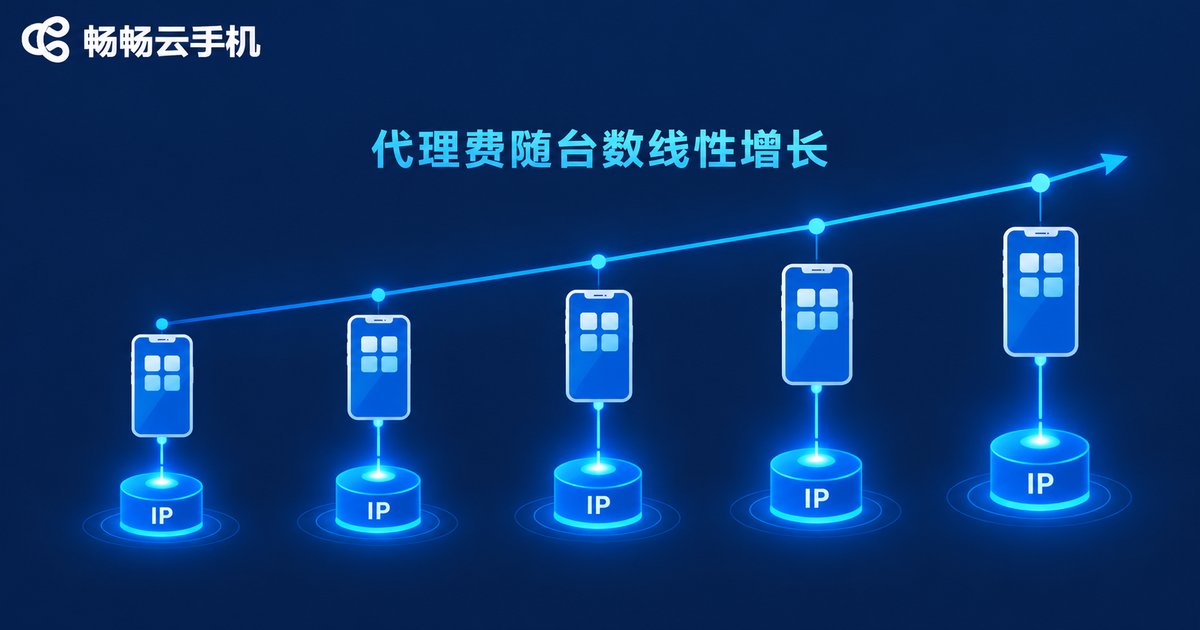
The second block is proxy IP cost, and it is the most underestimated one. For account operations and multi-platform distribution, each instance usually needs its own IP, which means proxy fees grow almost 1:1 with instance count — and there are virtually no volume discounts, because IPs are billed per unit.
Worse, as scale grows, IP quality requirements tend to rise with it:
| IP type | Typical price level | Best for |
|---|---|---|
| Datacenter IP | Lowest | Environment-insensitive tasks |
| Dynamic residential IP | Medium | Routine multi-account operations |
| Static residential IP | Highest | Long-term account nurturing, high-value accounts |
A common pattern in practice: at small scale proxy fees are pocket change; at large scale they catch up to or even exceed instance fees. When calculating marginal cost, always factor in what IP each instance gets — don't just read the cloud phone price tag.
Management Cost: The Only Component That Gets Diluted with Scale
The first two are paid in money; management cost is paid mostly in people and time: provisioning, installing apps, tweaking settings, daily checks, handling exceptions, rebuilding devices. How it scales is the most interesting part — with the right tools it gets diluted; done manually it grows linearly or worse.
Purely manual management: every instance needs human attention, so total management cost rises linearly with count. Ten instances are barely manageable, fifty starts producing errors, and a hundred forces you to hire.
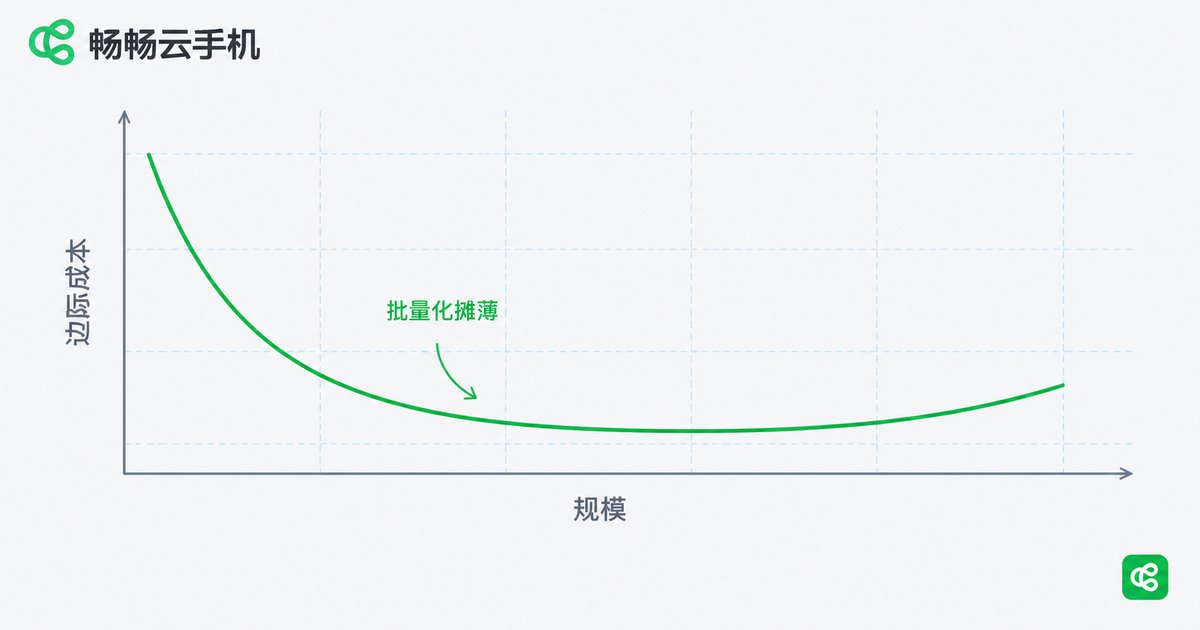
Batch management: with a cloud phone that supports batch operations — bulk install, bulk configuration, group-control style unified actions — one action covers every instance and per-instance management time drops sharply. Marginal management cost decreases, and that is the main source of economies of scale in multi-opening.
But do not celebrate too early: past a certain scale, coordination costs kick in — exception rates, rework caused by account risk control, handoff losses between team members — and the curve ticks back up. So the marginal management cost curve roughly looks like: a steep drop, then a flat stretch, then a slight rise at very large scale.
Adding It Up: What the Marginal Cost Curve Looks Like
Put the three together with illustrative numbers (per added instance per month; for structure demonstration only, not real quotes):
| Scale step | Instance fee margin | Proxy fee margin | Management margin (converted) | Total |
|---|---|---|---|---|
| 10 → 20 | $6.0 | $4.0 | $3.5 | $13.5 |
| 50 → 60 | $5.0 | $4.0 | $1.5 | $10.5 |
| 100 → 110 | $4.5 | $4.5 | $1.8 | $10.8 |
Three patterns stand out: marginal instance cost declines slowly, depending on whether you reach volume tiers; marginal proxy cost barely moves, and may even creep up with quality requirements; marginal management cost drops sharply then flattens, and it is the main reason the total curve gets cheaper as you grow.
The takeaway: with proxy costs under control and batch tooling in place, the marginal cost of multi-opening typically declines and then flattens. To decide whether to keep adding, compare this curve against per-instance revenue — when marginal cost is below per-instance monthly net profit, adding more is a positive investment.
Three Ways to Push Marginal Cost Down with CCloudPhone
Picking the right provider optimizes all three blocks at once. Taking CCloudPhone (ccloudphone) as an example, here is a three-step approach:
First, test the curve at small scale before ramping up. Run the business on a handful of instances, record real instance fees, proxy fees and management hours, plot your own marginal cost curve, and only then set your scaling pace — instead of stockpiling instances for a discount tier on day one.
Second, batch every management action. CCloudPhone supports multi-instancing and batch management — do installs, configuration and daily operations in bulk to minimize per-instance management time and get the management cost curve into its flat zone as fast as possible.
Third, plan independent IPs early. Decide each instance's IP setup before you scale and treat proxy fees as a fixed linear item in your model, rather than upgrading IP quality reactively later. For current plans and pricing, refer to the official CCloudPhone website (ccloudphone).

FAQ
Q: For 100 instances, buy all at once or in batches?
Scale in batches. Grow to 50 first, re-measure marginal cost, and keep adding only after management cost has flattened and proxy IPs are stable — idle instances inflate your effective unit price.
Q: Does every instance really need its own proxy IP?
It depends on the business. Account-based operations that need environment isolation should be one IP per instance; environment-insensitive background tasks can share, but set risk expectations accordingly.
Q: How low should marginal cost be before adding more?
Simple rule: when per-instance monthly marginal cost is below per-instance monthly net profit, adding more pays. Once batch tools dilute management cost, this threshold usually drops noticeably.
Q: How does CCloudPhone charge?
Plan tiers differ by business scale; for exact billing methods and prices, check the official CCloudPhone website (ccloudphone) and confirm a bulk plan with support before scaling.