
How to Evaluate Cloud Phone ROI: A Framework for Efficiency Gains and Cost Control
Why Comparing Monthly Prices Is Not Enough
Ask most teams how they evaluate cloud phones and the first answer is a price comparison: the monthly subscription versus the purchase price of a physical handset. That looks intuitive, but it misses more than half of the picture. Buying a phone is only the beginning. After that comes depreciation, floor space, electricity, network, system maintenance, staffing, and the eventual replacement of ageing hardware. Cloud phones compress all of these into a single monthly figure. So the real comparison is not price versus price — it is total cost versus total cost, and total output versus total output.
The framework below runs in five steps: capture the full cost, quantify efficiency, find the break-even point, reweight by use case, and turn it into a repeatable review loop.
Step 1: Capture the Full Cost, Not Just Visible Spending
Split costs into two buckets. Visible costs are the ones you can look up on a ledger: hardware purchases, subscriptions, bandwidth and rent. Hidden costs are the ones that never get their own line item but still consume resources: the hours your ops team spends on disconnects, reboots and re-flashing, the downtime caused by failing devices, and the long procurement cycle every time you need to scale.
| Cost item | Physical handset | Cloud phone | What to check |
|---|---|---|---|
| Device investment | Full-unit purchase, large one-off spend | Paid per subscription period, no hardware purchase | Look at cash tied up, not just total price |
| Space and power | Racks, charging, cooling, electricity | Usually included on the service side | The most overlooked hidden cost |
| Ops labour | Flashing, rebooting, swapping, inspection | Batch management, centralised operation | Converting to labour hours is clearest |
| Scaling speed | Limited by procurement and logistics | On-demand provisioning, ready in minutes | Estimate the opportunity cost |
| Depreciation | Performance lags after roughly 24 months | Refresh handled on the service side | Annualising gives a fairer figure |
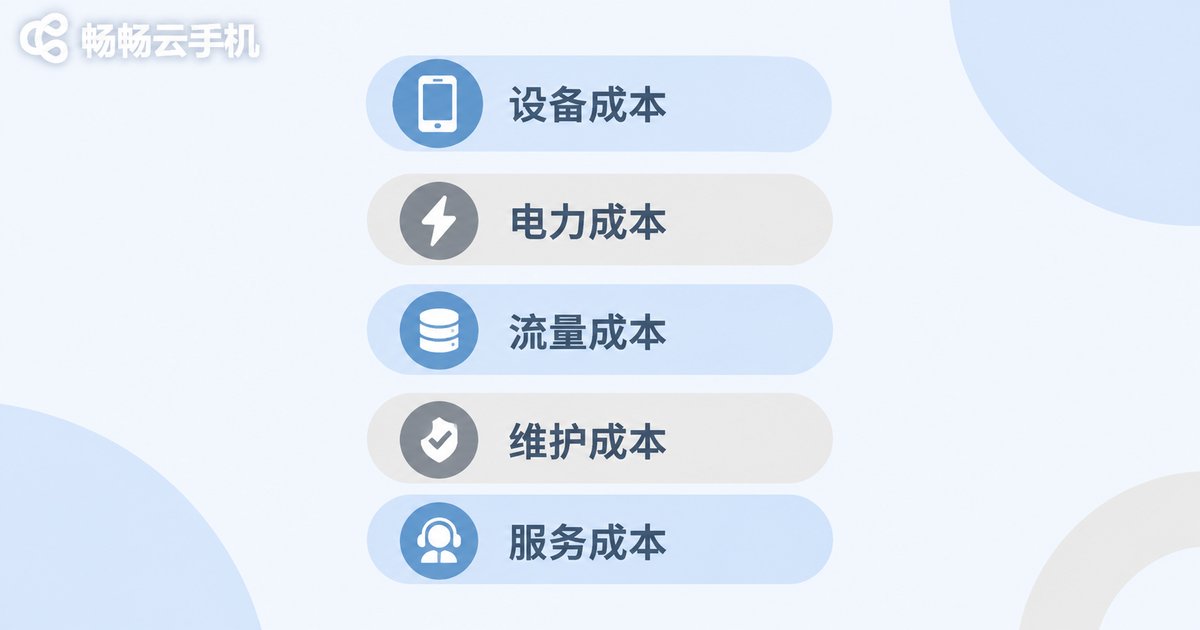
What to do: fill in the middle column with your team's real numbers, then place them side by side with actual cloud phone spending. Filling in three rows is enough — the key is that the figure for total handset cost should no longer be limited to the purchase price.
Step 2: Quantify Efficiency With Observable Metrics
Efficiency gains easily turn into vague claims. The fix is to break them into metrics you can actually collect. Most teams can establish a baseline for all five of the following within two weeks.
| Metric | How to calculate | Why it matters |
|---|---|---|
| Devices per operator | Total managed devices ÷ ops headcount | Directly reflects labour leverage |
| Average task duration | Total task time ÷ number of tasks | Measures scripting and batch capability |
| Device readiness time | Average time from request to operable | Shows scaling and response speed |
| Recovery time | Average time from detection to recovery | The direct source of downtime loss |
| Idle rate | Idle device hours ÷ total device hours | Indicates whether elastic downsizing is needed |
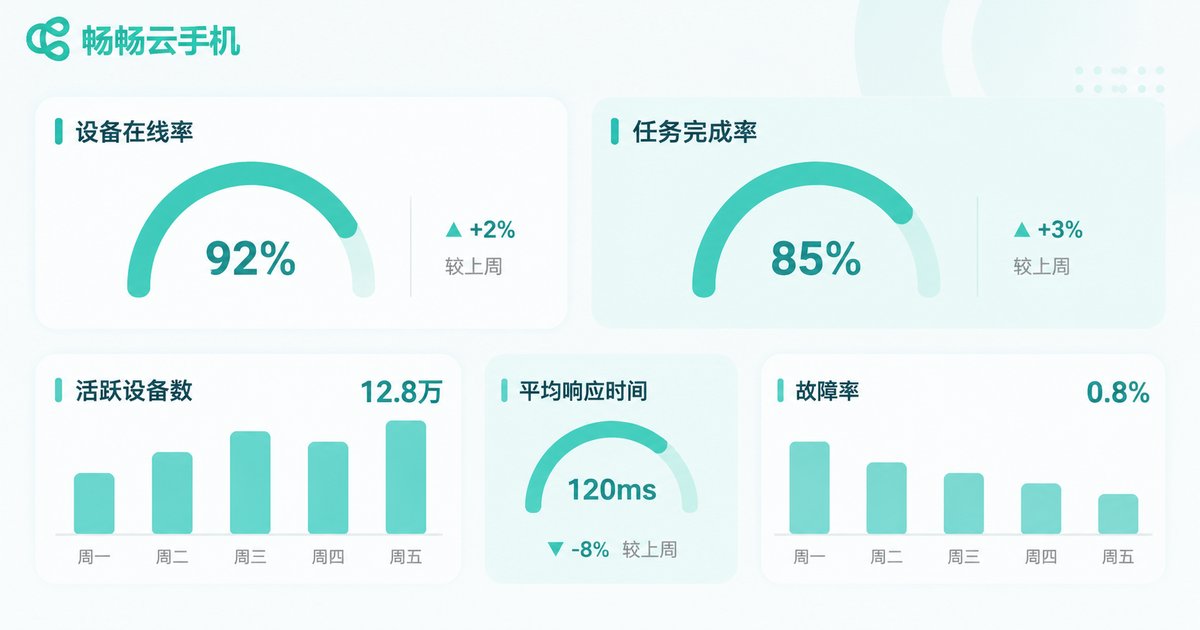
Record a two-week baseline, then run two weeks for comparison. Efficiency gains without a baseline are just feelings.
Step 3: Calculate the Break-Even Point
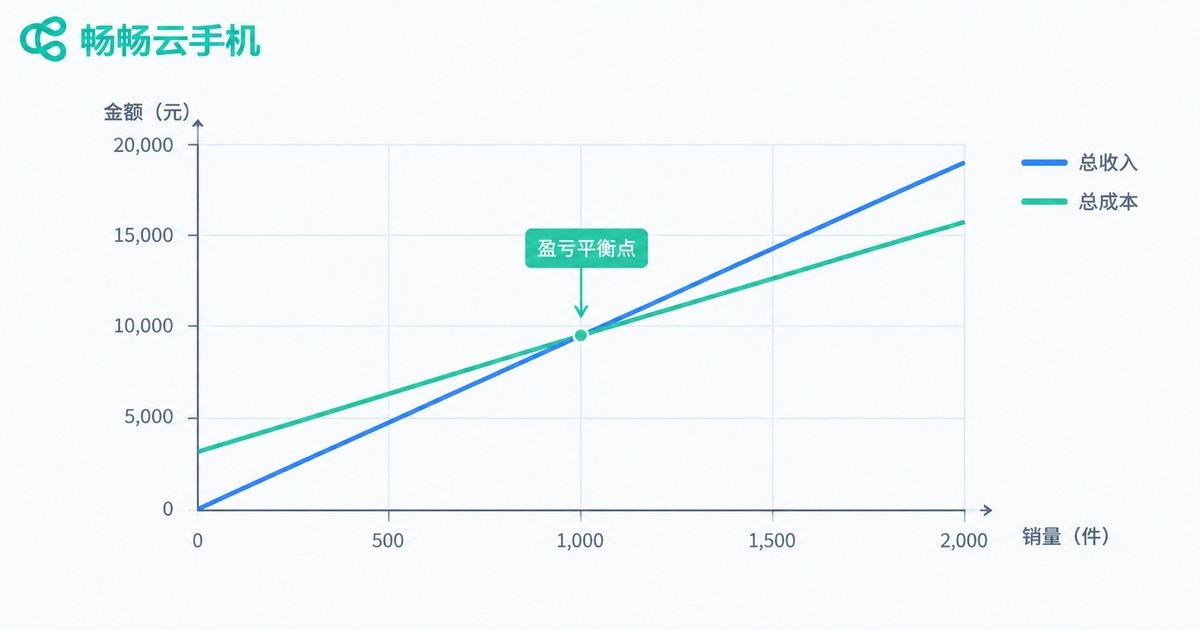
Put cost and efficiency into one formula and the conclusion becomes very concrete:
Monthly cost per cloud phone = subscription + bandwidth share + ops labour share
Monthly cost per handset    = depreciation + space + power + ops + refresh reserve
Monthly net benefit         = handset monthly cost − cloud phone monthly cost
Break-even utilization      = cloud phone monthly cost ÷ handset monthly cost × 100%
Break-even utilization answers a simple question: what share of real usage does a cloud phone need before the investment pays for itself? If the number comes out at 60% and your actual utilization sits above 80% all year, the direction is clearly worthwhile. If it comes out at 35%, either scale is too low or elastic downsizing is not being used properly.
Step 4: Reweight the Analysis by Use Case
The same cost structure carries very different value in different scenarios, so the weighting should shift accordingly.
- Multi-account e-commerce operations: weight account environment isolation, bulk listing efficiency, and overnight staffing cost.
- App automated testing: weight device model coverage, parallel task count, and the cost of re-running failed jobs.
- Content and social media matrices: weight multi-account switching efficiency and upload stability.
- Short-term campaigns: weight provisioning speed and how easy it is to scale down once the campaign ends.
Step 5: Build a Repeatable Review Loop
A one-off conclusion goes stale as the business changes, so the more practical approach is to make evaluation a recurring routine:
- Set the baseline: record devices per operator, task duration and failure rate under your current handset setup.
- Pilot at small scale: pick one use case, run it for 2 to 4 weeks, and collect the same metrics.
- Compare and attribute: identify where the difference comes from — labour, downtime, or scaling speed.
- Decide the scale: use the break-even utilization to decide whether to expand, hold, or shrink.
- Review quarterly: rerun the formula whenever business volume changes.

Choosing a Platform: Turning the Model Into Real Capability
Whatever the framework concludes has to be delivered by an actual platform. Changchang Cloud Phone (ccloudphone) provides Android instances running in the cloud that can be managed centrally through a desktop client or a web browser, with on-demand provisioning and batch operations. That converts device purchasing and day-to-day operations from fixed costs into elastic spending that scales with your business volume. For teams running the evaluation above, a sensible first move is to pilot one small use case for two to four weeks and then compare it against the handset setup using exactly the same metrics.
When selecting a platform, confirm three things: whether batch management genuinely saves labour, whether provisioning speed keeps up with your scaling rhythm, and whether recovery from failures interrupts task continuity. Those three map directly onto the ops labour, device readiness time and recovery time rows in the earlier table.
Frequently Asked Questions
Q: How long does it take to get a clear read on cloud phone ROI?
A: A 2 to 4 week pilot is usually enough to judge direction. To decide how far to scale, run through a full business cycle — typically one quarter.
Q: How do I convert efficiency gains into money?
A: Multiply the labour hours saved by your labour cost, then add the reduction in downtime hours multiplied by output per hour. The sum is the monetary value of the efficiency gain, which can then be compared directly with the subscription spend.
Q: Can cloud phones and physical handsets be used together?
A: Yes, and it is very common. Most teams keep a small number of handsets for hardware-specific work and move batch, long-running, elastic workloads to the cloud. Just split the cost by task volume during evaluation.
Q: Is this framework worth it if I only use a handful of devices?
A: Simplify it. The minimum version is three numbers: full handset cost, cloud phone cost, and break-even utilization. Those three are enough for a directional decision.
Q: What is the most common mistake in these evaluations?
A: Comparing unit prices only, and leaving efficiency gains as a subjective impression. Fill in the hidden costs and quantify the efficiency metrics, and the conclusion usually becomes much more robust.