

Cloud Phone Cost Accounting Methods: Per Person, Per Project, and Per Usage Hour
Why cloud phone cost accounting should not rely on unit price alone
When many teams buy cloud phones, their first instinct is to compare the monthly price per device. But the real cost is more than the unit price: it also includes idle waste, project switching, temporary scaling, and management labor. Only by breaking costs down into three dimensions—per person, per project, and per usage hour—can you see where the money goes and build a reliable basis for the next budget cycle.
This article explains three practical accounting methods in plain language, with formulas, suitable scenarios, and a comparison table to help you calculate cloud phone costs clearly.
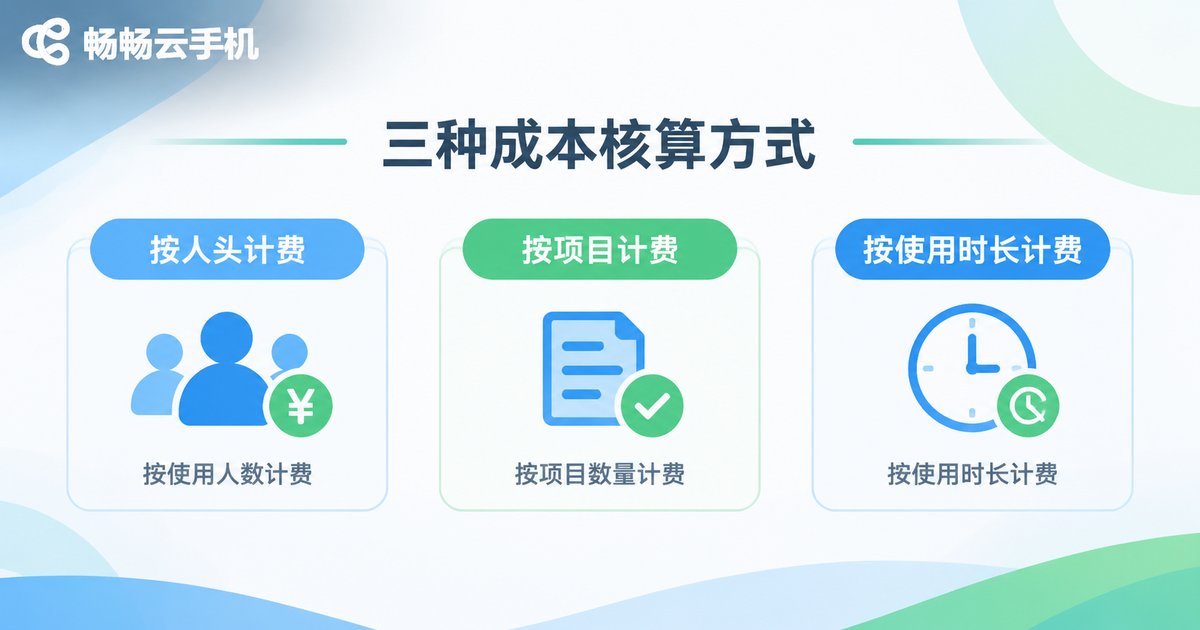
Method 1: Per-person accounting — suitable for fixed roles and long-term use
Per-person accounting is the most intuitive approach: allocate cloud phone costs to each person who uses cloud phones.
Formula: Cloud phone cost per person = Total cloud phone cost ÷ Number of actual users
If each person uses a fixed number of cloud phones, you can first calculate the average devices per person, then multiply by the unit cost. For example, a team of 20 people uses 2 cloud phones each, and the total monthly cost is X. The cost per person is X ÷ 20.
Suitable scenarios: Customer service, operations, and testing roles that use cloud phones long term; a relatively stable headcount; departmental labor cost budgeting.
Advantages: Simple and easy to understand, and easy to combine with labor cost management. Note: If employee turnover is high or devices are shared, per-person accounting can overestimate or underestimate actual usage. It is best to reconcile with active accounts every month.
Method 2: Per-project accounting — suitable for parallel projects and independent settlement
When a team serves multiple projects at the same time, or different projects need independent cost accounting, per-project allocation is more reasonable.
Formula: Project cloud phone cost = Number of cloud phones used by the project × Usage hours per device × Price per hour + Project-specific resource fees
If precise splitting is not possible, you can allocate total costs by the ratio of device-hours used by each project. For example, Project A uses 300 device-hours and Project B uses 700 device-hours, so the total cost is allocated 3:7.
Suitable scenarios: Agency operations, multi-client projects, game testing with multiple parallel versions, and short-term campaign projects.
Advantages: You can see the real investment in each project, which helps with quotations and reviews. Note: You need a project ledger recording device IDs, start and end times, and project ownership to avoid cross-occupation that distorts allocation.
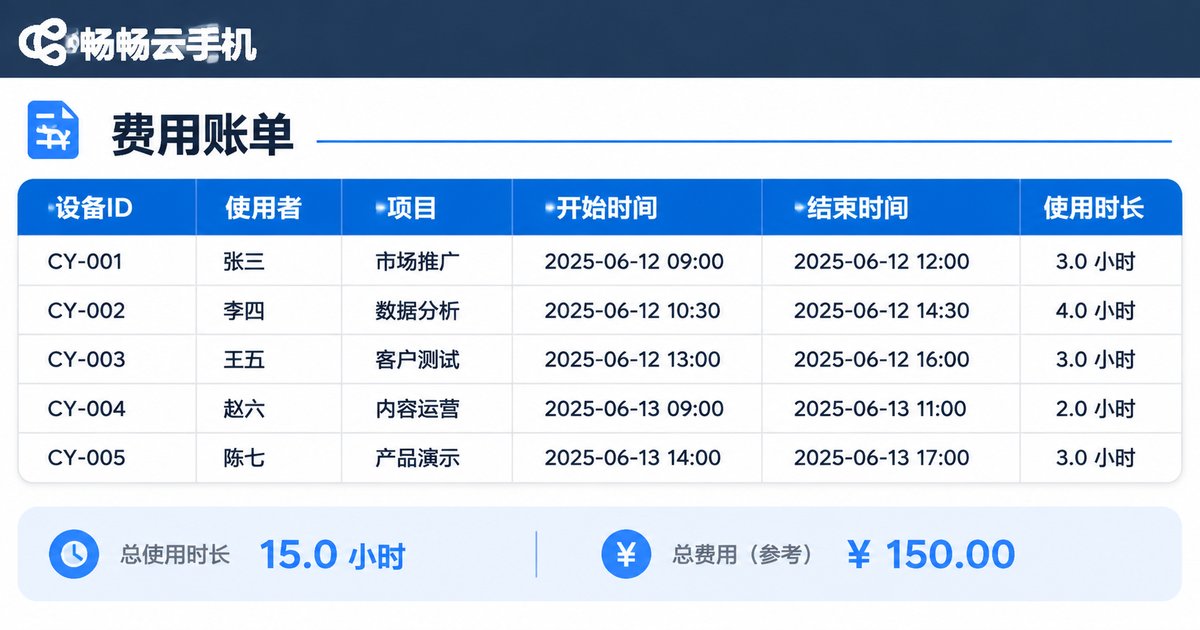
Method 3: Per-usage-hour accounting — suitable for elastic use and temporary tasks
Cloud phones support on-demand use, and billing by actual usage hours can avoid paying for idle resources.
Formula: Usage-hour cost = Number of cloud phones × Actual usage hours × Price per hour
If different configurations have different unit prices, calculate each configuration separately and add them up. It is recommended to use device-hours as the unified unit of measurement for cross-project comparison.
Suitable scenarios: Short-term testing, temporary scaling, peak usage during campaigns, and hourly-billed outsourcing tasks.
Advantages: Highly elastic with low idle cost. Note: Set auto-shutdown or expiration reminders to avoid extra charges from forgotten resources. Also distinguish between power-on hours and actual active hours, and unify the definition based on business needs.
Comparison of the three accounting methods
| Method | Core formula | Best-fit scenario | Main risk |
|---|---|---|---|
| Per-person | Total cost ÷ Number of users | Fixed roles, long-term use | Deviation caused by staff turnover |
| Per-project | Project device-hours × Unit price + Specific fees | Parallel projects, independent settlement | Unclear ledger causing distorted allocation |
| Per-usage-hour | Quantity × Hours × Hourly price | Elastic use, temporary tasks | Forgotten resource release |
Implementation advice: build a ledger first, then choose a method
Whichever method you choose, start with three steps. First, give each cloud phone a unique ID and record the owner, project, activation time, and release time. Second, unify the unit of measurement, preferably device-hours. Third, produce a monthly cost report and cross-check it by person, project, and usage hour.
For most teams, a combined approach works well: use per-person accounting for budgeting, per-project accounting for settlement, and per-usage-hour accounting for optimization. This controls total cost while revealing idle waste.

Manage cloud phone costs with ccloudphone
ccloudphone provides cloud phone services with flexible configuration and usage options, making it easier for teams to manage cloud phone resources according to actual business needs. For cost accounting, you can use ccloudphone console records to organize ledgers by person, project, or usage hour, and then apply the formulas in this article. For specific plans, configurations, and billing methods, please refer to the official ccloudphone website.
It is recommended to include cloud phone costs in monthly business analysis: first review the total cost trend, then break it down by person and project, and finally check resources with high usage hours but low output, adjusting configurations or releasing idle devices in time.
Frequently asked questions
Q1: Can per-person and per-project accounting be used together?
Yes. A common approach is to use per-person accounting for departmental budgeting and per-project accounting for internal settlement, aligning both through a device-hour ledger.
Q2: When using per-usage-hour accounting, should we count power-on hours or active hours?
It is best to follow the business definition. If a task requires continuous online presence, use power-on hours. If it is only intermittent operation, active hours better reflect real consumption, but tool support is needed.
Q3: Does cloud phone cost accounting need finance involvement?
It is advisable for finance to help define the accounting rules and report format, while business teams record usage data. This makes cost data useful for budgeting and decision-making.
Q4: How can we avoid idle cloud phone waste?
Set expiration reminders and regular inspections, and recycle or downgrade devices with continuously low usage. For new projects, apply for usage-hour-based resources first and switch to long-term plans after demand stabilizes.