

How to Save More on Cloud Phone Renewals? Do the Math on Annual and Monthly Plans Separately
Before You Hit “Pay Now” on That Renewal
Most people spend real time choosing a cloud phone plan the first time they sign up, then renew with a single careless tap. In reality, roughly eighty percent of your long-term cloud phone cost is decided by how you renew. Monthly and annual billing are two fundamentally different financial arrangements, not just a slightly pricier and a slightly cheaper version of the same thing. Work through the two calculations separately, and you will know which one actually fits you.
This article is not selling any plan. It is about getting the math right.
What You Are Actually Paying For: Staying Online
A cloud phone is a virtual handset running in a data center. You do not buy hardware, charge a battery, or worry about heat. What your rent buys is essentially four things: compute power, storage, network bandwidth, and the reliability of staying online over time.
All four are consumed by time. That is why cloud phone pricing works a lot like renting an apartment: the longer the lease, the more willing the provider is to discount the unit rate, but the more cash you have to put down upfront. That tension is exactly where the annual-versus-monthly question begins.
The Monthly Calculation: Higher Unit Price, but You Are Buying Flexibility
The obvious benefit of monthly billing is that you keep the decision in your own hands. If this month goes well, renew next month. If the project ends, you stop without feeling you wasted money.
The hidden cost of monthly billing sits in the unit price. When billing month to month, the provider carries the risk that you might leave at any time, plus the recurring cost of processing payments and maintaining your instance every month. That eventually gets folded into the rate. So if you use the service continuously for a full year, monthly billing usually costs more in total than an annual plan.
The right use cases for monthly billing are clear: trial periods, short projects, requirements still in flux, and genuine uncertainty about long-term use. The extra unit cost you pay is essentially an insurance premium for the freedom to walk away.
The Annual Calculation: Lower Unit Price, but It Tests Your Certainty
Annual billing works the other way around. You pay for a year upfront in exchange for a lower average monthly cost. The trade-off is that your money is tied up in advance and your flexibility drops.
The real risk of an annual plan is not the price; it is idling. If you use it for three months and then let it sit, the remaining nine months become pure sunk cost, and the unit-price advantage never materializes. So the key question is not “is annual cheaper?” but “can I be confident this cloud phone will be working most of the time over the next twelve months?”
If yes, the annual unit price advantage holds. If not, monthly flexibility often ends up costing you less.
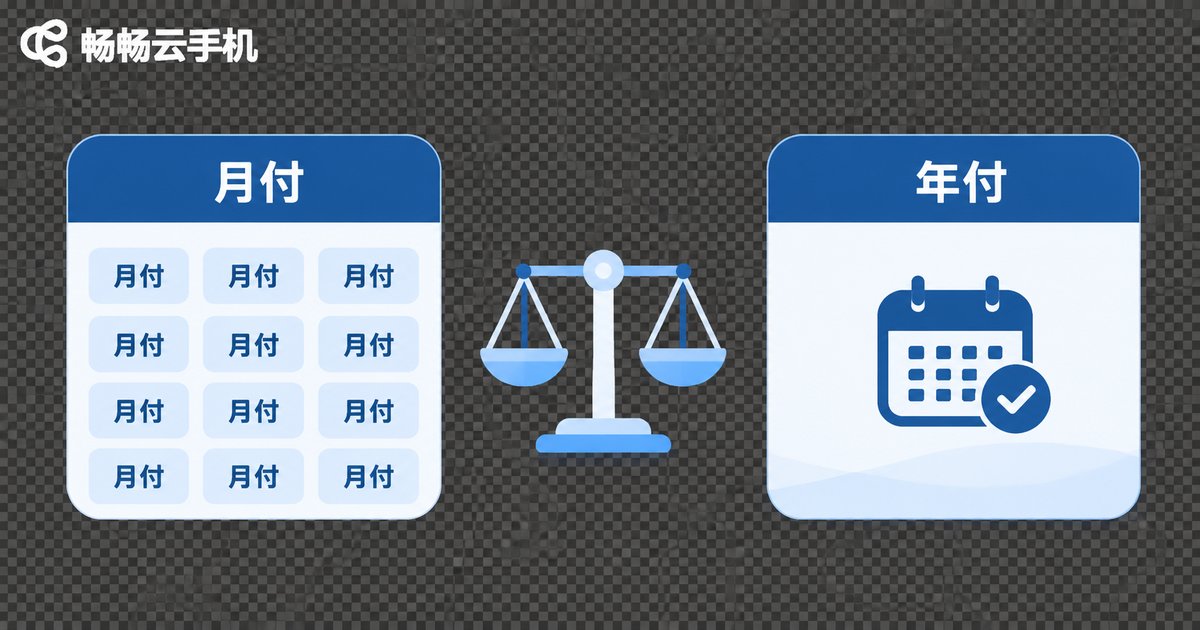
A Side-by-Side Look at Annual vs. Monthly
| Dimension | Monthly | Annual |
|---|---|---|
| Cash outlay per period | Low, paid monthly | High, paid upfront |
| Effective monthly cost | Higher | Lower |
| Flexibility | High, stop anytime | Low, stopping mid-term is costly |
| Idle risk | Almost none | Borne entirely by you |
| Best for | Trials, short projects, unstable demand | Steady long-term use, multi-instance running |
| Decision trap | Underestimating the full-year total | Overestimating how long you will actually use it |
Read the table and you will see there is no absolute winner. Each option solves a different problem. Real savings come from matching the billing cycle to your actual usage duration.
Three Types of Users, Three Renewal Strategies
Type 1: New to cloud phones. Start with one or two months of monthly billing. You need to find out whether this cloud phone runs your workload, whether stability is good enough, and whether the workflow feels right. What you save at this stage is not money; it is the risk of a large upfront commitment going nowhere.
Type 2: Already running smoothly and using it daily. If you have used it continuously for two or three months and it is genuinely in use every day, your demand is probably stable. Switching to annual billing to push down the average monthly cost is a natural move at this point.
Type 3: Clear busy and idle seasons. If you only use it during certain seasons or specific projects, do not jump into annual billing. Pay monthly as needed, renew in peak periods, pause in slow periods — the total often comes out lower than an annual plan.
Four Checks Before You Renew
1. Calculate the effective monthly cost. Do not look only at the annual total. Divide it by twelve and compare it with your current monthly rate. The difference is what you actually save.
2. Review your actual usage days over the past three months. If there were more than twenty days in three months when you never opened it, your usage intensity cannot justify an annual plan.
3. Confirm whether your configuration needs adjusting. Before renewing, decide whether your current spec is just right, too small, or oversized. Adjust the configuration first, then talk about the billing cycle — reversing that order tends to cost more.
4. Verify the current official pricing and rules. Prices and billing rules change. Before renewing, go by what the official site shows today, not what you remember.
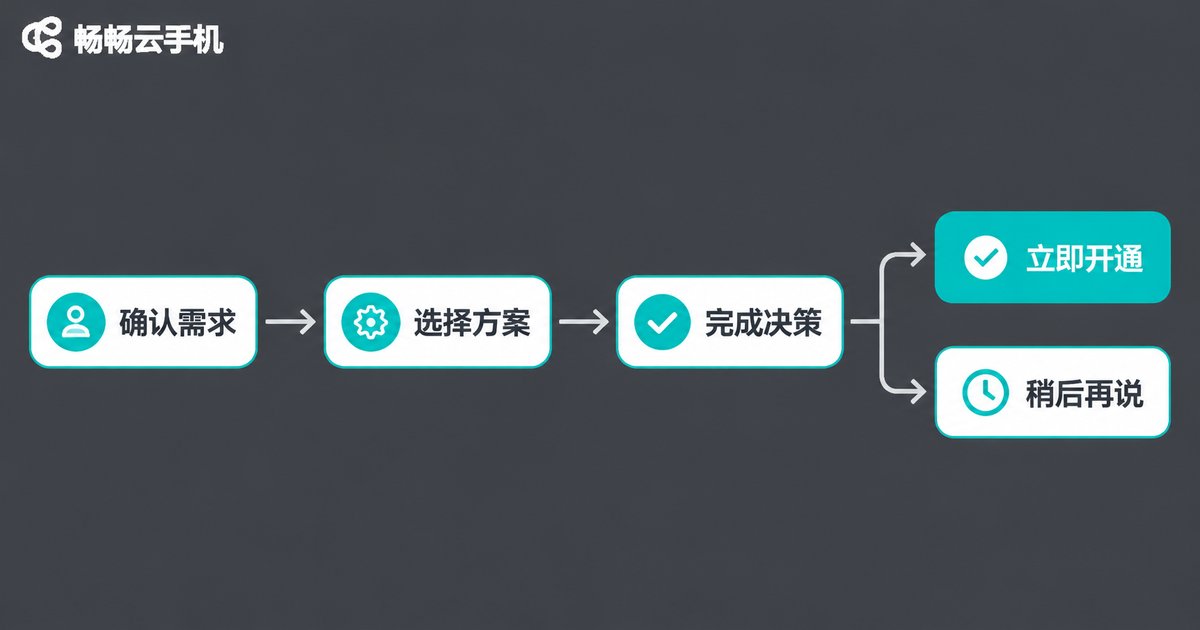
Running the Numbers on CCloudPhone
CCloudPhone (ccloudphone) provides cloud-based virtual phone instances that support multi-instance operation and long continuous online sessions, which suits scenarios that need stable always-on running or parallel accounts. When it comes to renewing, work through it in this order:
Step one: confirm your usage intensity. Check your usage record and see how many days the instance actually ran over the past month. Every other calculation rests on this number.
Step two: verify the current official pricing. Note down both the monthly rate and the actual annual plan price. Do not make decisions on stale numbers.
Step three: do the equivalent conversion. Divide the annual total by twelve to get the effective monthly cost, then compare it with your current monthly spend to find the monthly and annual difference.
Step four: back out the payback period. If the annual plan requires a larger upfront payment, divide that extra amount by the monthly difference. The result is how many months it takes to break even. Annual billing only genuinely pays off if you are confident you will use it beyond that point.
This method does not depend on any specific figure, so you can rerun it any time with the latest official pricing. The core idea is one sentence: work out your usage duration first, then the unit price, and only then choose a billing cycle.

Frequently Asked Questions
Q: Is an annual plan always cheaper than monthly?
No. Annual billing saves on unit price, but if the instance sits idle for long stretches, the waste can exceed the discount. Judge it by your real usage intensity over the next twelve months.
Q: Is it worth switching from monthly to annual after a few months?
You can calculate it. Compare the annual plan's effective monthly cost with the monthly rate, then check whether your remaining usage plans cover the payback period. If you have already been using it steadily for two or three months, switching is usually reasonable.
Q: Should I adjust my configuration at the same time as renewing?
Adjust the configuration first, then choose the cycle. Locking in an oversized spec for a full year bakes in the waste, while an undersized one forces an upgrade later, which is even more hassle.
Q: How do I know if I am the “annual plan” type?
Look for two signals: you have used it continuously for more than two months and it runs almost every day, and your needs over the coming year are fairly certain and will not be interrupted by a project ending. When both hold, the annual unit price advantage is on solid ground.
Q: Is the renewal price the same as the initial sign-up price?
Billing rules and listed prices may change as the official site updates. Before renewing, go by the actual information currently shown on the CCloudPhone official website rather than paying based on your earlier impression.