One Proxy List per Cloud Phone or a Shared Proxy Pool? Choosing the Right IP Strategy for Multi-Account Anti-Association
Why “IP Collision” Is the Biggest Risk in Multi-Account Operations
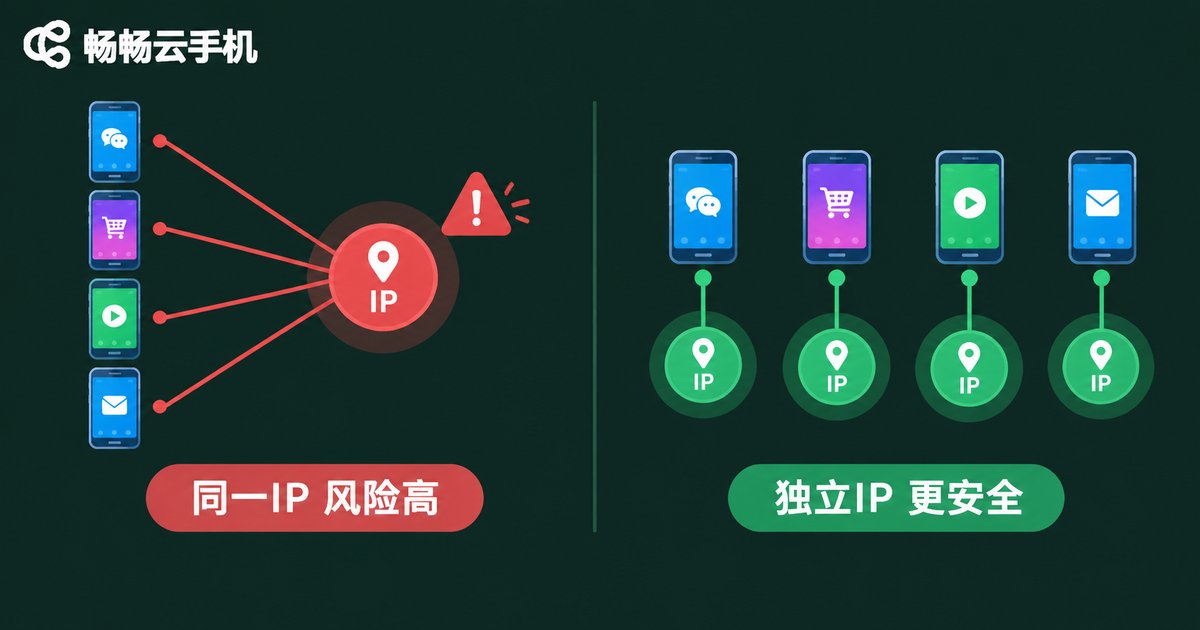
Anyone running an account matrix knows that platforms judge whether accounts belong to the same operator by looking at more than device parameters — the network environment matters too. The IP address is the most obvious giveaway: if ten cloud phones log into ten accounts but all share one IP, or keep jumping between a few IPs, risk-control systems can easily link them together and flag them as bulk registration or automated behavior — throttling at best, bans at worst.
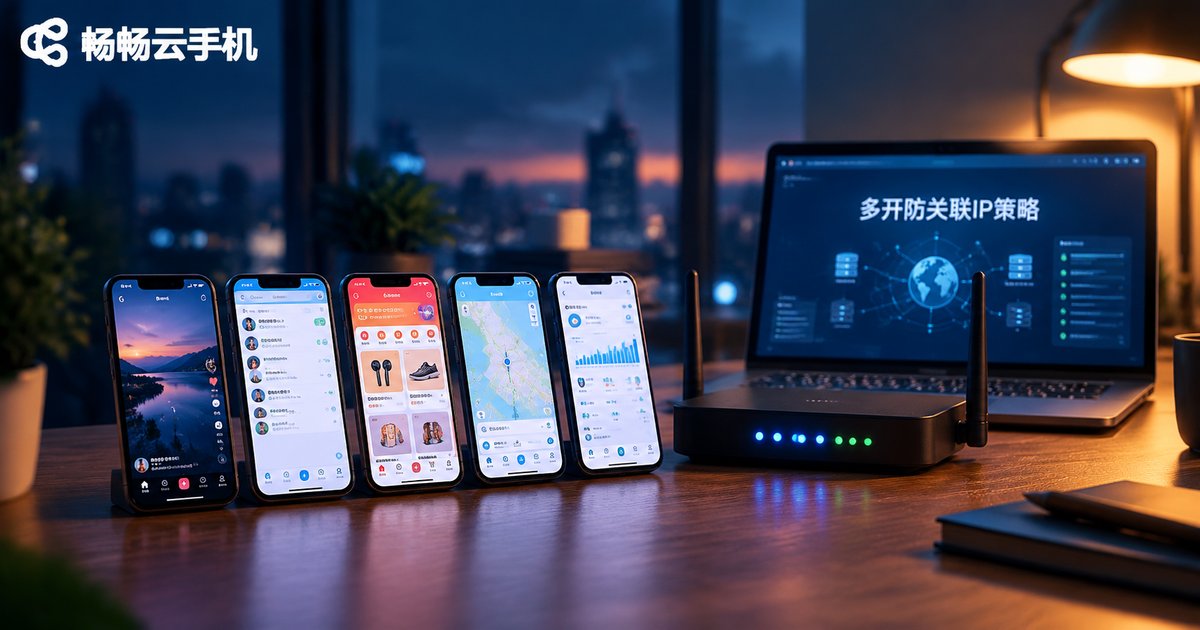
So the core of anti-association is not just giving each cloud phone an independent device environment, but also giving every device a sensible, stable, and well-separated IP strategy. For most operators, the choice comes down to two options: bind one dedicated proxy list per cloud phone, or let all devices share one proxy pool.
First, Understand What the Two Strategies Actually Are
One dedicated proxy list per phone: each cloud phone gets its own fixed proxy resources — either a static dedicated IP or a small dedicated list that rotates in order. The binding between device and IP stays unchanged for the long term, so the platform always sees “the same person on the same broadband line.”
Shared proxy pool: a large number of proxy IPs are pooled together, and all cloud phones draw from the pool by rule — the IP may change on every connection or rotate by time period. Its advantages are low cost and massive capacity, suitable for scenarios that need frequent exit-IP changes.
In one sentence: the former builds a “stable persona,” the latter enables “flexible costume changes.” Different directions, different use cases.
Side-by-Side Comparison: Which One Prevents Association Better?
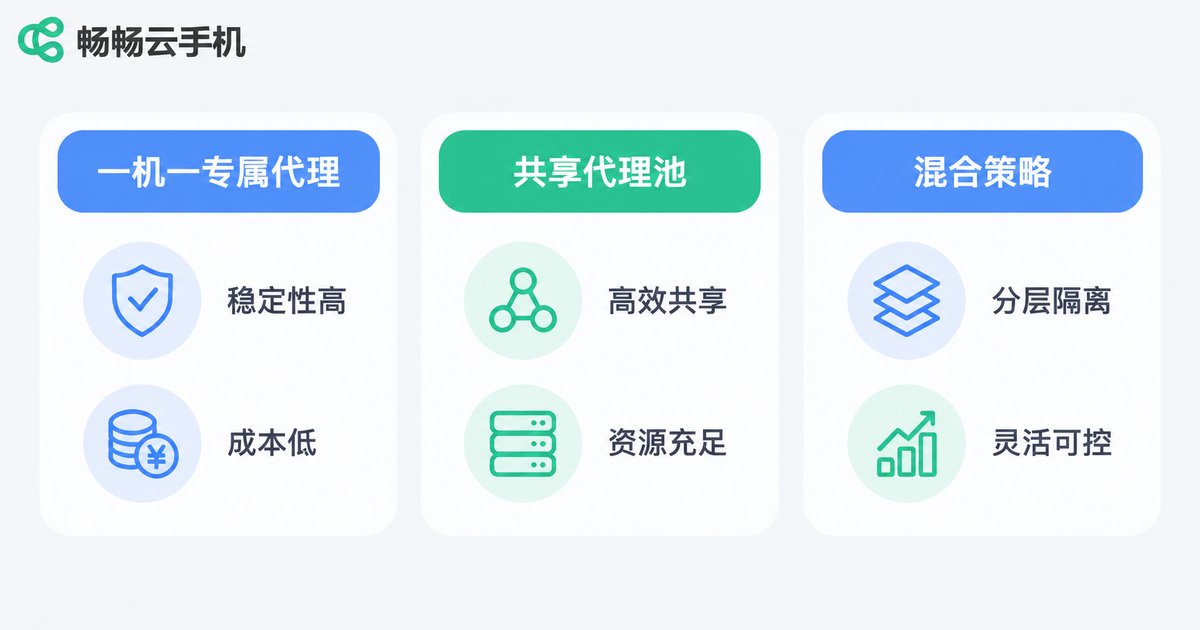
| Dimension | Dedicated proxy per phone | Shared proxy pool | Hybrid (recommended) |
|---|---|---|---|
| IP stability | High, fixed long-term | Low, changes often | Core accounts fixed, minor accounts rotating |
| Anti-association | Strong, consistent environment | Average, pool contamination risk | Strong, tiered isolation |
| Cost | Higher | Low | Allocated on demand, controllable |
| Best for | Core and key accounts | Warming, testing, low-value accounts | The entire matrix |
| Main risk | Big impact if the IP fails | Uneven IP quality, others’ behavior | Slightly higher management overhead |
As the table shows, the biggest hidden danger of a shared pool is not “changing IPs” itself but the uncontrollable purity of the pool: IPs in the pool may have been used or flagged by others, and your accounts take the blame. The weakness of a dedicated proxy per phone is cost, plus the single point of failure — if one line goes down, that device’s environment breaks.
How to Choose? Tier Your Accounts by Value
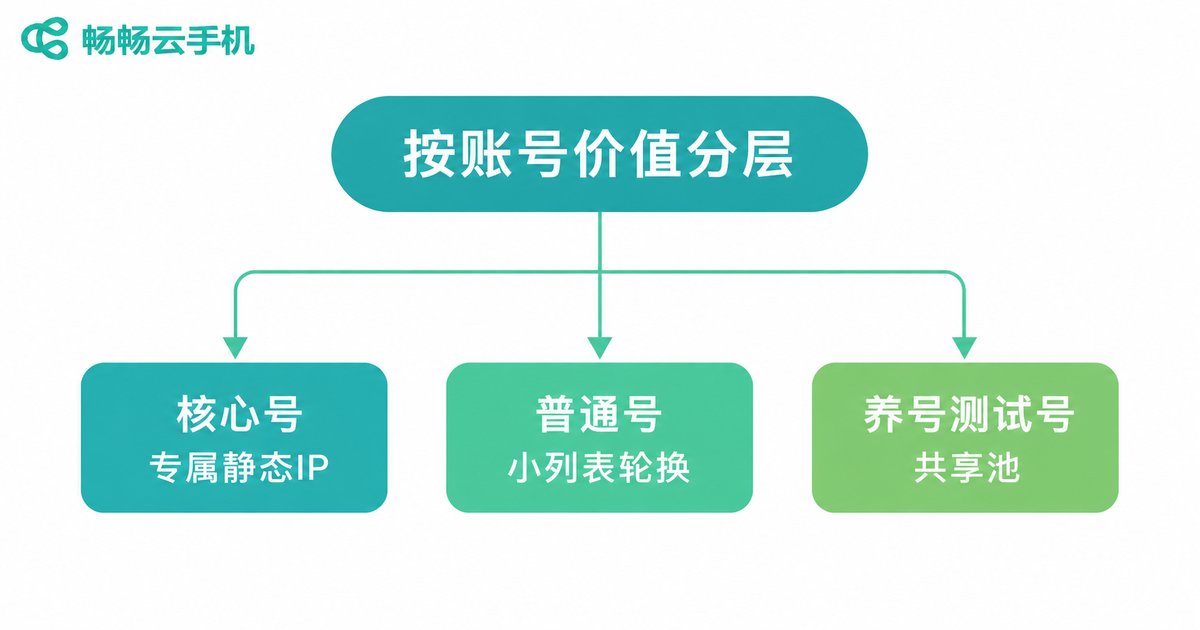
In practice, few operators pick just one. The more mature approach is a tiered combination:
Tier 1: dedicated IP for core accounts. Key accounts with real transactions or valuable followers get a fixed static residential IP, in a region consistent with the account profile, unchanged for the long term. These accounts fear environment fluctuation most — stability above all.
Tier 2: small dedicated lists for regular accounts. Bind each cloud phone to 3-5 IPs from the same city and carrier, rotating within that small range — keeping environmental consistency while spreading out cost.
Tier 3: shared pool for warming and testing accounts. Low-value, high-volume accounts can run on a shared pool to control cost, but enable session stickiness — never switch IP within one login session, to avoid the suspicious jump of “Beijing one second, Guangzhou the next.”
Four Practical Rules for Implementation
Whichever strategy you choose, follow these rules:
1. Match IP location with the account profile. If an account is registered as Shanghai-based, keep the device on Shanghai IPs long-term — do not let the login location sit a thousand kilometers away from the profile.
2. No IP changes within a session; few changes between sessions. Frequent switching is riskier than staying fixed. Rotate on a scale of days, not minutes.
3. Verify IPs before deployment. Check whether a proxy IP has been flagged by platforms and whether it is a datacenter IP; prefer residential IPs whenever possible.
4. Keep one environment intact. Once device parameters, IP, and account profile are bound together, do not casually split and recombine them. The more stable the environment, the safer the account.

Building an Isolated Multi-Instance Environment with ChangChang Cloud Phone
An IP strategy only works if every cloud phone is a genuinely independent Android environment. ChangChang Cloud Phone (ccloudphone) provides each instance with an independent cloud Android system and supports multi-instance batch management, working with proxy IPs to build a separated running environment for every device — well suited to account matrices and multi-platform operations. Combining independent device environments with a tiered IP strategy is what truly closes the loop on anti-association.
FAQ
Q: Can one cloud phone use multiple proxy IPs at the same time?
It can rotate through a list, but keep the range within one city and one carrier, and never switch within a session — otherwise the environment fluctuation itself increases association risk.
Q: Is a shared proxy pool always a bad idea?
No. For warming, testing, and low-value accounts, a shared pool is perfectly adequate. The keys are session stickiness and IP quality screening — just keep core accounts out of it.
Q: Static or dynamic IP — which prevents association better?
For core accounts, static IPs offer better environmental consistency; dynamic IPs suit scenarios that need frequent exit changes. Anti-association is about being “stable and plausible,” not “changing often.”
Q: Is IP isolation enough on its own?
No. IP is only part of the environment. Device parameters, app data, and behavior patterns must be isolated too. The cloud phone handles the device layer, the proxy handles the network layer — only with both layers in place is the setup truly stable.