Do Cloud Phone AI Agents Support Multi-Agent Collaboration? Coordination Mechanisms Explained
The Short Answer: Yes — and Cloud Phones Are the Ideal Home for Multi-Agent Collaboration
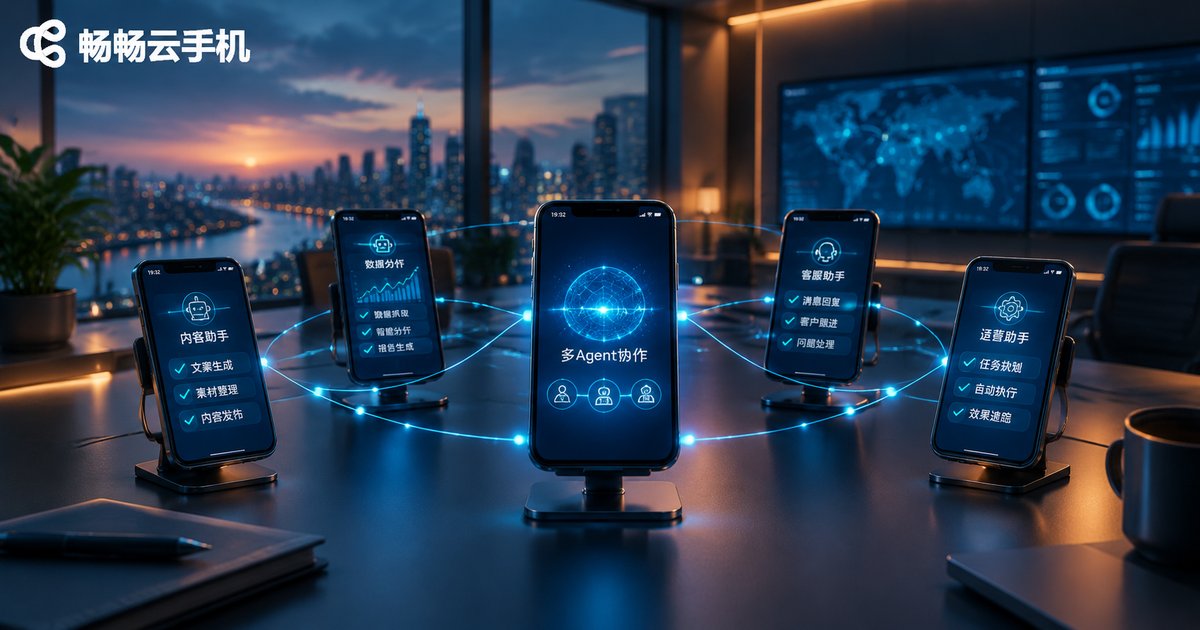
The answer is a clear yes. AI Agents on cloud phones fully support multi-agent collaboration, and the cloud phone architecture — one physical device mapped to many independent cloud instances — is a natural breeding ground for agent teamwork. A traditional phone runs a single environment, so multiple AI Agents must either take turns or fight over resources. On a cloud phone, each Agent can be bound to its own independent Android cloud instance: isolated, running in parallel, never stepping on each other's toes, and collaboration efficiency jumps to a whole new level.
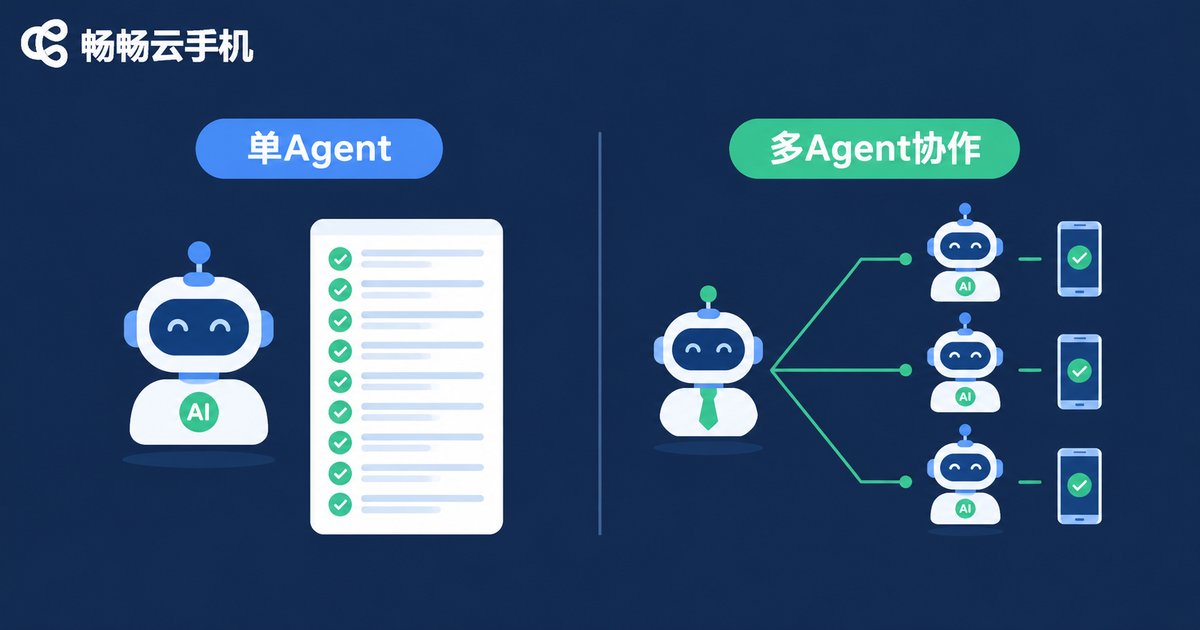
In plain terms: hand a complex job — say, managing daily tasks across 20 game accounts — to one commander Agent and several worker Agents. The commander decomposes tasks, assigns work, and reviews results, while each worker operates inside its own cloud phone instance. That is multi-agent collaboration at its most basic.
What Is Multi-Agent Collaboration? Start with the Limits of a Single Agent
A single AI Agent is like an all-around employee: it can read the screen, tap buttons, and follow workflows. But as tasks multiply and grow complex, a lone Agent runs into three walls:
Context overload: too many steps and states to track, which breeds errors. Serial inefficiency: one Agent works step by step, so jobs for 20 accounts queue up. No checks and balances: playing both athlete and referee makes self-review difficult.
Multi-agent collaboration upgrades one all-around employee into a well-structured team: someone plans, others execute, and someone verifies. Each Agent focuses on what it does best, and overall efficiency and stability actually improve.
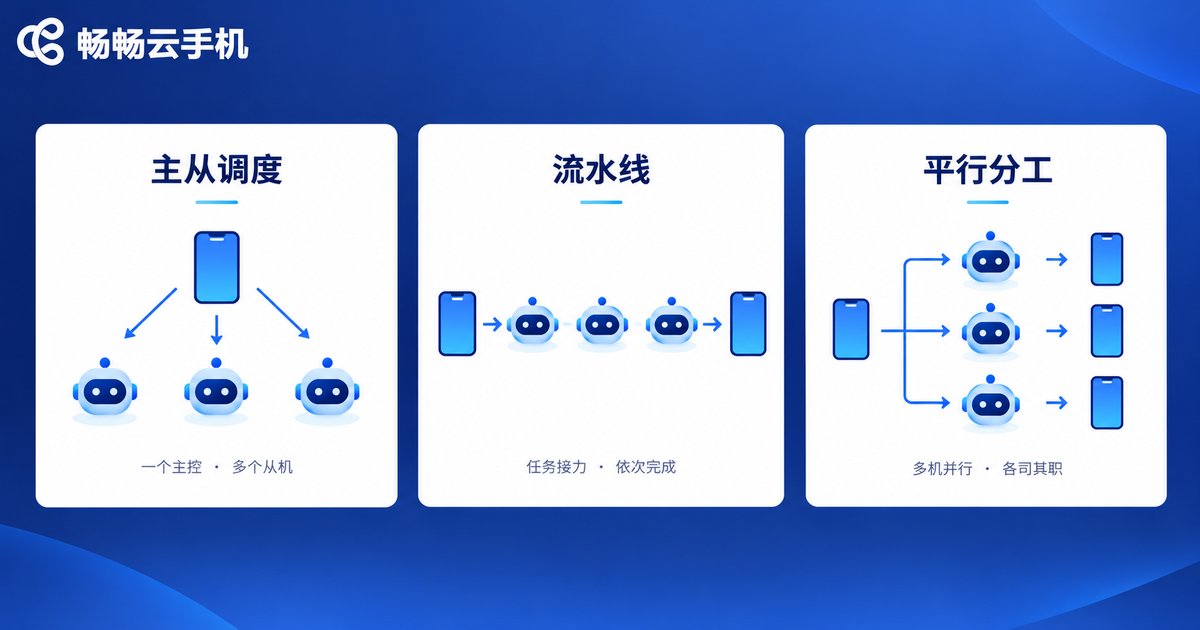
Three Common Multi-Agent Patterns on Cloud Phones
In real-world deployments, multi-agent collaboration in cloud phone scenarios is usually organized in three ways:
| Pattern | How It Works | Best For |
|---|---|---|
| Orchestrator-worker | A master Agent decomposes tasks and assigns them to worker Agents | Bulk account routines, scheduled operations |
| Pipeline | Tasks flow between Agents like an assembly line, each handling one stage | Content production, asset processing, publishing chains |
| Parallel partitioning | Multiple Agents each own a group of instances and work independently | Multi-account idle running, independent account nurturing |
No pattern is universally best: choose the orchestrator model when tasks need unified scheduling, the pipeline when workflows have many stages, and parallel partitioning when accounts are fully independent. Mature setups often blend all three.
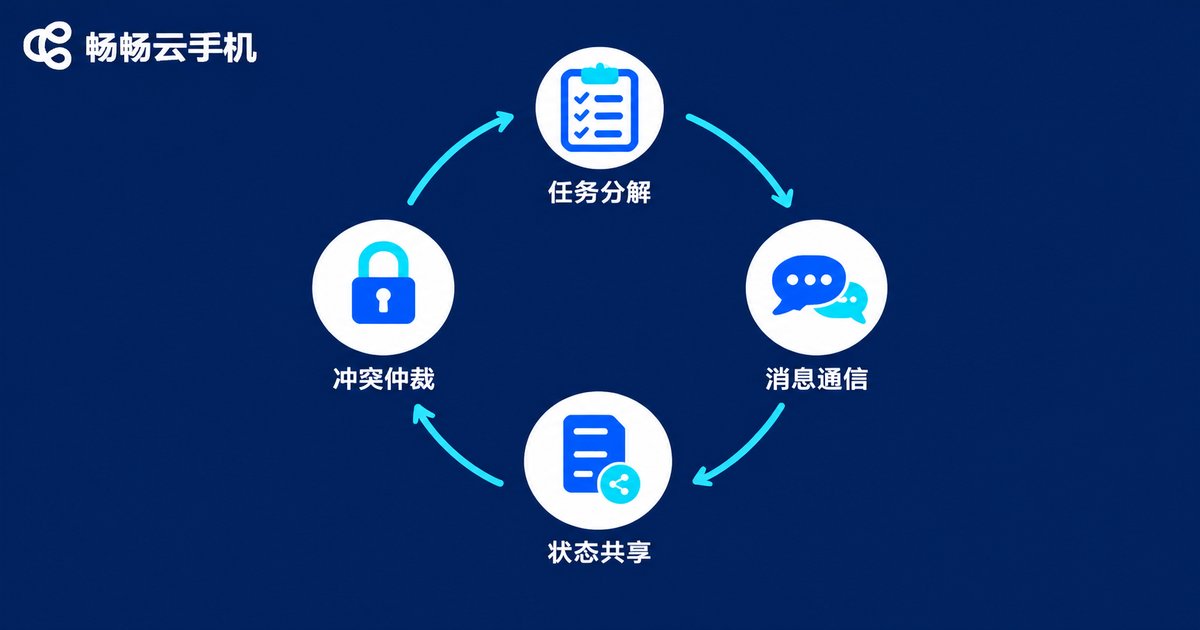
Inside the Coordination Mechanism: How Agents Talk and Work Together
Multi-agent collaboration sounds mysterious, but it boils down to four core mechanisms:
1. Task decomposition. The master Agent breaks a big goal into a prioritized checklist — for example, log in, check in, claim rewards, log out becomes four independently executable instructions that any free worker can pick up.
2. Message passing. Agents exchange tasks and results through structured messages. Who is doing what, and what is already done, is aligned via message queues to avoid duplicated work and missed steps.
3. Shared state. All Agents read and write a single task ledger: everyone's progress and which instances are idle are visible at a glance, giving the scheduler solid ground to stand on.
4. Conflict resolution. What if two Agents want the same instance at once? Instance locks and priority rules arbitrate, ensuring only one Agent operates a given instance at any moment.
These four mechanisms interlock into the operating system of multi-agent collaboration — and cloud phones provide the ready-made foundation: isolated instance environments, persistent state, and around-the-clock availability, so Agents can be woken up to work at any time.
Why Cloud Phones Are Especially Suited to Multi-Agent Collaboration
Running multi-agent collaboration on local devices versus on a cloud phone is a very different experience:
Instance isolation. Each Agent is bound to its own cloud Android instance; a problem on one instance never drags down the other Agents.
True parallelism. Cloud instances run independently in the data center, so multiple Agents can operate multiple accounts simultaneously — no more plugging in phones one by one.
Always on. Cloud instances never power off. Close your laptop and Agents still execute on schedule; timed and idle tasks keep running untouched.
Consistent, replicable environments. One configuration can be cloned across many instances, so Agents face highly consistent environments and scripts stay stable and reusable.

Build Your Multi-Agent System with ChangChang Cloud Phone
If you want to put multi-agent collaboration into production, choosing a reliable cloud phone platform is step one. ChangChang Cloud Phone (ccloudphone) provides independent Android cloud instances where apps run around the clock in the cloud and your local device can log off anytime — an excellent execution terminal for a fleet of AI Agents.
A proven setup: one master Agent decomposes, dispatches, and aggregates tasks; one worker Agent is deployed on each cloud instance to handle concrete operations; and an inspector Agent periodically checks instance health. Keep the task ledger in shared storage so every Agent reads and writes progress around it, and the whole collaboration system starts turning.
For the latest instance specs, plans, and pricing, please visit the official ChangChang Cloud Phone website — official pages always take precedence.
FAQ
Q: Does multi-agent collaboration require coding?
Not necessarily. Many automation tools now bundle orchestration features, letting you configure who does what and who takes over next with visual rules. Scripting helps with complex scheduling, but the entry barrier is low.
Q: Will multiple Agents interfere with each other or fight over resources?
Not on a cloud phone. Each Agent runs in its own isolated cloud instance with dedicated resources; as long as you lock instances so only one Agent operates an instance at a time, conflicts will not occur.
Q: Can Agent collaboration continue when my local computer is off?
Yes. Cloud phone instances run in the cloud and do not depend on your local device. As long as orchestration is deployed in the cloud or carried by cloud instances, shutting down locally changes nothing.
Q: How many Agents should collaborate?
It depends on task complexity. Simple bulk routines need one master plus a few workers; full content production, review, and publishing chains justify finer division of labor. The rule of thumb: fewer is better, and every Agent must have a clear role.