
How to Spot Common Cloud Phone Marketing Claims: Rational Buying and Requirement Matching Tips
Why Cloud Phone Ads Always Sound Right
Open an app store or a short video feed and cloud phone ads all say the same things: blazing performance, permanently free plans, and the ability to handle anything. Many people order one and find the real experience falls far short of the pitch. The problem is rarely the technology itself. It is that marketing turns 'can do it' into 'always does it', and turns 'good enough for a specific scenario' into 'strong in every scenario'.
The method below does not target any specific brand. It teaches you what to ask when you read a claim, and then how to judge whether that claim matches your real needs.
Claim 1: 'Performance Beats Flagship Phones, Unlimited Computing Power'
Cloud phone computing power comes from servers, so it may well be stronger than a three or four year old handset, but 'unlimited' does not exist. When you see this kind of wording, ask about the specification first: how many CPU cores, how much memory, which architecture, and whether the instance is dedicated or shared.
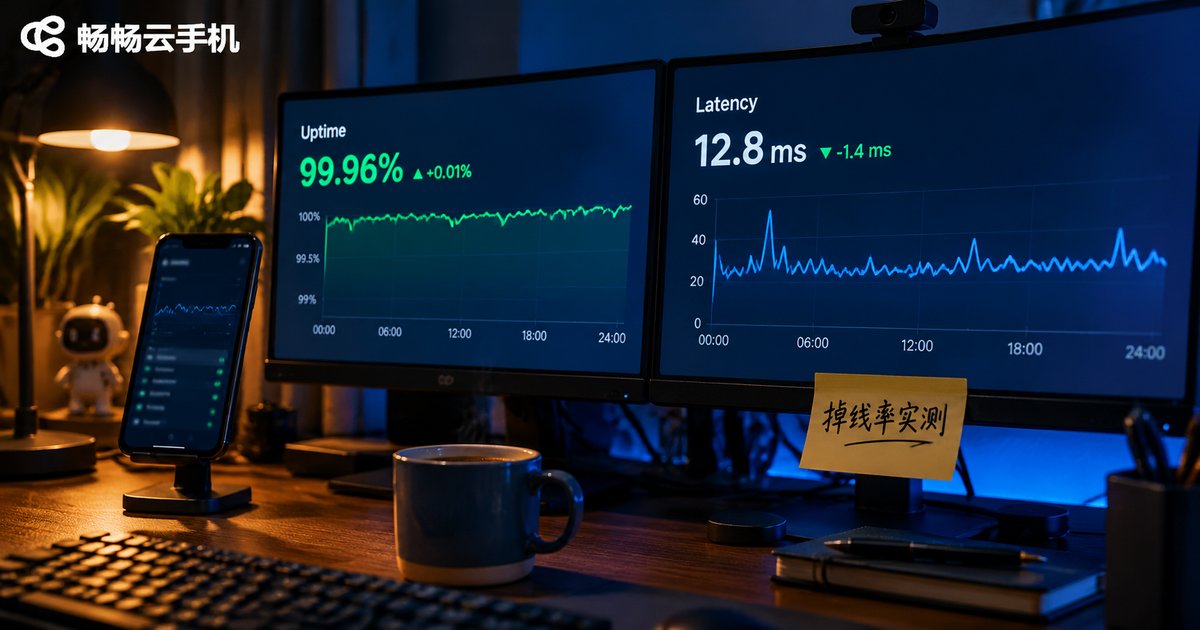
The same words 'high performance' can describe a very different experience when it means a dedicated four core instance versus a shared eight core one. In long-running, high-load scenarios such as game idle running or multiple app instances, what really decides the experience is stability and disconnect rate, not a screenshot of a benchmark score.
Ask yourself: strong under what conditions? Strong when idle, or still stable when fully loaded? Strong right after boot, or still stable after three days online?
Claim 2: 'Free Forever at Zero Cost / One Dollar for a Whole Year'
Free tiers really do exist in the cloud phone industry, but they usually carry hidden boundaries: limited hours, limited specifications, limited instance count, and limited features. A free instance may only stay online for a few hours a day, or may allow just one device, with anything beyond that billed by configuration.
The way to check is simple: scroll to the bottom of the pricing page and confirm three things. First, whether billing is hourly, daily, or monthly. Second, whether the price includes bandwidth, storage, and public network addresses. Third, how overage is charged. If any of these is vague, the long-term cost can far exceed your expectation.
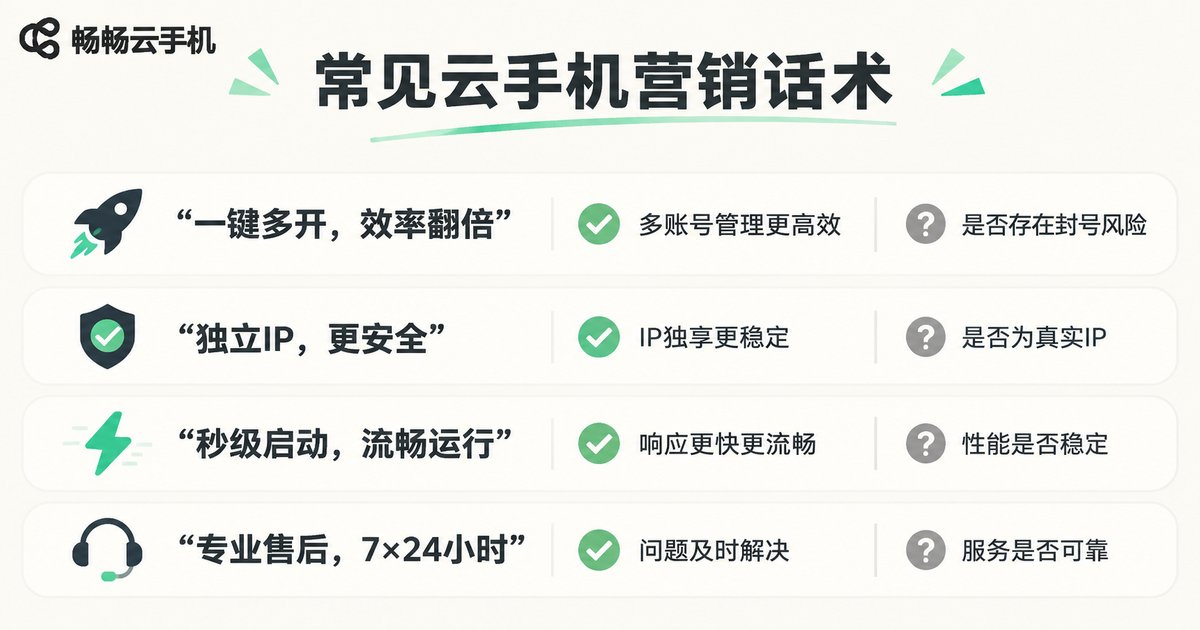
Claim 3: 'One Device Replaces Ten, All-In-One for Gaming, Office, and Streaming'
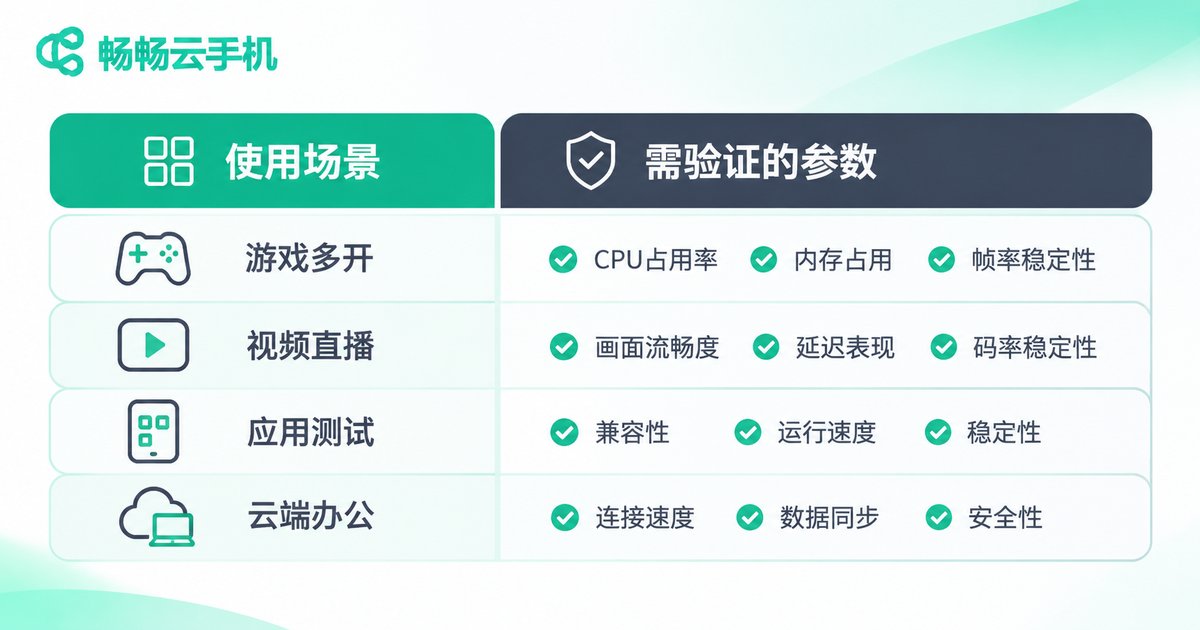
The statement is not exactly wrong. Cloud phones really do cover many scenarios, but the bottleneck is completely different in each one. Instead of being moved by the word 'all-in-one', translate your own use case into concrete parameters:
| Your scenario | Parameters you actually need to confirm |
|---|---|
| Game idle running and long uptime | Per-instance stability, reconnect behavior, background keep-alive support |
| Multiple social media accounts | Instance isolation, dedicated network environment, permission management |
| Live streaming and audio-video interaction | Latency, audio and video capture support, image quality and bandwidth usage |
| App testing and development | Available Android versions, ADB and API support, root access |
| E-commerce tools running continuously | Continuous online time, whether resources are crowded out by other instances |
After reading this table you realize that 'all-in-one' means nothing. 'Good enough for my scenario' is what actually matters.
Claim 4: 'Bank-Level Security, Data Never Leaves'
A cloud phone puts the whole device in the cloud, so data inherently leaves your local machine, which makes the phrase 'absolutely secure' worth questioning. What deserves asking instead: are instances isolated from each other, how are permissions assigned, is there an operation log, where is data stored, and what compliance qualifications does the provider hold.
If your work involves account assets such as multiple social media profiles or store operations, isolation mechanisms and permission management matter far more than the word 'secure'. An adjective is no substitute for a document you can actually read.
Requirement Matching: Write the Checklist Before Choosing a Product
Rather than being pulled along by marketing language, spend ten minutes writing a requirement checklist: purpose, how many instances, hours online per day, which Android version, whether a dedicated network environment is needed, whether ADB or API access is needed, budget ceiling, and how fast support must respond.
Once the list is done you will often find that many flashy selling points are irrelevant to you, while the parameters that genuinely affect experience are the ones ads tend to skip. That is the value of requirement matching: use your needs to filter parameters, not ads to shape your needs.
Test Instead of Trusting: A Three-Step Validation
Step one, small-scale trial. Start one instance, run your real workload, and observe it for two or three days, recording lag and disconnects.
Step two, check the extremes. Does it slow down noticeably at peak hours, how quickly does it recover after a disconnect, and do multiple instances crowd out each other's resources.
Step three, test the service. Ask a specific technical question and see whether the answer lands on parameters and steps, or just repeats the sales copy.
Only after all three pass should you discuss scale. Any decision to scale up without validation puts the risk entirely on you.
Ccloudphone: An Approach That Puts Parameters Up Front
Take ccloudphone as an example. Its product pages list instance specifications, billing methods, and applicable scenarios separately, so users can choose a configuration by actual purpose instead of relying on one vague phrase about high performance. It provides cloud-hosted Android instances that support multi-instance management, long-term online operation, ADB debugging, and API integration, which suits scenarios such as game idle running, social media operations, and app testing where devices need to stay online for long periods.
For the latest details on configurations, billing, and supported features, check the official ccloudphone website and combine it with the requirement checklist above. Confirm needs first, compare parameters second, and talk about price last — that order should not be reshuffled by any advertisement.
Frequently Asked Questions
Q: If an ad says free forever, does that mean I must avoid it?
No. A free tier is useful for validating features and completing a full workflow, but read the limits carefully and plan a paid budget for long-term business use.
Q: Is a higher specification always better?
Not necessarily. Running a simple script on a high-end configuration is a waste. The key is matching the configuration to the task while keeping long-term stability. High spec does not equal stable, but stable equals peace of mind.
Q: How do I judge whether a cloud phone is stable?
Look at continuous online time, reconnect speed, resource usage when running multiple instances, and whether peak hours bring obvious lag. A few days of trial will tell you all of this yourself.
Q: What should I watch out for with multiple accounts?
Focus on instance isolation, whether a dedicated network environment is provided, and how account permissions are assigned, so that accounts do not interfere with each other.
Q: How long should my first purchase be?
Start with a short trial, complete your full business workflow, and only then decide on long-term scale. Keep the cost of trial and error as small as possible.