Cloud Phone Exit IP and SIM Operator Mismatch: Risk Triggers and a Consistency Checklist
Why Your Exit IP and SIM Operator Must Tell the Same Story
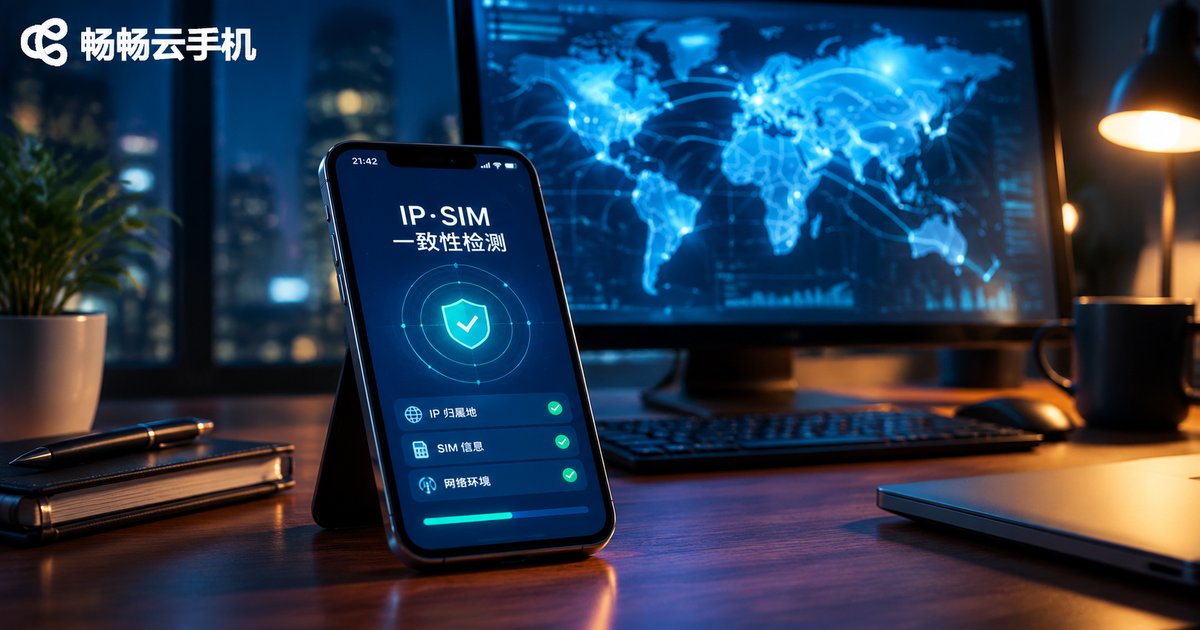
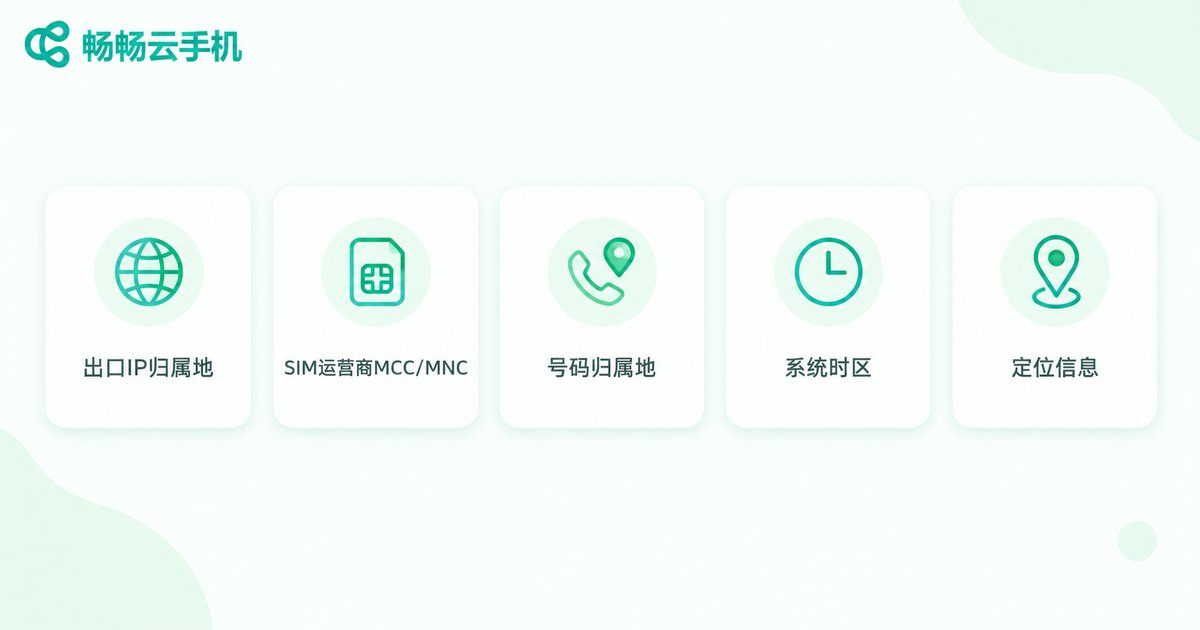
Many account operators assume that changing the IP is enough to keep an account “safe.” In reality, mainstream platforms never judge by a single signal. Their risk engines cross-check dozens of device signals at once: exit IP geolocation, IP carrier type, the SIM card's MCC/MNC country and carrier codes, phone number region, system timezone, language settings, and location data.
When every signal tells the same story — say, “a user in Hangzhou with a China Mobile SIM, connected through a Zhejiang network, on a UTC+8 device” — the system treats you as an ordinary user. But the moment signals contradict each other, for example a Los Angeles exit IP paired with a Chinese carrier SIM, suspicion rises instantly: who is really operating this device?
What Exactly Do Risk Control Systems Check?
Think of the risk engine as a meticulous visa officer comparing every line of your “travel documents”:
1. Exit IP geolocation: the country and city the IP is registered in, and the network it belongs to. Platforms can tell whether an IP comes from residential broadband, a data center, or a mobile network.
2. SIM information (MCC/MNC): the country and carrier codes stored on the SIM tell the platform directly which carrier issued the card, and in which country.
3. Phone number region: whether the country code and region of the bound number match the IP location.
4. Timezone and language: whether the device timezone matches the IP location, and whether the system language and input methods look “local.”
5. Location data: whether the coordinates returned by the app's location permission match the IP city.
What Risk Control Gets Triggered by Inconsistent Signals?
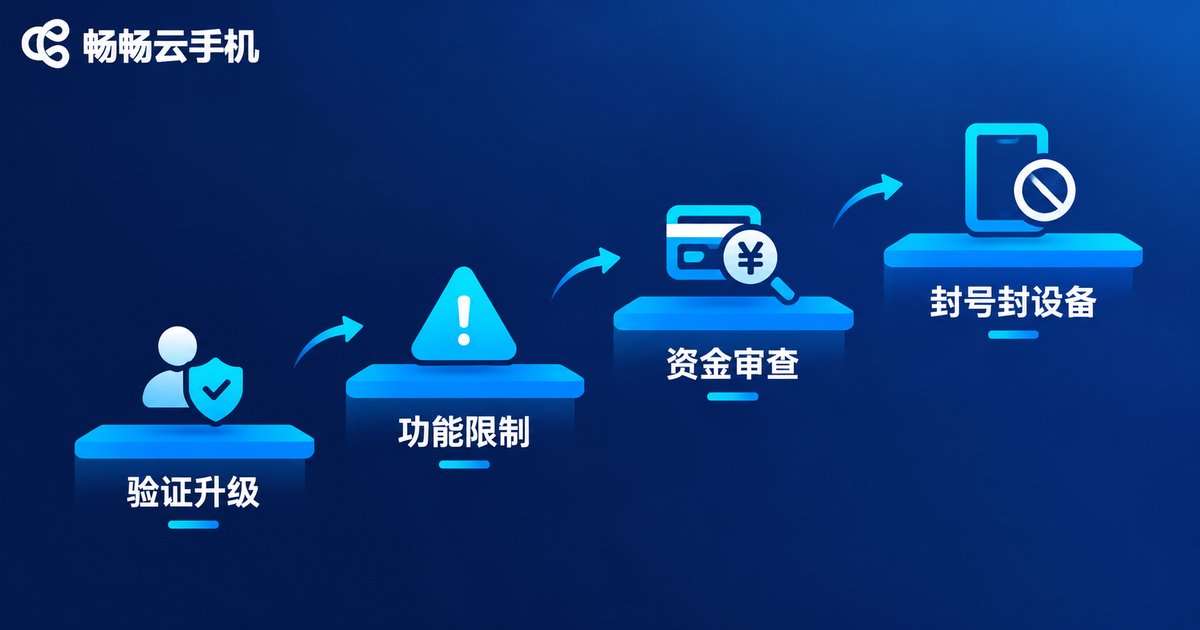
Every platform tunes its own rules, but typical reactions fall into four escalating levels:
Level 1: Verification escalation. Frequent SMS codes, face verification, or device checks at login — one prompt after another.
Level 2: Reach restrictions. Content throttling, reduced recommendation weight, and lower search ranking. The account is “alive” yet nobody sees it.
Level 3: Financial review. Frozen payments and withdrawals, ad accounts forced into re-verification, sometimes with balances temporarily held.
Level 4: Account and device bans. The environment is flagged as abnormal or bulk-registered; accounts get banned, the device fingerprint is blacklisted, and replacement accounts get linked and banned too.
Common Mismatch Scenarios at a Glance
| Scenario | How risk control sees it | Risk level |
|---|---|---|
| US exit IP with a Chinese carrier SIM | Cross-border setup, suspected remote operation | High |
| Data center IP on an account posing as a local individual | Suspected bulk registration or marketing account | Medium-high |
| IP in Guangdong, SIM registered in Heilongjiang | Could be a relocated user; explainable | Medium |
| Device timezone hours apart from IP timezone | Sign of tampered device parameters | High |
| English system language with a Chinese IP and SIM | Obvious signs of a patched-together environment | Medium |
| Multiple accounts sharing one exit IP | Account matrix linkage | High |
The pattern is clear: the more fundamental the mismatch, the higher the chance of triggering risk control. A country-level contradiction (IP country differs from SIM country) almost always draws attention, while small city-level gaps can usually be explained.
The Consistency Checklist: Tick Every Box Before Launch
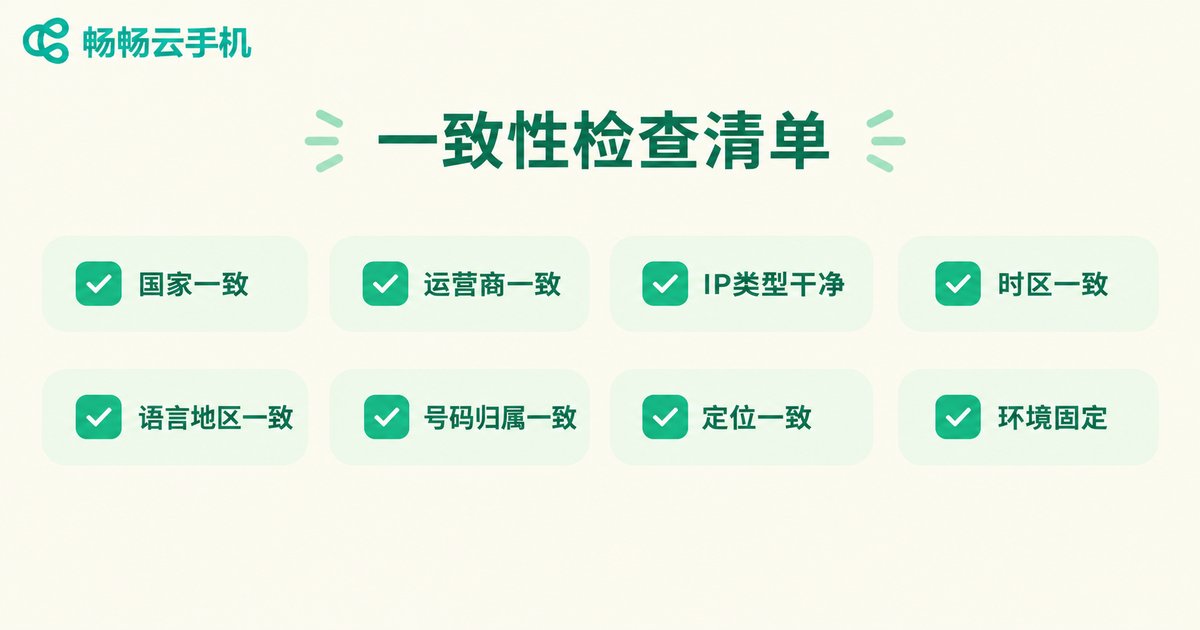
Don't wait for an account problem to start investigating. Before deploying any new cloud phone environment or onboarding a new account, run through this list:
□ 1. Country match: exit IP country = SIM country = target market.
□ 2. Carrier match: the IP's carrier matches the SIM carrier, or at least a major carrier in the same country.
□ 3. Clean IP type: prefer residential or carrier-network IPs; avoid data center ranges heavily shared by other accounts.
□ 4. Timezone match: the cloud phone's system timezone exactly matches the IP location.
□ 5. Language and region match: system language, region format, and input method fit the target market.
□ 6. Number region match: the bound phone number's region sits in the same area as the IP city.
□ 7. Location match: the app's reported location matches the IP city without wild deviations.
□ 8. Stable binding: each account stays on a fixed “IP + cloud phone instance” pair, with no frequent jumps.
□ 9. IP reputation: confirm the IP is not blacklisted and shows no traces of heavy shared use.
□ 10. Orderly changes: when switching environments, complete the full environment change first, then log in — never jump countries mid-session.
Make Consistency the Default with ccloudphone
Manually checking a dozen parameters is tedious and error-prone, which is why more and more teams manage environments with a professional cloud phone service. Using ccloudphone (畅畅云手机) as a reference, make sure any provider you choose covers these points:
1. Independent environments: every cloud phone runs as an isolated device environment, so multiple accounts never share one fingerprint.
2. Controllable networking: supports assigning each cloud phone an independent, fixed exit IP that can be matched with SIM information, reducing mismatch at the source.
3. Long-term stability: cloud phones keep running around the clock, so environment parameters do not drift after reboots.
4. Batch management: bulk operations and unified templates let studios group devices by market, with one consistency profile per group.
Lock consistency into your tooling, and your team only needs a final spot check before launching an account — both efficiency and safety improve noticeably.
FAQ
Q: Will an IP and SIM carrier mismatch definitely get my account banned?
Not necessarily. A mismatch only raises your risk score; whether penalties trigger depends on the platform's rules, the account's history, and the degree of mismatch. But running with a known defect long term lets risk keep accumulating.
Q: Running overseas accounts on a cloud phone — how should I pick the IP?
The core rule is to make the whole environment tell one story: choose a local IP in the target market, then align SIM information, timezone, language, and number region with it. Never change only the IP while leaving everything else untouched.
Q: After changing the IP, how long should the account rest?
Observe for a few days with low-risk actions such as browsing and liking before resuming posting or transactions. The smoother the transition, the smaller the risk response.
Q: Can one cloud phone host multiple accounts?
Yes, but limit the number and keep the environment stable. The more accounts on one environment, the bigger the blast radius when something goes wrong. Keep key accounts one per device or in small groups.