
How to Build a Cloud Phone Group Control System: Control Plane and Data Plane Separation Explained
What Exactly Is a Cloud Phone Group Control System
In plain terms, a cloud phone group control system is a single software platform that commands dozens, hundreds or even thousands of Android phones running in the cloud, making them perform batch app installs, synchronized taps and swipes, scheduled scripts and bulk configuration changes. Typical use cases include multi-account mobile gaming, app matrix operations, automated testing and bulk content distribution.
Unlike traditional fleet control setups that rely on physical phones and USB hubs, cloud phones run in virtualized Android environments in data centers. Scaling simply means launching more instances, and every management action happens online — a key reason for the technology's rapid adoption.
Why Separate the Control Plane from the Data Plane
Many first-time builders cram command delivery and video streaming into the same service process. When dozens of phones stream their screens back simultaneously, bandwidth saturates, commands stall and packets drop — the whole fleet freezes together. That is the classic symptom of not separating the control plane from the data plane.
Once separated, each side scales independently: the control plane is tuned for low latency and high reliability, while the data plane is tuned for high throughput and high concurrency. A failure on one side no longer cascades into the other, and troubleshooting boundaries become much clearer. This is the standard architecture behind every mature fleet control platform.
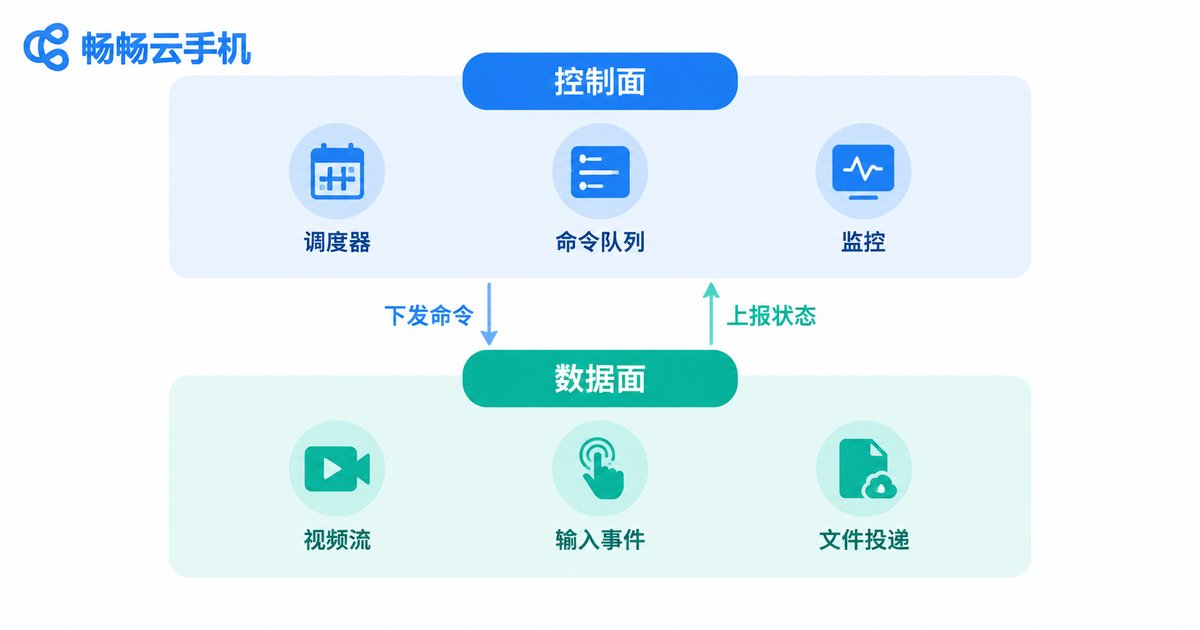
The Control Plane: the Brain of the System
The control plane handles all decision-making and scheduling. Its five core components:
1. Device registry: every cloud phone checks in here when it comes online, reporting model, OS version and status to form a real-time device table.
2. Task scheduler: accepts batch jobs (for example, install one app on 500 phones), breaks them into per-device commands and dispatches them by priority.
3. Command queue: a message queue buffers surges so a burst of tasks cannot overwhelm downstream devices.
4. Heartbeat and monitoring: devices report heartbeats periodically; dropouts are flagged automatically and trigger reconnection or replacement.
5. API gateway and admin console: a visual interface for operators and programmatic APIs for automation.
A typical batch task command looks like this:
{ 'task': 'install_app', 'target': 'all', 'stagger_ms': 500 }The Data Plane: the Hands That Do the Work
The data plane carries all heavy traffic over three independent channels:
Video stream channel: each phone's screen is encoded in real time as H.264/H.265 (or delivered via WebRTC) to viewers. It consumes the most bandwidth and requires a dedicated streaming gateway.
Input event channel: taps, swipes and keystrokes are relayed back to the right instance with minimal latency, usually over persistent WebSocket connections.
File distribution channel: APK packages, images and config files are pushed in bulk through object storage plus CDN, keeping them off the command bandwidth.
Five Steps to a Minimum Viable Fleet Control Platform
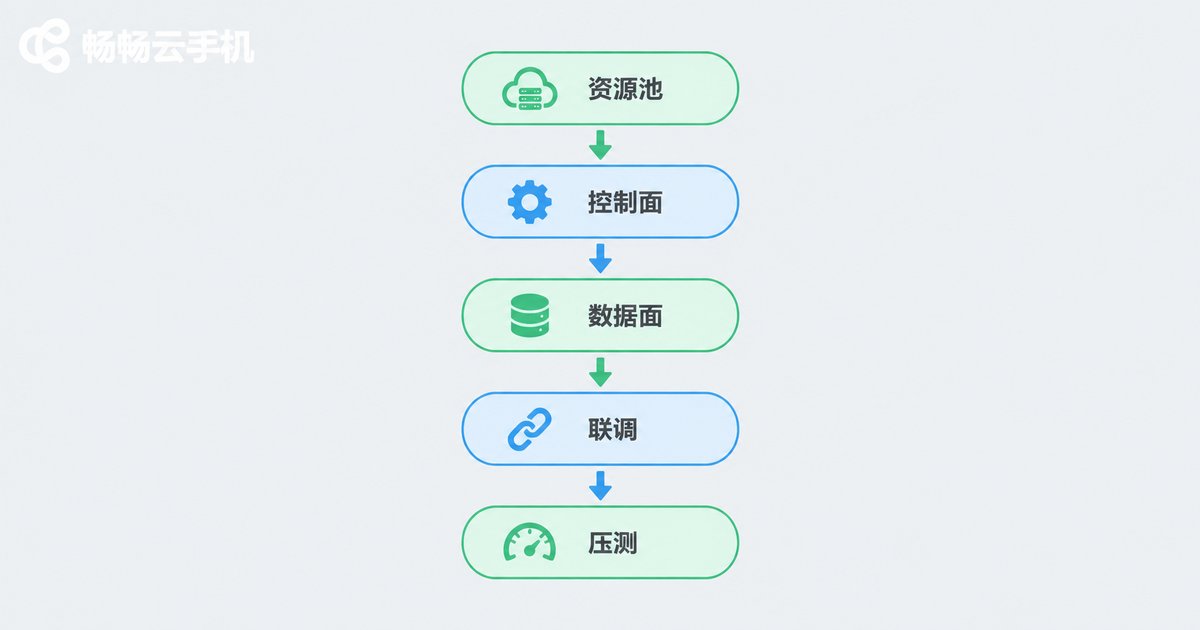
Step 1: Prepare the cloud phone pool. Either build virtualized Android environments on your own servers, or plug into a ready-made service such as CCloudPhone (ccloudphone) to skip the low-level virtualization work.
Step 2: Deploy the control plane. One scheduler server, one message queue and a simple web console are enough to run device registration and task dispatch.
Step 3: Deploy the data plane. Stand up a dedicated streaming gateway for transcoding and distribution, and run input events over a separate long-connection service.
Step 4: Close the command loop. Verify the full dispatch–execute–acknowledge chain so every command returns a clear execution result.
Step 5: Load-test small, then scale. Start with 10 devices, watch latency and dropout rates, then grow to hundreds and thousands.
Key Metrics and Common Pitfalls
| Metric | Target | Notes |
|---|---|---|
| Command delivery latency | Under 100 ms | Higher values cause visible desynchronization |
| End-to-end video latency | Under 300 ms | Affects manual inspection and live intervention |
| Concurrent streams per gateway | 200 to 500 | Depends on bandwidth and transcoding capacity |
| Reconnection time | Under 3 seconds | Shorter is better for task continuity |
Frequent pitfalls: missing heartbeats that leave zombie devices in the queue, unthrottled broadcast commands causing storms, video and commands sharing the same bandwidth, and full-volume rollouts without canary testing. Design around all four from day one.
Skip the Build: Start Directly with CCloudPhone
Building the full stack demands virtualization, streaming media and distributed scheduling expertise — a tall order for small teams. CCloudPhone (ccloudphone) offers ready-made cloud Android devices with batch management built in, with the underlying architecture already optimized around control plane and data plane separation. Sign up, launch devices in bulk and start fleet operations, focusing your energy on scripts and strategy instead of infrastructure. See the official website for plan and feature details.
FAQ
Q: For small deployments, must the control plane and data plane be physically separated?
Under roughly 50 devices you can co-deploy them to save cost, but keep the code organized as two modules so you can split them smoothly later.
Q: How many cloud phones can one server handle for fleet control?
It mainly depends on gateway bandwidth and transcoding performance; an entry-level server typically sustains 100 to 200 streams, beyond which you need a gateway cluster.
Q: Is building my own system cheaper than using CCloudPhone?
With a dedicated ops team and a long-term thousand-device scale, self-building can be evaluated; most studios and small teams are better served by a ready platform like CCloudPhone, avoiding server and ops costs and going live faster.
Q: Do batch tasks all execute at the same instant?
Mature schedulers support staggered, batched dispatch with randomized delays to prevent concurrency spikes from overwhelming the system.


