
Can You Use a Free Cloud Phone? Feature Limits, Usage Time & Best Use Cases
Can You Actually Use a Free Cloud Phone?
The short answer is yes—but it depends on what you need. Nearly every cloud phone provider offers a free tier or free trial so users can test the service before committing. A free cloud phone is essentially a virtual Android device running on remote servers: you can install apps, log into accounts, and keep tasks running just like on a physical phone, while all data lives in the cloud instead of taking up local storage.
That said, free plans almost always scale back on device specs, online hours, and feature access. Whether the free tier is enough depends entirely on your use case. Here is a detailed breakdown.
Common Feature Limitations of Free Plans
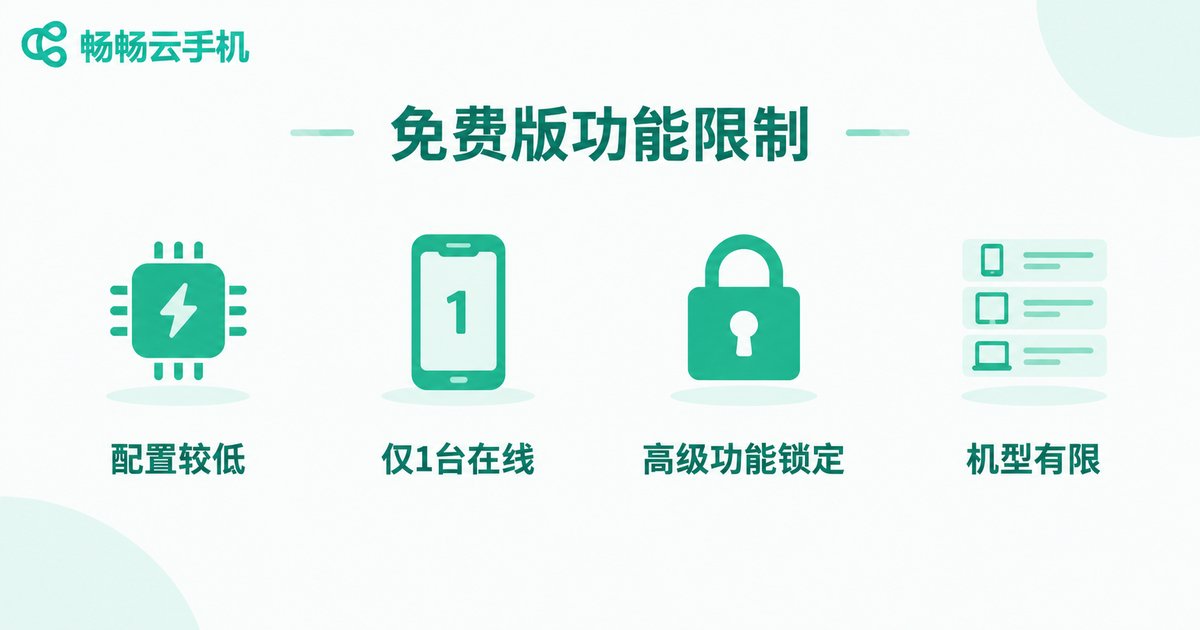
Most providers restrict free cloud phones in these areas:
- Lower device specifications: free instances usually get less CPU and RAM, so demanding games drop frames and graphics settings must stay low.
- One concurrent device: free plans generally allow only a single cloud phone at a time, with no multi-instance support.
- Locked advanced features: batch control, multi-instance management, ROOT access, and virtual location are typically reserved for paying users.
- Limited model choice: free users are usually assigned a standard configuration and cannot pick high-performance devices.
| Feature | Free Plan | Paid Plan |
|---|---|---|
| Device specs | Basic, fine for light apps | High-performance, smooth for large games |
| Concurrent devices | Usually one | Multiple instances |
| Online time | Daily caps or task-based credits | Online around the clock |
| Batch control / multi-instance | Not available | Supported |
| Data retention | Short retention after going offline | Long-term retention |
Usage Time: The Biggest Constraint of All
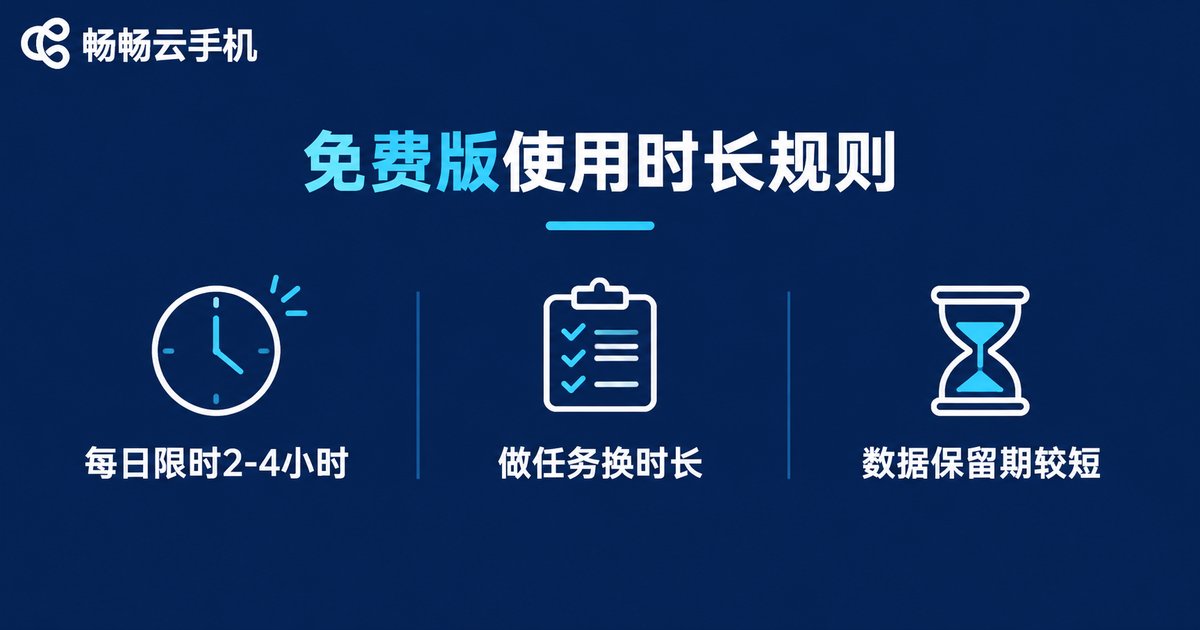
Compared with feature limits, online hours are the most practical constraint on free plans. Three rules are common:
First, daily time caps: you may get only two to four hours per day before the device goes offline automatically. Second, task-based credits: extra hours are earned through daily check-ins and simple tasks. Third, pay-as-you-go top-ups: once the free quota runs out, you buy extra hours or days.
Keep in mind that after a free device goes offline, cloud data is usually retained for a limited period—often shorter than paid plans. If your task is halfway through when the device disconnects, progress can be interrupted. For anyone who needs round-the-clock, always-on operation, the free tier time quota will almost certainly fall short.
Scenarios Where the Free Tier Is Genuinely Enough
A free cloud phone is not useless. It fits these situations well:
- First-time trial: if you simply want to understand what a cloud phone feels like and whether the workflow suits you, the free tier is enough.
- Light app testing: developers and regular users can verify app compatibility or account environments in short sessions.
- Occasional low-frequency tasks: check-in style, low-consumption tasks that only need brief daily sessions.
- Budget-conscious users: if you occasionally need a second device for a secondary account, the free tier costs nothing.
When Is It Worth Upgrading to a Paid Plan?
Upgrading makes sense if any of the following applies to you:
- Heavy game automation: long daily sessions running in-game tasks demand stability and smooth performance.
- Multi-account operation: running several cloud phones simultaneously for matrix or batch management.
- Data safety concerns: you want cloud data retained long term without worrying about device recycling.
When choosing a paid provider, prioritize stability and support. For example, ccloudphone focuses on stable, responsive cloud Android devices with multi-instance management and long-duration operation. New users can try it for free first and pick a plan based on actual needs—check the official site for current offerings.
FAQ
Q: Is a free cloud phone safe for my accounts?
Reputable providers isolate cloud data per user, so the risk is low. Still, avoid keeping payment-related accounts on a free instance long term, and enable two-factor authentication for important accounts.
Q: Will I lose my data on the free tier?
Cloud data usually survives for a short period after the device goes offline, but the retention window is shorter than paid plans. Back up important data regularly, or upgrade for longer retention.
Q: Can I play large games on a free cloud phone?
You can install them, but free instances usually lack the horsepower, so expect stuttering and lower frame rates. For gaming, a high-spec paid device is the better choice.
Q: How big is the gap between free and paid plans?
The difference lies in specs, online hours, instance counts, and advanced features. Light users are fine on the free tier; heavy users get far better value from a paid plan.