
What Is a Cloud Phone Edge Computing Solution? The Impact of ARM Server Costs
What Is a Cloud Phone Edge Computing Solution?
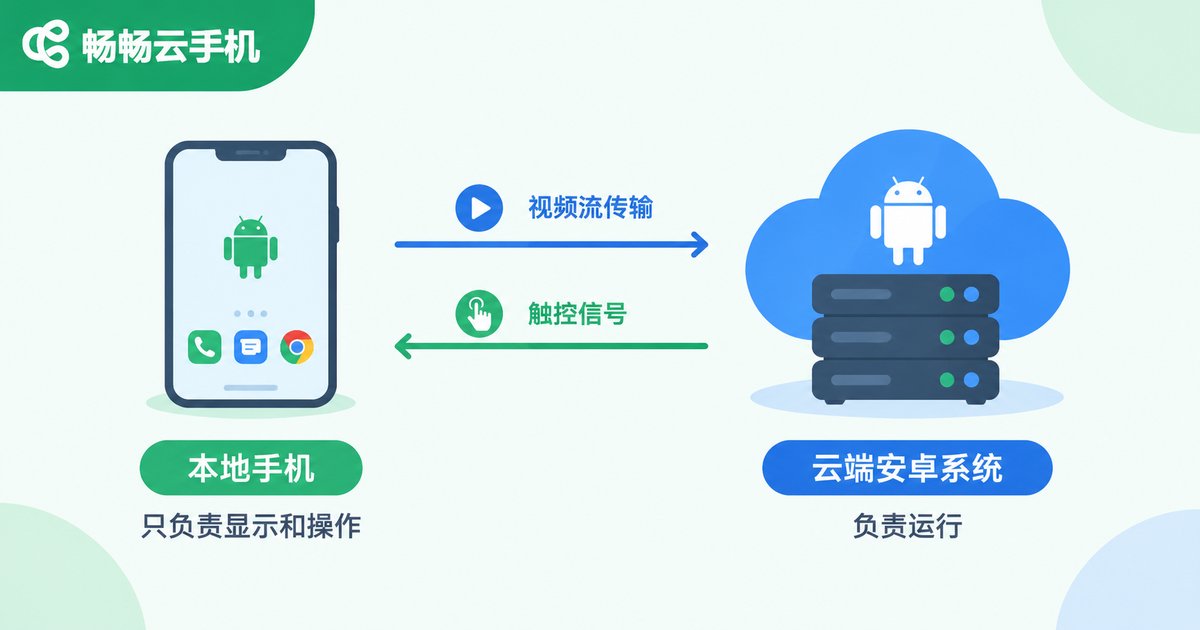
In simple terms, a cloud phone runs the Android system on servers in the cloud, and your phone or computer is just a screen. An edge computing solution means distributing those cloud servers from a few large central data centers to edge nodes closer to users—for example, local data centers in individual cities.
This way, when you operate a cloud phone, commands and data are processed nearby instead of traveling across the country. Just like the convenience store downstairs is handier than the big supermarket downtown, the shorter the distance, the lower the latency, and the smoother the experience.
The Three-Layer Architecture of an Edge Solution
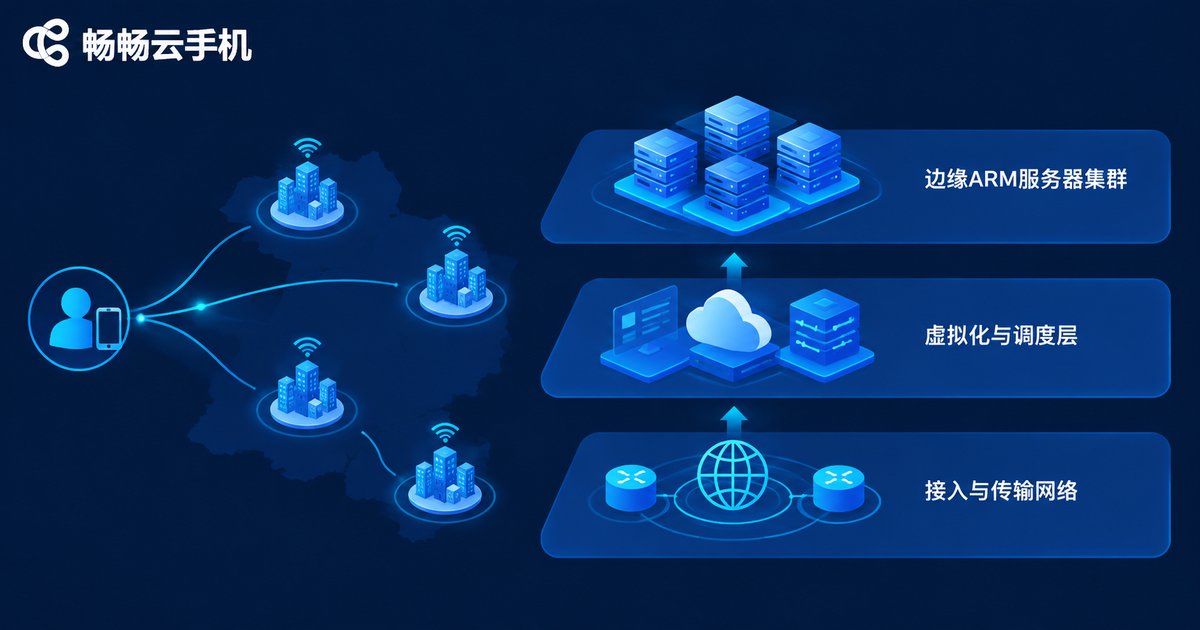
A complete edge computing cloud phone solution usually consists of three layers:
Layer 1: Edge ARM server clusters. The physical carrier of computing power, deployed in edge data centers across regions, with each server running multiple Android instances at the same time.
Layer 2: Virtualization and scheduling layer. It splits one physical server into dozens of independent cloud phone instances and routes each request to the most suitable node based on user location and node load.
Layer 3: Access and transport network. Users connect through a client to the nearest edge node, and video and data travel within the local network, so lag is naturally reduced.
Monthly cost per instance ≈ (server price ÷ depreciation months + rack power + bandwidth rental) ÷ instances per serverThis formula is the foundation for understanding cloud phone economics: the larger the denominator (instances per server) and the smaller the numerator (total cost), the lower the cost of each instance. As you will see, ARM servers are the key to optimizing both ends at once.
Why Do Edge Nodes Prefer ARM Servers?
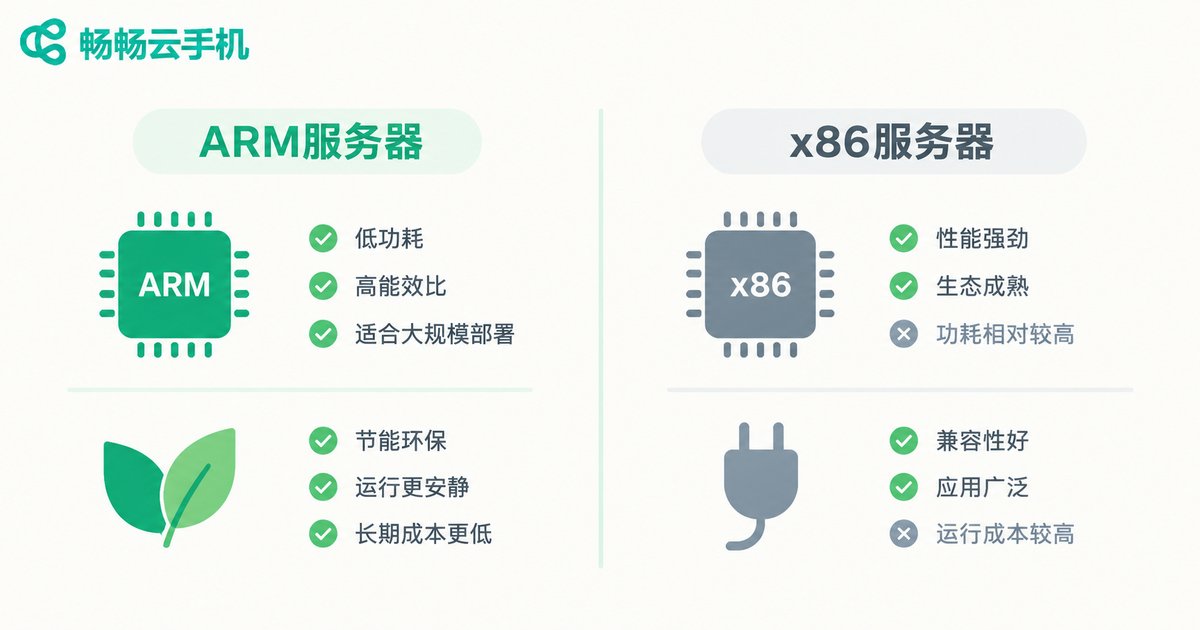
Traditional data centers are dominated by x86 servers, but for cloud phone workloads ARM servers are becoming the mainstream choice, for three reasons:
1. Native architecture match. Mobile apps are designed for ARM chips in the first place. Running Android instances on ARM servers requires no instruction translation, so compatibility and stability are naturally better, while x86 servers need a translation layer that costs performance and creates compatibility issues.
2. Higher energy efficiency. ARM chips consume less power, so within the same electricity budget an ARM server often hosts more instances. Edge data centers run 24/7, electricity is a major expense, and energy efficiency directly determines operating cost.
3. Lower cost per instance. ARM servers are generally cheaper than comparable x86 servers, making the hardware cost per cloud phone instance easier to control.
| Dimension | ARM Server | x86 Server |
|---|---|---|
| Android compatibility | Native ARM, no translation | Needs translation, with overhead |
| Power and electricity | Low power, high efficiency | Higher power, higher bills |
| Hardware cost per instance | Lower | Higher |
| Ecosystem fit | Maturing fast for cloud phones | Oriented to traditional enterprise apps |
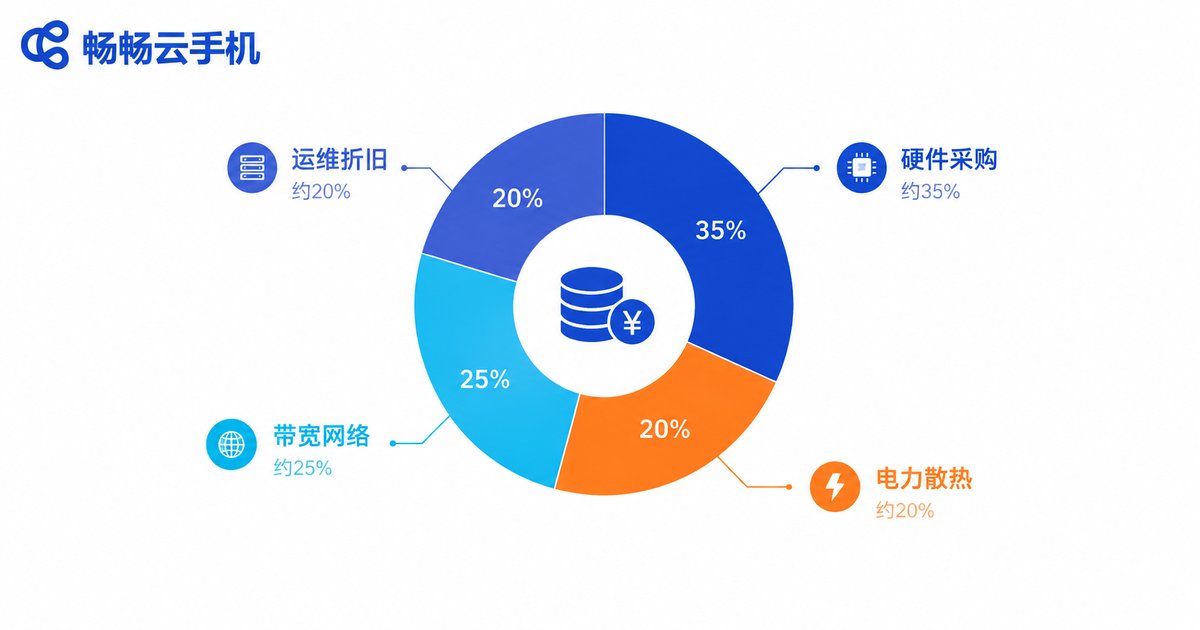
ARM Server Cost Breakdown: Where Does the Money Go?
To evaluate the economics of an edge solution, break the costs apart:
Hardware procurement (about 40%-50%). ARM SoCs, high-capacity memory, fast storage, and network cards. Chips and memory take the largest share, and bigger purchase volumes mean lower unit prices.
Power and cooling (about 20%-30%). Edge data centers are small and scattered, so per-kWh prices and cooling efficiency are often worse than in large central sites—this part is the easiest to underestimate.
Bandwidth and networking (about 15%-25%). Cloud phones stream real-time video and consume heavy bandwidth. One of the biggest values of edge deployment is turning long-distance transport into local transport, significantly reducing bandwidth unit prices.
Operations and depreciation (about 10%-15%). Data center hosting fees, equipment depreciation, and remote operations staff. The more scattered the nodes, the more complex the operations, so automated tooling is needed to spread out the cost.
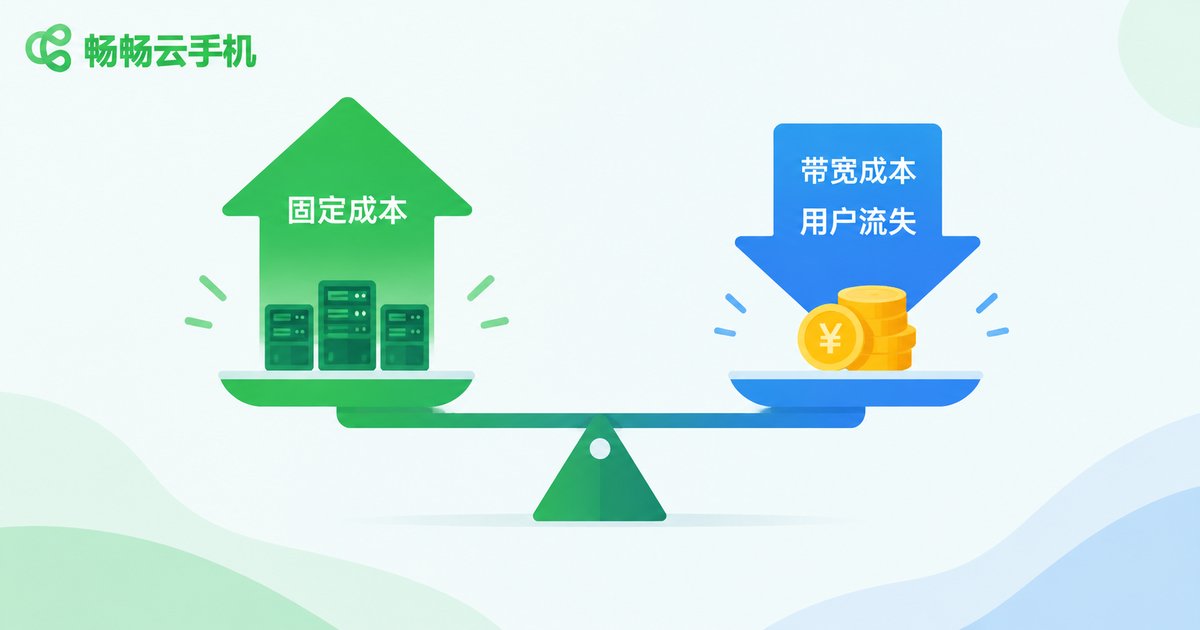
How Does Edge Deployment Affect Overall Costs?
The cost impact of an edge solution can be summarized as one rise and one fall:
What goes up: more nodes mean more rack rentals, more backup hardware, and a more complex operations system, with fixed costs spread across more sites.
What goes down: bandwidth costs drop noticeably (local transport is cheaper); churn drops (a better experience keeps users longer); and each node can scale on demand, avoiding heavy one-time capital spending.
Overall, as long as instance density per node is high and scheduling is smart, the total cost of ownership of an edge solution is usually better than a purely centralized one, especially for latency-sensitive scenarios like gaming and live streaming.
Three Key Strategies for Cost Optimization
Strategy 1: Raise instance density per server. Choose ARM servers with more cores and larger memory so one machine hosts more instances, directly diluting hardware and electricity costs.
Strategy 2: Schedule dynamically to smooth peaks and valleys. Favor interactive users during the day and concentrate idle-running and multi-instance workloads at night, keeping every server highly utilized around the clock.
Strategy 3: Pick the right regions. Build edge nodes first in cities with concentrated users, friendly bandwidth prices, and reasonable power costs, instead of expanding blindly.
CCloudPhone: Edge Computing as an Out-of-the-Box Service
For individual users and small teams, building your own edge cluster is too demanding—server procurement, data center hosting, and operations monitoring are all specialized jobs. The smarter move is to use a cloud phone service whose edge network is already built.
CCloudPhone (ccloudphone) is built on an ARM-based cloud Android environment and delivers a smooth, stable cloud phone experience, supporting common scenarios such as running multiple apps and long-hour idle running. You never need to think about how the ARM servers and edge nodes behind it are deployed—just pick a suitable plan on the official website ccloudphone and it works out of the box, leaving the complex economics of computing to the professional team.
Whether it is multi-instance gaming, app testing, or automated operations, CCloudPhone lets you enjoy the low-latency benefits of edge computing at a lower cost of use.
FAQ
Q: How is an edge computing cloud phone different from a regular cloud phone?
A: The main difference is where servers are located. Edge solutions place servers in city nodes close to users, so latency is lower and controls feel more responsive—ideal for gaming and other real-time scenarios. Regular cloud phones concentrate in a few central data centers, with wide coverage but relatively higher latency.
Q: Why do cloud phones use ARM servers instead of x86?
A: Android apps are natively built for the ARM architecture. ARM servers run Android instances without instruction translation, offering better compatibility, lower power draw, and lower cost per instance—clearly better overall efficiency than x86.
Q: Are ARM servers expensive? Will the cost be passed on to users?
A: ARM servers usually cost less than comparable x86 servers, and low power consumption saves on electricity, so the cost per instance is actually more favorable. At scale, users get stable service at lower prices.
Q: Do individual users need to build their own edge cluster?
A: Generally no. Self-building involves heavy fixed investments in hardware, hosting, and operations. Individuals and small teams can simply use a mature service like CCloudPhone for lower costs and faster setup.
Q: Do edge nodes compromise data security?
A: Reputable cloud phone services isolate and encrypt data in storage and transit. Edge nodes only change the physical location of servers; the security mechanisms remain the same as in central data centers. Choosing a provider with a complete security system like CCloudPhone is enough for peace of mind.