

Cloud Phone Automated Marketing: Which Behaviors Cross Platform Anti-Fraud Red Lines — Risk Boundaries Explained
Why Automated Marketing Gets Flagged by Platform Risk Control
Using cloud phones for automated marketing essentially means letting programs handle follows, likes, comments, mass messaging, and content publishing on your behalf. Efficiency goes up, but platform anti-fraud systems keep upgrading too. Today, the risk-control systems of major content and e-commerce platforms can judge whether a real human is behind an account by analyzing device environment, behavior patterns, content quality, and operation frequency. Once flagged as bot behavior, consequences range from reduced reach and demotion to a permanent ban. So before chasing efficiency, understanding where the red lines are is the real first lesson of automated marketing.
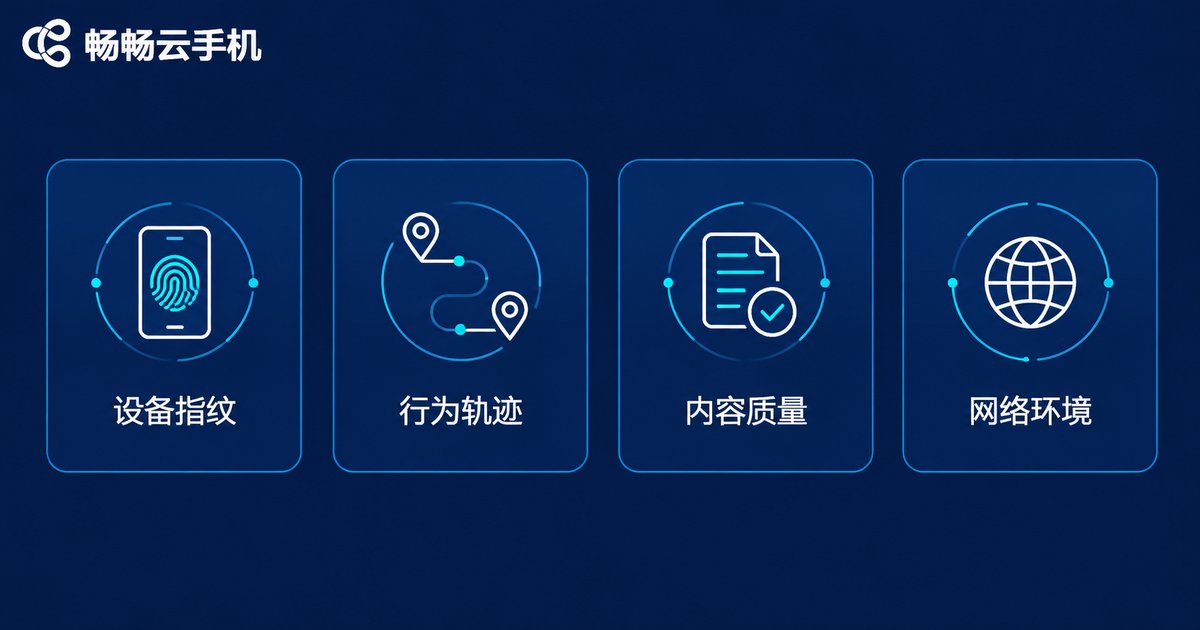
What Platform Risk-Control Systems Actually Watch
Many operators assume switching devices is enough to evade detection, but modern anti-fraud systems examine far more dimensions than expected:
| Dimension | What Platforms Check | Common Mistakes |
|---|---|---|
| Device fingerprint | Whether device parameters look real; whether many accounts share one environment | Running dozens of accounts on one modified device |
| Behavior pattern | Whether intervals look human; whether actions follow a fixed rhythm | Performing identical actions every 30 seconds around the clock |
| Content quality | Whether content is original or mass-duplicated | Blasting the same copy and images from many accounts |
| Network environment | Whether network signals look abnormal or jump frequently | Accounts hopping between nodes in different cities |
Once you understand this table, the key insight becomes clear: risk control does not judge whether you use tools, but whether your behavior looks like a normal user.
Four Red Lines You Should Never Cross
Red line 1: Mass-registering account farms. Registering large numbers of new accounts from the same environment in a short time is the number one target of every risk-control system. New accounts carry low trust, so bulk registration almost always triggers verification or instant bans.
Red line 2: Mechanical high-frequency actions. Following, liking, and commenting at fixed intervals, in a fixed order, non-stop all day, creates a behavior pattern so regular that it tells the platform you are a bot.
Red line 3: Duplicate and recycled content. Publishing the same copy and the same images across dozens of accounts is treated as bulk spam distribution, and your main account can be penalized by association.
Red line 4: Fake engagement and inflated metrics. Buying followers, likes, views, or mutual-engagement rings can now be precisely identified as data anomalies. Once the platform purges fake data, all previous investment goes to zero.
Gray Areas: Handle With Extra Care
Beyond the clear red lines, some behaviors sit in a gray zone where moderation is everything:
Scheduled mass DMs: Sending identical messages in bulk to non-followers is easily flagged as harassment. Limit the volume and vary the copy.
Fast follow-then-unfollow: This growth trick is closely monitored on many platforms; slightly excessive frequency leads to reach throttling.
Synchronized multi-account posting: Posting on the same theme across a matrix is fine, but stagger the timing, rewrite the copy, and swap the assets. Perfect synchronization exposes the whole network.
Frequent account switching: Logging in and out of many accounts on one device environment within a short window looks like an account farm.
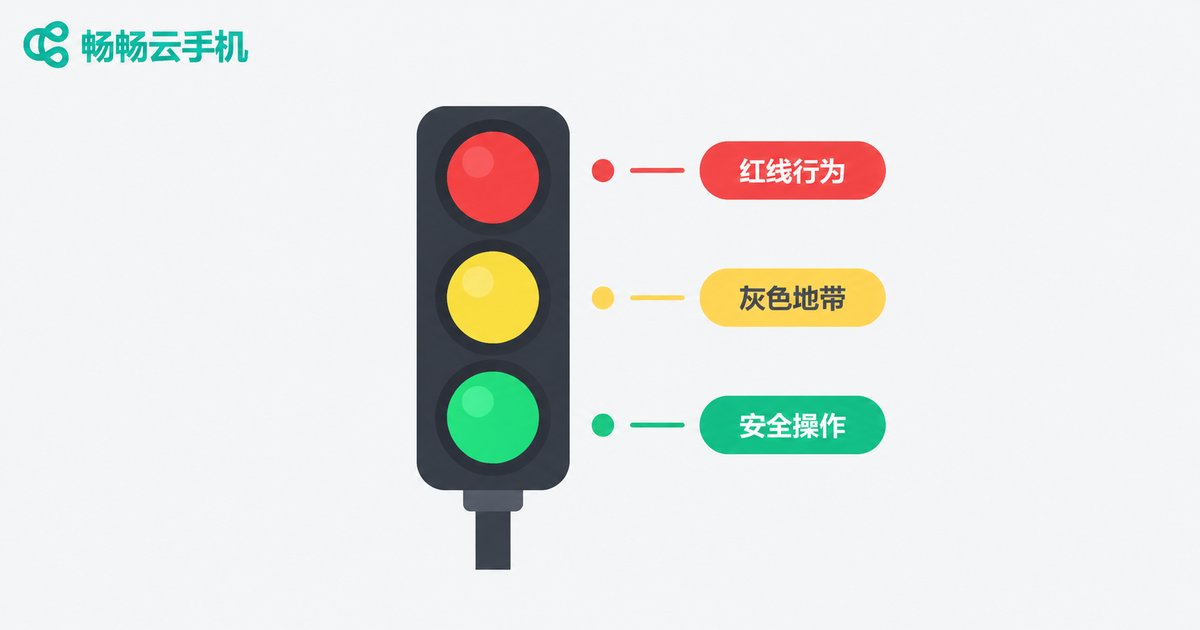
The Safe Zone: Automation Platforms Allow
Automation does not equal cheating. The following scenarios fall within normal operations and are safe to accelerate with tools:
Scheduled publishing: Draft content in advance and publish on plan. This is a feature many official tools support.
Data collection and reporting: Automatically aggregating views, engagement, and follower growth is read-only and very low risk.
Content asset management: Use tools to draft and organize material, then let humans review and publish.
Multi-account management in isolated environments: Running each account long-term in its own stable device environment is compliant in itself. The keys are a realistic environment and human-like behavior.
Risk Boundary Quick Reference
| Behavior | Risk Level | Recommendation |
|---|---|---|
| Bulk registering new accounts | High | Avoid it; operate mature accounts instead |
| Fixed-frequency engagement loops | High | Add random intervals and cap daily volume |
| Identical content blasted from many accounts | High | Rewrite copy and stagger publishing times |
| Scheduled content publishing | Low | Safe to use |
| Data aggregation and reporting | Low | Safe to use |
| Multi-account management in isolated environments | Low to medium | One account per device, human-like pacing |

Staying Compliant with ChangChang Cloud Phone
Balancing efficiency and risk control starts with the device environment. ChangChang Cloud Phone (ccloudphone) provides genuine cloud-based Android device environments. Each cloud phone is an independent device, so accounts can stay settled in their own stable environment long term, avoiding the environment anomalies caused by frequent device switching. Apps run in the cloud 24/7, so scheduled tasks and content publishing continue even when your local devices are powered off or offline, reducing the operational drift caused by manual intervention.
Even more important is how you use it: one account per device, human-like behavior, original content. Apply automation where it saves time, not where it fakes human engagement. Visit the ChangChang Cloud Phone official website (ccloudphone.com) to explore device plans and feature details, choose a setup that matches your operation scale, and turn risk-boundary awareness into a daily operating habit.
FAQ
Q: Will using a cloud phone for automation always get my account banned?
Not necessarily. Platforms penalize abnormal behavior, not tools themselves. As long as accounts run in stable, isolated environments with reasonable frequency and original content, automation can actually be more consistent than manual work.
Q: How many accounts count as a bulk matrix?
There is no universal threshold; what matters is environmental correlation. If multiple accounts share the same device fingerprint, the same content, and the same behavior template, even five or six accounts can be linked and flagged. One account per device with independent operation is the safe approach.
Q: What automation frequency is considered safe?
Mimic human rhythm: keep proactive follows and comments to a few dozen per day per account, add random intervals between actions, set idle hours at night, and avoid running 24 hours non-stop.
Q: My account is already throttled. What should I do?
Stop all automation first, return to normal manual use for one to two weeks, keep publishing original content, and only gradually resume low-frequency helper tools once behavior data returns to normal.