
Are 10-Yuan-a-Month and 6-Yuan-a-Year Cloud Phone Deals Reliable? The Real Cost of Cheap Plans
10 Yuan a Month, 6 Yuan a Year: Why Are Cheap Cloud Phone Ads Everywhere?
Open any app store or short-video platform and you will see ads shouting "cloud phone for 10 yuan a month" or "cloud phone for 6 yuan a year". If you want a cloud phone for AFK farming, multi-instance running, or account nurturing, the price looks irresistible — a cup of milk tea for a whole year? But the sweeter the price, the more you should ask: how does the provider make money?
A cloud phone is a real device running in a cloud data center, and every instance consumes real hardware, bandwidth, and electricity. If the price stays below cost for long, the provider either earns money some other way — or has a catch. This article breaks the real cost of ultra-cheap plans down line by line.
Four Common Tricks Behind Ultra-Low Prices
1. Oversold resources that lag when you actually use them. A host machine meant to serve a handful of users is oversold to dozens. It feels fine at noon, but at peak evening hours you get lag, disconnects, and black screens.
2. Cheap first payment, doubled renewal. "6 yuan a year" is often just a hook. The second-year renewal may jump back to dozens or even over a hundred yuan. After a year your data lives there, and paying the inflated renewal feels like the only option.
3. Crippled features, paywalls everywhere. Budget plans often limit resolution, instance count, or background keep-alive time. To get a normal experience you buy "speed packs" and "HD packs" one after another, and the total quietly exceeds your budget.
4. Fly-by-night platforms, lost data. Ultra-low prices mean almost no profit. If the platform shuts down, the accounts and game progress stored in your cloud phone may be wiped overnight with no chance to export anything.
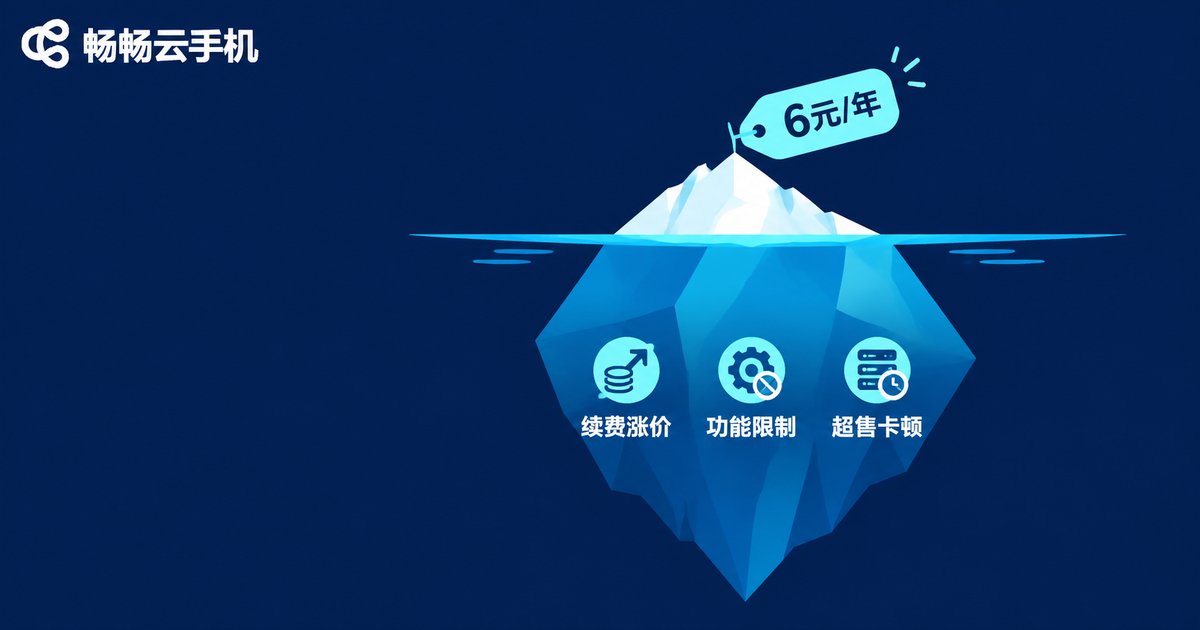
How to Calculate the Real Cost, Line by Line
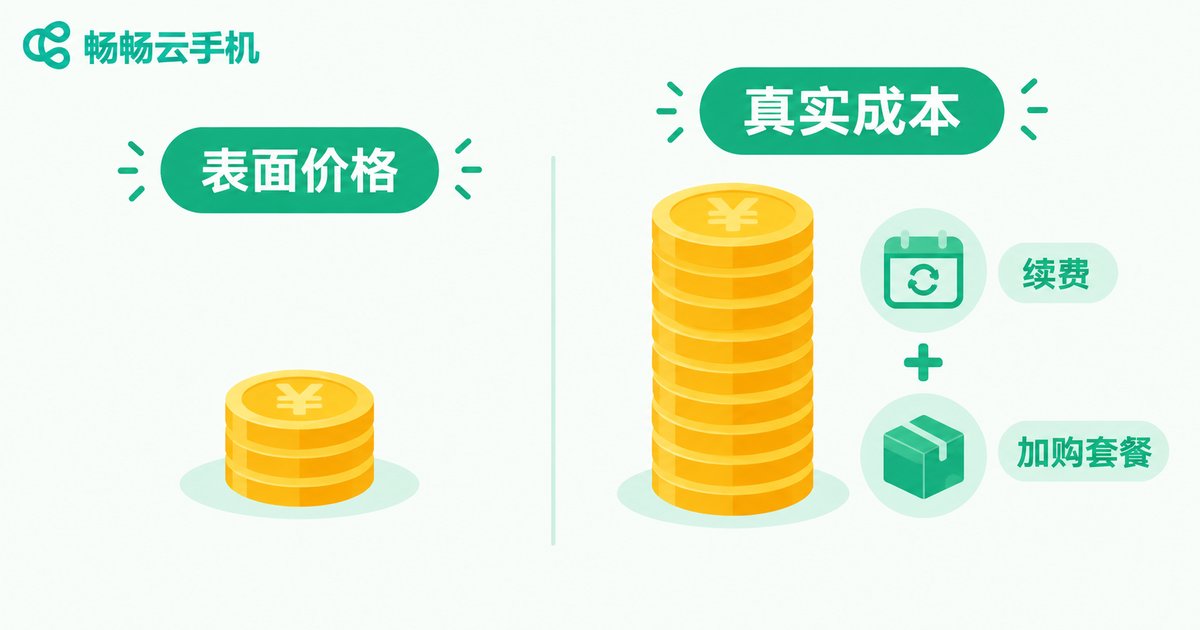
To judge a cheap plan, ignore the sticker price and calculate the full lifecycle cost. Example: a platform charges 6 yuan for the first year. Sounds like nothing — until you read the fine print: the second year renews at 96 yuan; smooth performance requires a "premium line" at 10 yuan per month; a second cloud phone instance costs extra. The math:
96 yuan (renewal) + 120 yuan (speed packs) = 216 yuan per year — 36 times the advertised "6 yuan". A transparently priced plan with the same renewal rate may actually be cheaper.
| Item | Bait-style cheap plan | Transparently priced plan |
|---|---|---|
| First-year price | 6 yuan/year, 10 yuan/month hook price | Published pricing, no hidden items |
| Renewal price | May rise several times or more | Same price on renewal, or close to it |
| Add-on fees | Stacked speed packs and HD packs | All features stated upfront in the plan |
| Peak-hour experience | Oversold lag, frequent disconnects | Sufficient resources, stable uptime |
| Data safety | High shutdown risk | Sustainable service, protected data |
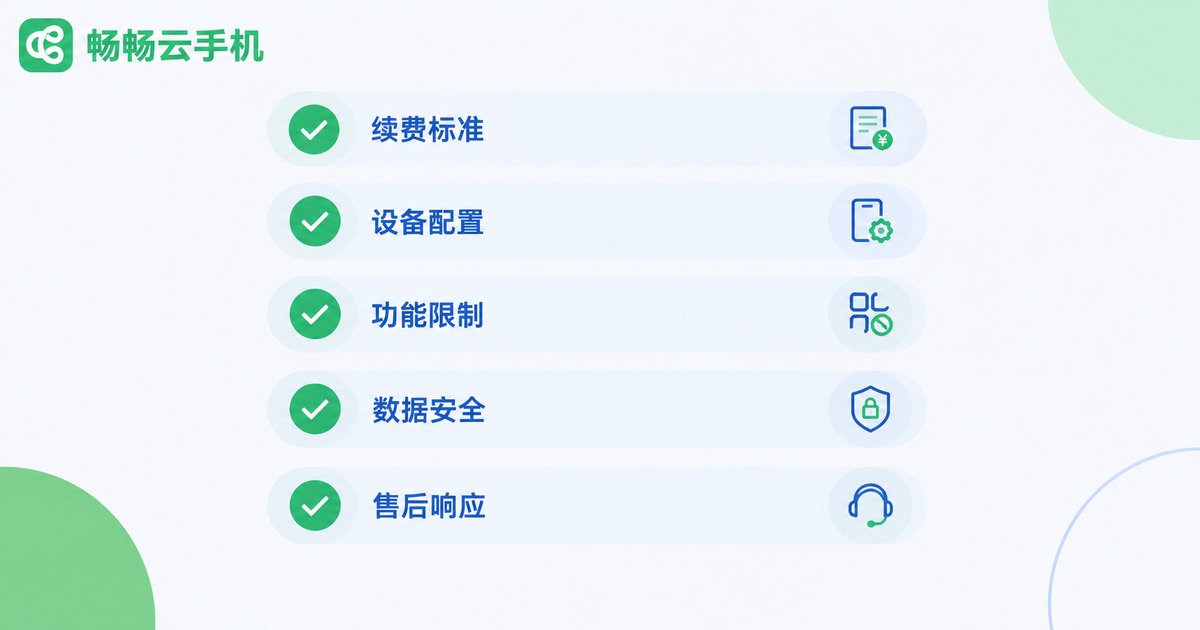
5 Checkpoints to Quickly Judge a Cheap Plan
1. Renewal terms: scroll to the bottom of the sales page and find the renewal price. If you cannot find it, walk away.
2. Device specs: are CPU, RAM, and OS version clearly listed? A "high-performance device" with no published specs is usually inflated.
3. Feature limits: resolution, instance count, keep-alive duration, forced ads — confirm every detail that affects your daily experience.
4. Data security: can you export your data? How do you recover a lost account? How many years has the platform been operating? Longer track records are safer.
5. Support quality: ask a technical question before paying. Pre-sales response speed and professionalism set the ceiling for after-sales service.
Cheap Is Fine — as Long as It Is Transparently Cheap
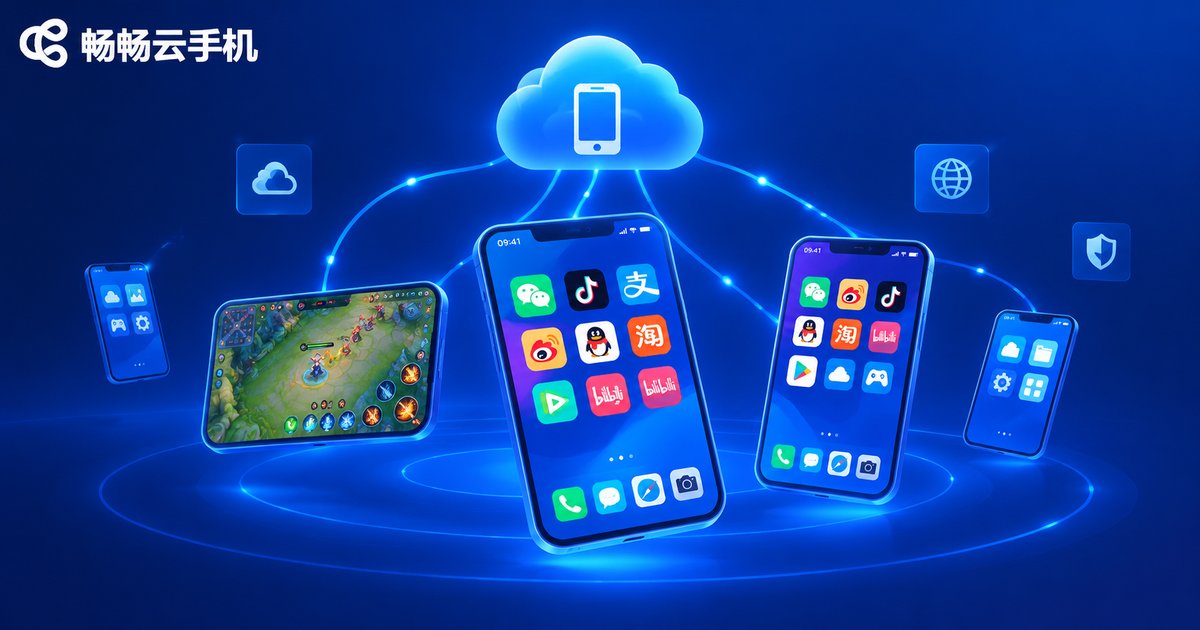
Cheap does not have to mean bad; it must be cheap in a clear, honest way. Services like ChangChang Cloud Phone (ccloudphone) publish their plans and pricing openly on the official website. They may not be the absolute cheapest, but you always know what you pay for, what the renewal costs, and which features are included — no mid-term hostage-taking.
The suggested buying order: define your needs first (AFK farming, multi-instance, or app hosting), pick a plan tier accordingly, then run it through the 5 checkpoints above. Buying exactly what you need is the real way to save money.
FAQ
Q: Should I buy a 6-yuan-a-year cloud phone?
You can try it, but treat it as a trial: do not store important accounts in it, check the renewal price before it expires, and only commit long term if it holds up.
Q: What is the biggest risk of cheap cloud phones?
Data security. If a small platform shuts down, game progress and account data in the cloud phone may be unrecoverable, so keep important workloads on a stable, well-reviewed platform.
Q: What is a normal monthly price for a cloud phone?
Entry-level devices commonly range from a few yuan to a dozen-plus yuan per month depending on specs. Judge by configuration, uptime, and transparent renewal terms — not the sticker price alone.
Q: How do I avoid low-price traps?
Three steps: check the renewal price, check feature limits, check how long the platform has operated. If all three are clear and consistent, it is likely reliable; if any answer is vague, stay cautious.
Q: Who is ChangChang Cloud Phone (ccloudphone) for?
It suits users who need multi-instance AFK game running, app hosting, and multi-account management. Its plans and feature details are published on the official website — compare them with your needs before choosing a tier.