ARM Bare Metal or Containerized Cloud Phone? 2026 Hardware-Level Isolation Risk Control Comparison and Pitfall Guide
Why Architecture Choice Decides Your Cloud Phone's Fate in 2026
For years, many teams chose cloud phones based purely on price and smoothness, only to regret it when accounts got restricted in batches and devices kept dropping offline. Entering 2026, mainstream platforms' risk control systems have evolved from "checking parameters" to "checking environments": they no longer just look at the device model and IMEI you report, but probe the underlying kernel, resource isolation traces, and consistency of hardware characteristics. At this point, whether your cloud phone runs on ARM bare metal or a containerized architecture is no longer a technical detail — it is the key variable that directly determines account survival rates.
What Are the Two Mainstream Architectures
Cloud phones on the market today fall into two main camps:
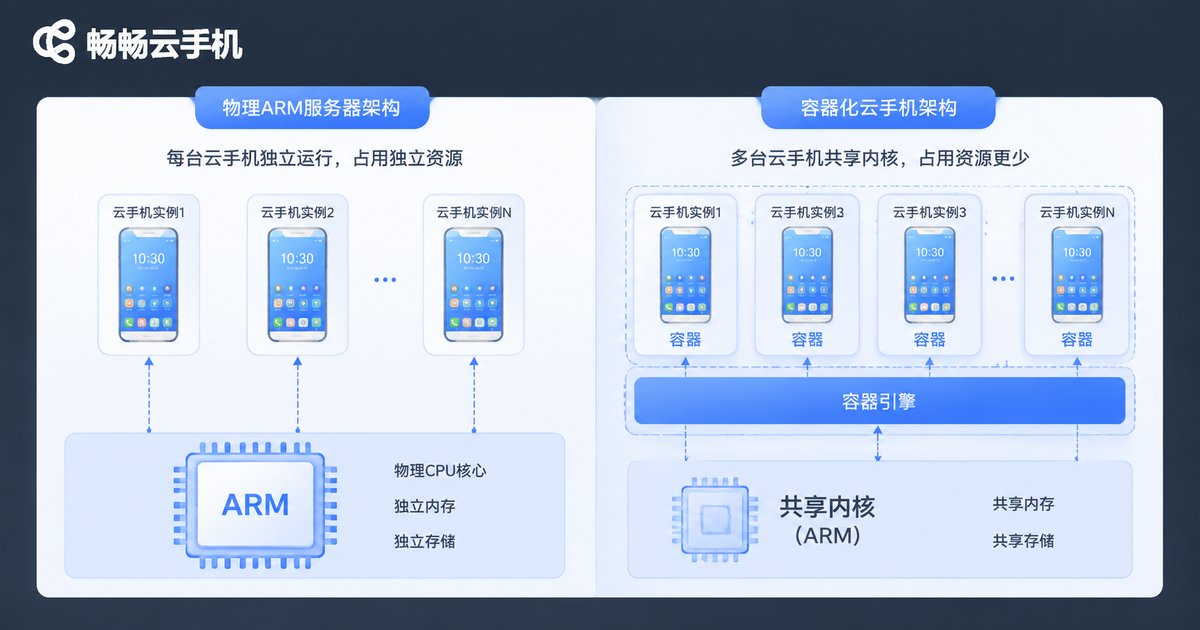
ARM bare metal: Cloud phone instances run directly on real ARM physical servers. Each instance gets dedicated or highly exclusive CPU cores, memory, and storage, with independent hardware characteristics. Think of it as "moving a real phone into a data center."
Containerized: A host machine slices out multiple "phones" via container technology, and all containers share the same host kernel. The advantage is high density and low cost; the trade-off is inherently weaker isolation — kernel parameters, system call behavior, and resource scheduling traces are highly similar across instances.
Hardware-Level Isolation: The Core Difference from a Risk Control Perspective
So-called hardware-level isolation means each cloud phone instance is independent at the hardware characteristic level and decoupled from the host environment. The four dimensions risk control systems probe most happen to be exactly where the two architectures differ most:
1. Kernel consistency. Under containerized solutions, hundreds or thousands of "devices" report identical kernel versions and build information — nearly impossible in a real user population and a classic batch signature. ARM bare metal instances have underlying environments much closer to real independent devices.
2. Device fingerprint uniqueness. Hardware-level isolation ensures each cloud phone has an independent, stable combination of hardware parameters, avoiding the "changed IMEI but exposed by underlying traits" trap.
3. Performance jitter. Containers share resources and compete during peak hours; fluctuating frame rates and response latency patterns are easily flagged as machine environments by behavioral analysis models.
4. Sensors and environmental characteristics. A real-device-grade hardware base provides more natural sensor data and thermal curves, while container solutions often rely on simulated values that can reveal subtle flaws.

One Table to Compare Risk Control Performance
| Dimension | ARM Bare Metal | Containerized |
|---|---|---|
| Isolation level | Hardware-level isolation | Shared kernel, weaker isolation |
| Underlying environment | Independent, close to real devices | Shared host kernel |
| Device fingerprint | Independent and stable | Prone to batch similarity |
| Performance | Dedicated resources, low jitter | Peak-hour resource contention |
| Cost per instance | Higher | Lower |
| Best for | Multi-account operations, long-term nurturing | Short-term testing, low-risk tasks |
2026 Risk Control Trends: What Platforms Are Actually Checking
Looking at the past year of risk control upgrades across platforms, three trends stand out:
Trend one: from parameter detection to environment detection. Tools that simply change device models and parameters have largely failed; platforms now collect deeper environmental signals like kernel characteristics and system call patterns.
Trend two: behavioral chain cross-analysis. A single device's behavior may look normal, but if a group of devices sharing one underlying environment operates in highly synchronized rhythms, it gets flagged as a coordinated control environment.
Trend three: binding hardware characteristics to account history. Once an underlying environment is marked, new accounts running on it afterward come under extra scrutiny. This is why cheap cloud phones with "polluted environments" are so damaging — the money saved is nowhere near enough to cover the account assets lost.
Pitfall Guide: 5 Questions to Ask Before Choosing a Cloud Phone
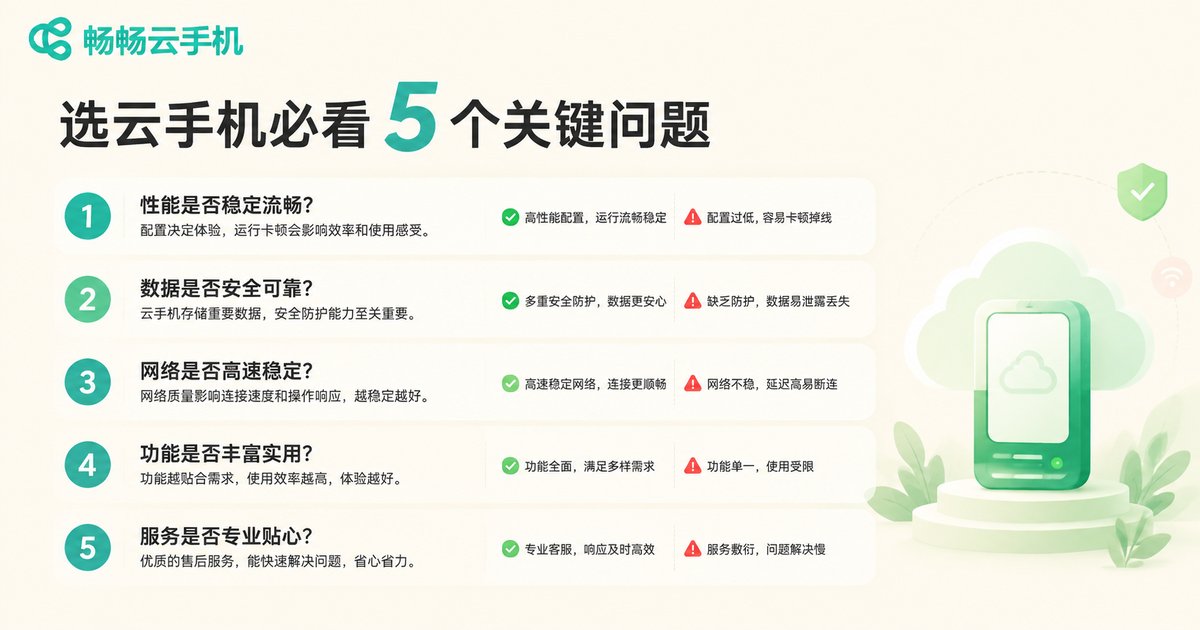
Question one: bare metal or containers underneath? Ask the provider directly about the architecture. Vague answers paired with "it's cheap" deserve extra caution.
Question two: dedicated or shared resources? Confirm whether CPU cores and memory are exclusive. Shared resources mean performance jitter and similar underlying characteristics — a double loss.
Question three: are device fingerprints independent and stable? Test whether parameters drift after restarts and whether underlying traits across devices are suspiciously alike.
Question four: what is the IP resource strategy? Crowding many devices onto the same IP ranges undermines even the best hardware isolation through correlation — environment and network must be evaluated together.
Question five: are there reviews from long-term real scenarios? Focus on feedback from users of six months or more, not just first-month experiences.
ccloudphone: A Reliable Choice for Hardware-Level Isolation
If your business demands high account survival rates, ccloudphone is a solution worth prioritizing. Built on an ARM-based real-device environment, each instance has independent device characteristics and an independent underlying environment, reducing batch-signature exposure risk at the architectural level. It also delivers a stable, smooth running experience, making it well suited for multi-account operations, app multi-instance use, long-term account nurturing, and other scenarios with high environment quality requirements. Check the official website for specific plans and configurations, and choose according to your actual needs.
FAQ
Q: Do containerized cloud phones always fail risk control?
Not absolutely, but the risk is significantly higher. Low-intensity scenarios may work temporarily, but once platforms upgrade environment detection, container solutions expose batch signatures far faster than bare metal ones.
Q: Why are ARM bare metal cloud phones more expensive?
Each instance occupies real hardware resources and cannot be oversold the way containers can be "split into many." The cost structure sets the price floor — but it also buys genuine isolation quality.
Q: Does hardware-level isolation guarantee zero bans?
No. Isolation solves the "environment being detected" problem; whether account behavior itself is compliant matters just as much. Architecture is the foundation; how you operate sets the ceiling.
Q: Do individual users need hardware-level isolation?
For single-account everyday use, requirements can be relaxed. But once multiple accounts, long-term operations, or accumulated account assets are involved, the ROI of hardware-level isolation becomes very attractive.
Q: How can I quickly tell if a cloud phone offers real isolation?
The simplest way: launch two instances and compare whether the underlying environment information matches; then check whether performance stays stable at peak hours. Identical traits and peak-hour lag usually mean a shared environment.