
ARM Bare-Metal vs Container Cloud Phones: A Selection Guide Based on Target Platform Detection Depth
Why Detection Depth Is the First Variable in Your Decision
When teams evaluate cloud phones, the first instinct is to compare prices, instance counts, and hardware specs. What actually decides whether the business runs stably over the long haul, however, is the environment detection depth of your target platform. Detection depth means how thoroughly the app or game you intend to run examines its surroundings: a casual glance at device parameters, or a layer-by-layer audit of sensors, system characteristics, and behavioral traces?
The deeper the inspection, the higher the bar for the cloud phone's underlying architecture. That is precisely why two technical routes coexist on the market—ARM bare-metal cloud phones and container-based cloud phones. One does not replace the other; each matches a different detection intensity and business scenario.
Two Technical Routes: What Actually Differs
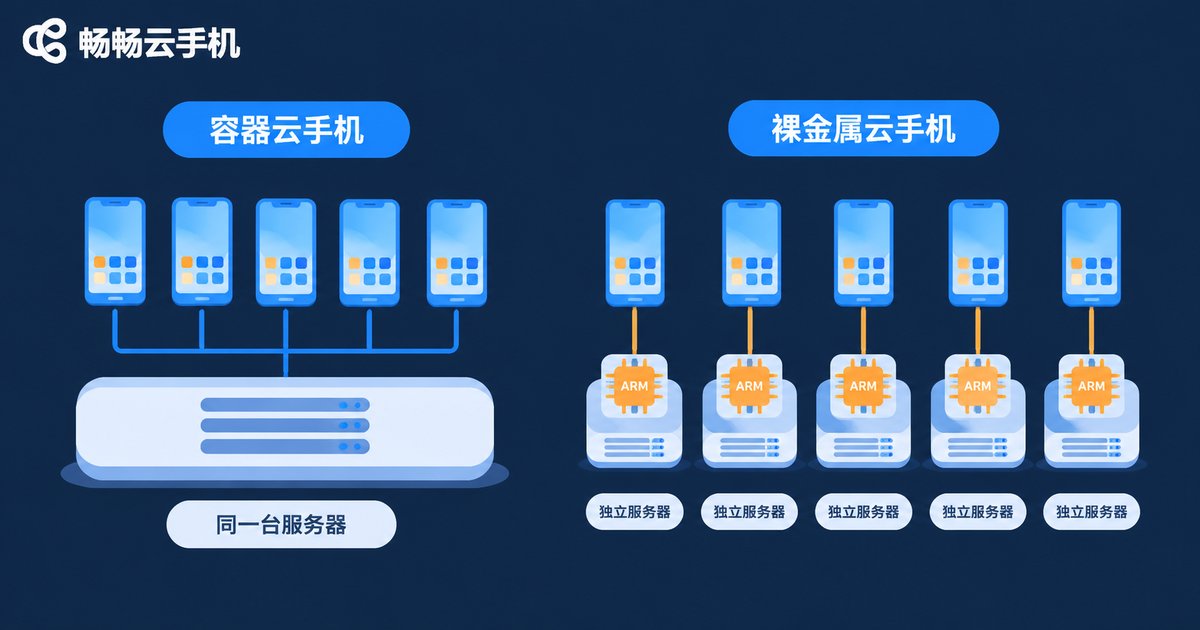
Container cloud phones: one ARM physical server is partitioned into a large number of cloud phone instances via containerization, and every instance shares the same underlying kernel and hardware resources. The strengths are high density, low cost, and instant provisioning—great for running at scale. The trade-off is a pronounced same-origin signature: underneath, all instances look remarkably alike.
ARM bare-metal cloud phones: instances are built directly on ARM physical compute with far fewer abstraction layers in between. Device fingerprints sit much closer to a genuine standalone handset, and hardware parameters plus sensor data carry far more credibility.
| Dimension | Container Cloud Phone | ARM Bare-Metal Cloud Phone |
|---|---|---|
| Architecture | Shared kernel, same-origin instances | Close to physical hardware, independent instances |
| Fingerprint authenticity | Average, needs heavy tuning | High, close to real devices |
| Cost per instance | Low | Relatively higher |
| Best fit | High-volume, light-detection workloads | Strong risk control, long-term multi-account ops |
The Three Levels of Target Platform Detection
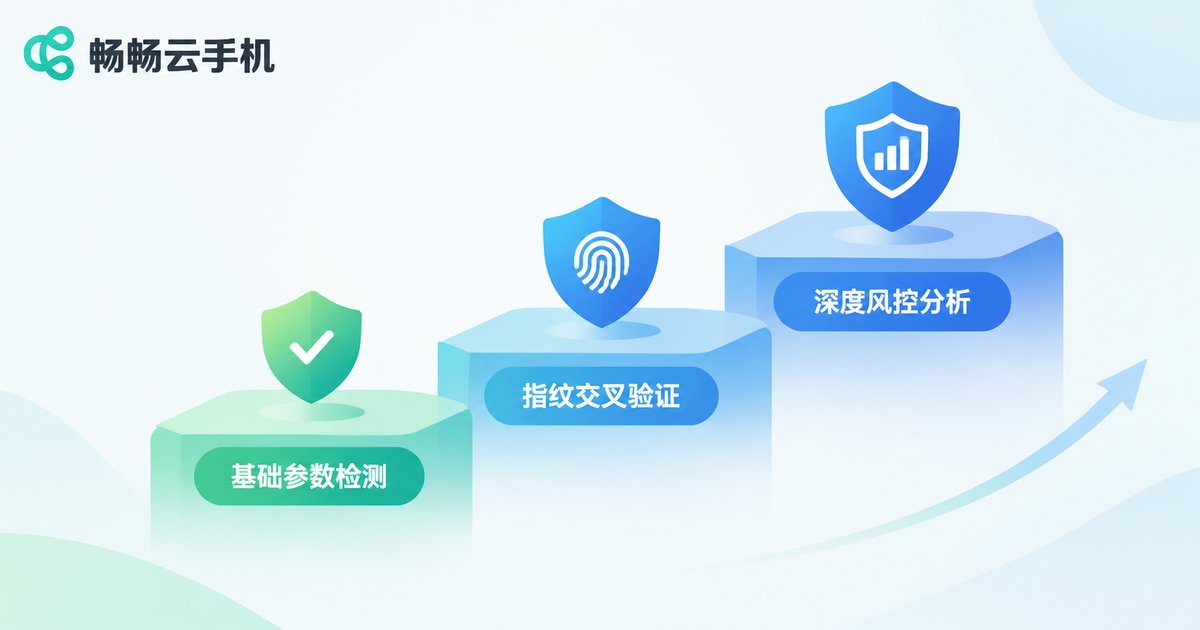
Level 1: Basic parameter checks. The app reads surface-level values such as model and OS version with little cross-validation. Typical of utility and content apps. Container cloud phones handle this level comfortably.
Level 2: Fingerprint cross-validation. The platform checks whether device parameters are internally consistent—does the CPU model match GPU rendering traits, are sensor readings plausible, do system files leave abnormal traces? Plenty of games and e-commerce risk controls stop here. Tuned container setups pass sometimes, but stability is a coin toss; bare-metal holds a clear structural advantage.
Level 3: Deep risk control and behavioral analysis. The platform weaves device fingerprints, network environment, and operation trajectories into a unified risk score, sometimes with hardware-level attestation. Multi-account and long-term account-nurturing operations fail here most often. Only an environment close enough to a real device—bare-metal—can stay stable at this level over time.
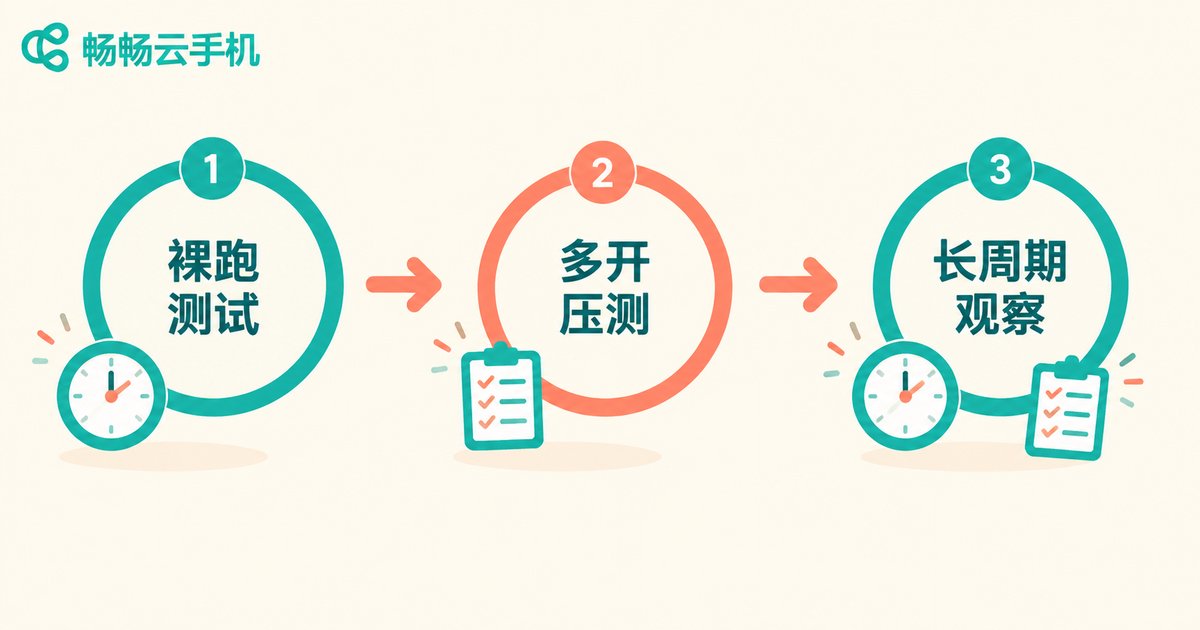
A Three-Step Self-Test for Detection Depth
No need to guess—measure it:
Step 1, baseline run. Install the target app on an ordinary container cloud phone and use it normally for 3 to 7 days. Watch for restricted features, more frequent captchas, or environment warnings.
Step 2, multi-account stress test. Run several accounts simultaneously in the same environment and look for correlation flags, such as batch verification prompts or throttled accounts.
Step 3, long-cycle observation. Keep operating for 2 to 4 weeks and see whether the platform settles scores later. Many platforms are lenient with fresh accounts for the first few days, then start batch enforcement.
Pass all three steps and detection depth sits at Level 1—containers are enough. Any anomaly along the way means you should retest on ARM bare-metal rather than keep burning accounts on environmental issues.
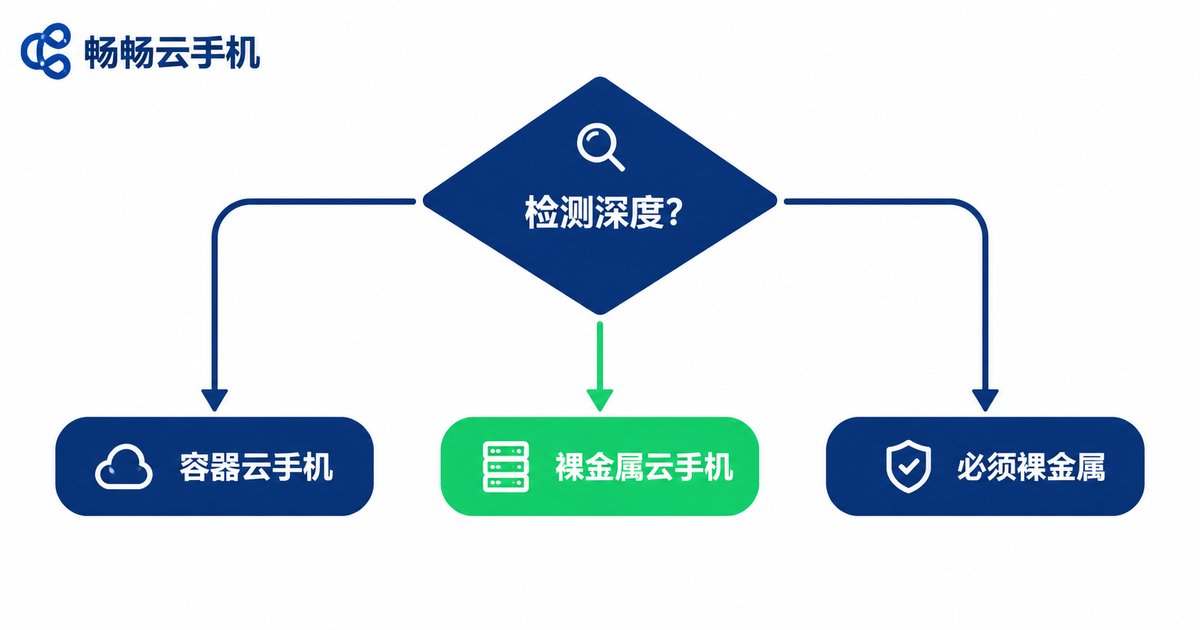
A Decision Table to Match Against
| Test Outcome | Recommended Route | Why |
|---|---|---|
| All three steps pass | Container cloud phone | Low cost, high density, efficient at scale |
| Anomalies in multi-account or long-cycle tests | ARM bare-metal cloud phone | Fingerprint authenticity drives pass rates |
| Professional risk control, frequent attestation | Bare-metal is a must | Only near-real-device environments stay stable long term |
Calculate Total Cost, Not Unit Price
Bare-metal instances usually cost more per unit than container instances, but selection cannot stop at unit price. When container setups hit Level 2 scenarios and trigger batch anomalies, the hidden costs of replacing accounts, re-nurturing them, and starting over often dwarf the savings. The sounder formula is unit cost × expected account lifespan × value per account. On deeply detecting platforms, the 'expensiveness' of bare-metal is actually a bargain.
Practical Recommendations
If your target platform has confirmed deep detection, or your business depends on long-term multi-account operations, go straight to a cloud phone provider offering ARM bare-metal resources. Take ChangChang Cloud Phone (ccloudphone) as an example: its ARM-based cloud phone service provides stronger assurance of device environment authenticity and supports multi-instance and batch management. For available specifications and the latest features, check the official website.
Still unsure? Run the three-step self-test on a small pool of instances first and let the data set your scaling pace—far more reliable than any rule of thumb.
FAQ
Q: Are container cloud phones always detectable?
Not necessarily. At Level 1 detection, containers pass unnoticed. But the deeper the inspection, the more easily the shared-origin traits of containers get flagged, and stability drops accordingly.
Q: Why are ARM bare-metal cloud phones closer to real devices?
Because instances are built directly on ARM physical compute with fewer abstraction layers, hardware parameters and sensor data come from more authentic sources and hold up better under cross-validation.
Q: Which option should I trial first?
Run the three-step self-test on a few container instances to gauge real detection depth, then decide. If environment warnings appear during testing, switch to bare-metal for a direct comparison.
Q: Which scenarios suit ChangChang Cloud Phone?
ChangChang Cloud Phone (ccloudphone) offers ARM-based cloud phone services with multi-instance and batch management, suited to workloads that need a stable device environment. Refer to the official website for current specifications, and validate on a small scale before scaling up.