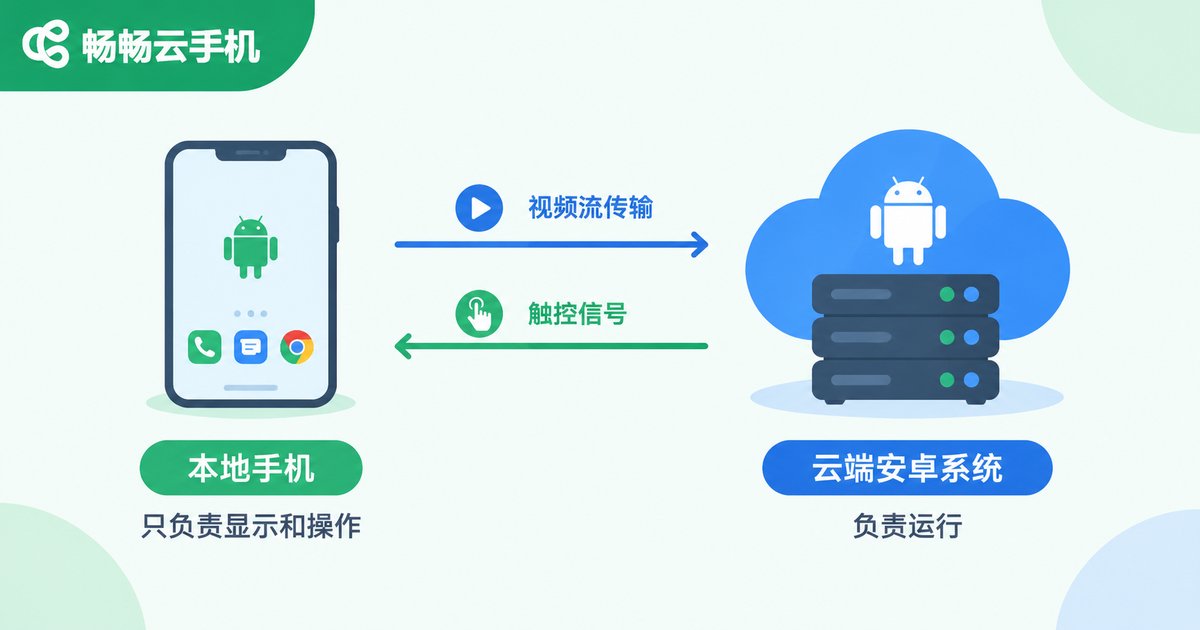
Unresponsive Touch: Whose Fault Is It?\n\nPlaying games on ChangChang Cloud Phone and your skills won't fire, movement drifts, taps don't register — this kind of touch lag can ruin an entire match. But "unresponsive touch" is a vague description hiding completely different root causes.\n\nThe touch pipeline in a cloud phone differs from a physical phone: your local screen touches go through coordinate capture, network transmission, and cloud injection before becoming actual touch events in the cloud phone. Delay or deviation at any stage makes it feel "unresponsive."\n\n## Touch Pipeline Breakdown: Where Latency Comes From\n\n| Stage | Latency Source | Typical Delay | Optimization |\n|:---:|:---|:---|:---|\n| Local touch capture | Screen sampling rate, touch IC response | 5–15ms | Increase touch sampling rate |\n| Coordinate encoding | Touch event serialization/compression | 1–3ms | Usually no optimization needed |\n| Network transmission | Uplink latency, jitter | 10–50ms | Wired network, nearest node |\n| Cloud injection | Touch event injection into Android framework | 2–8ms | Close unnecessary background processes |\n| Frame return | Render + encode + transmit + decode | 15–40ms | Lower frame rate or resolution |\n\nTotal latency = sum of all stages. The "unresponsiveness" you feel typically kicks in when total latency exceeds 80ms. The optimization approach is to identify the bottleneck and target it.\n\n## Step 1: Distinguish "Latency" from "Drift"\n\nThese are completely different problems with completely different solutions:\n\n| Symptom | Manifestation | Root Cause | Solution Direction |\n|:---:|:---|:---|:---|\n| Touch latency | Tap registers after a delay | Network latency or low frame rate | Optimize network, raise frame rate |\n| Touch drift | Tap position A, triggers position B | Coordinate mapping deviation | Recalibrate touch mapping |\n| Touch loss | Some taps don't register at all | Insufficient sampling rate or packet loss | Increase sampling rate, check network |\n| Touch jitter | Finger still but cursor jumps | Touch IC noise or network jitter | Hardware troubleshooting or network optimization |\n\n## Touch Mapping Calibration: Fixing Drift\n\nChangChang Cloud Phone provides a touch mapping calibration feature. When your tap position doesn't match the actual trigger position, recalibration is needed.\n\n### Calibration Steps\n\n1. Go to ChangChang Cloud Phone client "Settings → Touch → Calibration"\n2. The system displays a full-screen calibration interface with crosshair markers\n3. Use your finger to precisely tap the center of each crosshair\n4. After completing all markers, the system automatically calculates the offset and corrects the mapping\n\n> Calibration frequency: Recalibrate after every device change (e.g., phone to tablet), resolution change, or screen rotation. If taps suddenly feel off during daily use, calibrate again.\n\n### Resolution and Touch Mapping Relationship\n\nMany people don't know that changing resolution shifts the touch mapping. Cloud phone touch coordinates are based on virtual resolution — when you switch from 1080P to 720P, the coordinate ratio changes, but the mapping table doesn't update, causing tap offset.\n\n| Resolution Change | Touch Impact | Fix |\n|:---|:---|:---|\n| 1080P → 720P | Coordinate ratio change, tap offset | Recalibrate touch mapping |\n| Portrait → Landscape | Coordinate axis rotation, mapping fails | Recalibrate after rotation |\n| Phone → Computer cast | Screen size change, different DPI | Calibrate + adjust DPI |\n| DPI modification | Touch area size change | Recalibrate |\n\n## Reducing Touch Latency: Network and Frame Rate Optimization\n\nIf the problem is "tap registers after a delay," calibration won't help — you need to address latency.\n\n### Network Optimization\n\n| Measure | Expected Effect | Difficulty |\n|:---|:---|:---:|\n| Switch to wired network | Reduce 10–30ms latency | ★☆☆ |\n| Select nearest cloud phone node | Reduce 5–20ms latency | ★☆☆ |\n| Disable VPN/proxy | Eliminate extra routing hops | ★☆☆ |\n| Router QoS priority | Reduce bandwidth contention | ★★☆ |\n| Upgrade broadband plan | Increase uplink bandwidth | ★★☆ |\n\n### Frame Rate and Touch Relationship\n\nFrame rate affects not just visual smoothness but also touch response speed. The reason is simple: each rendered frame on the cloud triggers one round of touch event processing. Lower frame rates mean longer intervals between touch event processing, making latency more noticeable.\n\nRecommendation: Keep frame rate at 60FPS or above for gaming. If network conditions don't allow 60FPS, lower the resolution rather than the frame rate — lower resolution makes the image blurry, but lower frame rate makes the game unplayable.\n\n## Touch Sampling Rate: The Overlooked Key Parameter\n\nTouch sampling rate is how many times per second the local device screen captures touch data. Most phone screens have touch sampling rates of 120–240Hz, while flagship gaming phones can reach 480Hz or even 720Hz.\n\n| Sampling Rate | Touch Response | Use Case |\n|:---:|:---|:---|\n| 120Hz | Barely adequate | Daily operations, video |\n| 240Hz | Smooth | Most games |\n| 360Hz+ | Ultra-responsive | Competitive shooter games |\n\nChangChang Cloud Phone client offers different sampling rate tiers under "Settings → Touch → Sampling Rate." If your device supports high sampling rates, enable it — this directly reduces 5–10ms of touch latency.\n\n## Touch Optimization Tips for Gaming\n\n### Tip 1: Enable High Touch Sensitivity Mode\n\nChangChang Cloud Phone's "Settings → Touch → Sensitivity" offers "Standard" and "High Sensitivity" options. High sensitivity mode lowers the debounce threshold for touch events, allowing lighter touches to register. Ideal for games requiring rapid tapping.\n\n### Tip 2: Adjust Touch Dead Zone\n\nThe touch dead zone is the area where small finger movements don't trigger drag events. Too large and fine operations are ignored; too small and natural finger tremor causes misoperations.\n\n| Game Type | Recommended Dead Zone | Notes |\n|:---|:---:|:---|\n| Shooter (aiming) | Small (2–4px) | Needs fine micro-adjustments |\n| MOBA (movement) | Medium (5–8px) | Balance precision and stability |\n| Card / casual | Large (8–12px) | Prevent mis-taps |\n\n### Tip 3: Use Virtual Button Mapping\n\nFor games requiring precise operation, ChangChang Cloud Phone supports virtual button mapping. You can map touch areas on the screen to virtual buttons triggered by keyboard or gamepad, bypassing the touch pipeline's latency entirely.\n\n## Q&A\n\nQ1: Still feels like taps are off after calibration. What now?\n\nA: First confirm whether you've changed resolution or DPI — these changes invalidate previous calibration. If not, try calibrating twice: calibrate once, exit settings, then re-enter and calibrate again. Sometimes the first calibration's baseline is itself offset, and a second pass corrects it. If it's still off, it may be a client version issue — update to the latest version.\n\nQ2: Aiming always feels half a beat slow in shooter games. How to optimize?\n\nA: Shooter games are most sensitive to touch latency. Three-step optimization: first, ensure frame rate is above 60FPS; second, enable high touch sampling rate (if device supports it); third, reduce touch dead zone to 2–4px. If network latency exceeds 40ms, switch to wired network or a closer cloud phone node. Also, consider using keyboard-mouse mapping instead of touch — mouse precision and response speed far exceed touchscreens.\n\nQ3: Touch is always off in landscape mode but fine in portrait. What's going on?\n\nA: This is a classic post-rotation mapping failure. When the cloud phone switches from portrait to landscape, the touch coordinate axis rotates 90 degrees. If the mapping table doesn't update synchronously, offset occurs. Fix: recalibrate after every screen rotation. Some versions of ChangChang Cloud Phone support auto-rotation calibration — check if there's a "Rotation Auto-Calibration" option in client settings.\n\nQ4: Touch sometimes freezes for a few seconds then recovers. What causes this?\n\nA: This intermittent freezing is typically caused by network jitter. Touch events are transmitted via network uplink — when the network experiences brief congestion, touch events accumulate in the send queue and are injected all at once when the network recovers, manifesting as "freeze for a few seconds then jump." The fix is to check network stability and prefer wired connections. If it happens frequently, contact your ISP to check line quality.\n\nQ5: Playing cloud phone on a computer, mouse clicks feel different from phone touches. Is that normal?\n\nA: Completely normal. Mouse clicks and touch operations use different event models — mouse has a hover state, touch doesn't; mouse clicks are discrete events, touch is continuous press + move. ChangChang Cloud Phone's client performs touch simulation conversion, but the conversion itself introduces a small delay. If you're after ultimate precision, use the client's keyboard-mouse mapping feature to directly map mouse and keyboard events to in-game actions, bypassing the touch simulation layer.