
Is Cloud Phone Reliable? Platform Risk and Service Stability Analysis
What Is a Cloud Phone and Why Do People Worry About Reliability?
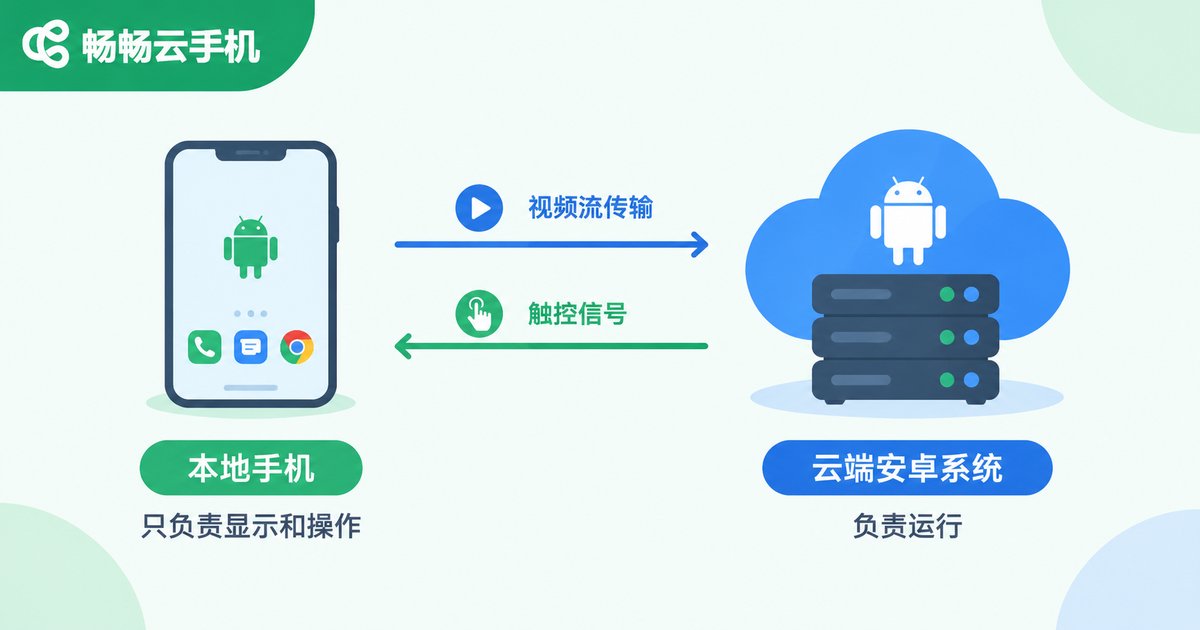
In simple terms, a cloud phone is a full Android phone that lives on a remote server. You open a client on your PC or phone, and what you see and interact with is a complete Android system — you can install apps, play games, run scripts, and the experience is nearly identical to a physical phone.
That sounds great, but many users have one nagging question: What happens to my data, my game accounts, and my prepaid balance if the company running the cloud phone suddenly shuts down? This concern is not unfounded. Over the past few years, several small cloud phone platforms have gone out of business due to cash flow problems, leaving users stranded.
So understanding whether cloud phones are truly reliable — and how to spot a platform that might fold — is something every user should do before getting started.
Where Does the "Platform Shutdown" Risk Actually Come From?
Running a cloud phone platform is essentially a capital-intensive, high-cost business. Every cloud phone instance requires real server compute, bandwidth, and storage resources. This means:
1. Large upfront investment: Procuring or leasing massive server capacity, building network infrastructure, developing client apps and management backends — the initial cost easily runs into millions.
2. Ongoing high costs: Electricity, bandwidth fees, server depreciation, and engineering team salaries are fixed daily expenses. If user numbers are insufficient, losses snowball quickly.
3. Long payback period: Unlike selling software as a one-time purchase, cloud phones are a monthly subscription service. The payback period typically exceeds 12 to 24 months.
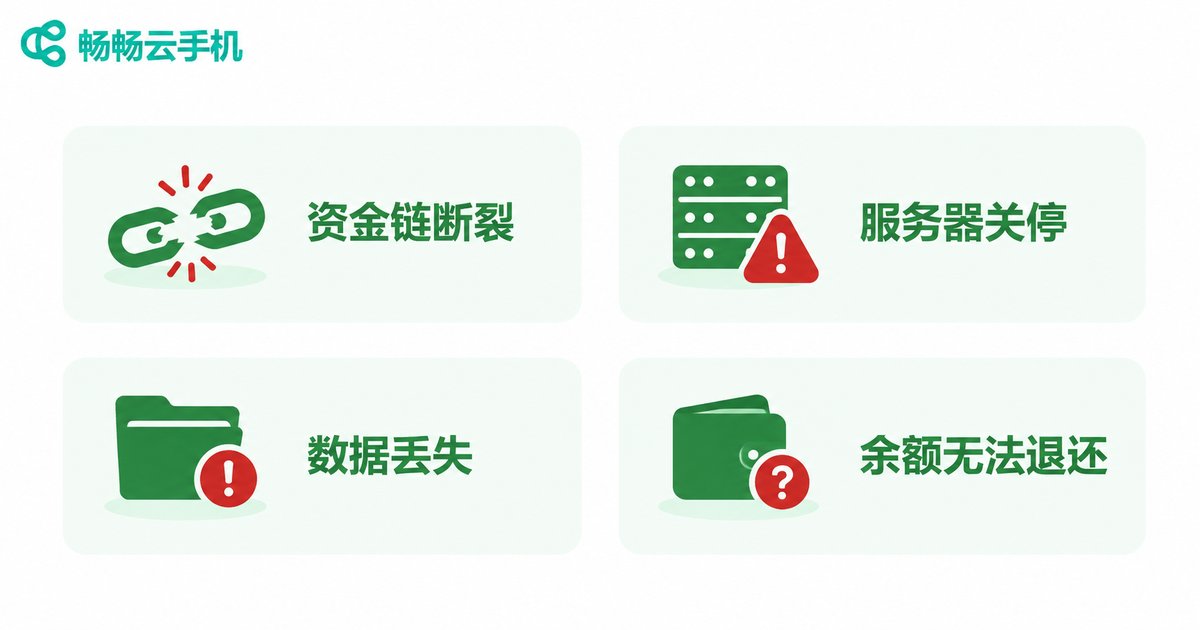
When a company lacks sufficient funding, user growth falls short of expectations, or market competition triggers a price war, the risk of a cash flow crisis spikes dramatically. The most immediate consequences of a cash flow break are server shutdowns, data loss, and inability to refund user balances.
How to Tell If a Cloud Phone Platform Is Trustworthy
With so many cloud phone services on the market, ordinary users can make a basic assessment using the following dimensions:
| Dimension | Risk Signal | Reliability Signal |
|---|---|---|
| Business registration | No verifiable company registration, no ICP filing | Clear corporate entity, ICP filing, verifiable business license |
| Technical architecture | Frequent lag, high latency, instances dropping offline | Multi-node deployment, automatic failover, 99.9%+ uptime |
| Data protection | No data backup, opaque account binding | Data snapshots, exportable data, clear account ownership |
| Operating history | Less than 6 months old, frequent domain changes | Over a year of continuous operation, active user community |
| Customer support | Long-term unresponsive support, no ticket system | 24/7 support, clear response time commitments |
One point deserves special emphasis: Do not judge by price alone. If a cloud phone service is priced significantly below the industry average, it most likely cuts corners on server specs, bandwidth quality, or operational investment — which makes it less stable in the long run.
Service Stability: The Core Metric That Actually Matters
Even if a platform won't shut down, unstable service will still be a terrible experience. Cloud phone service stability comes down to these key areas:
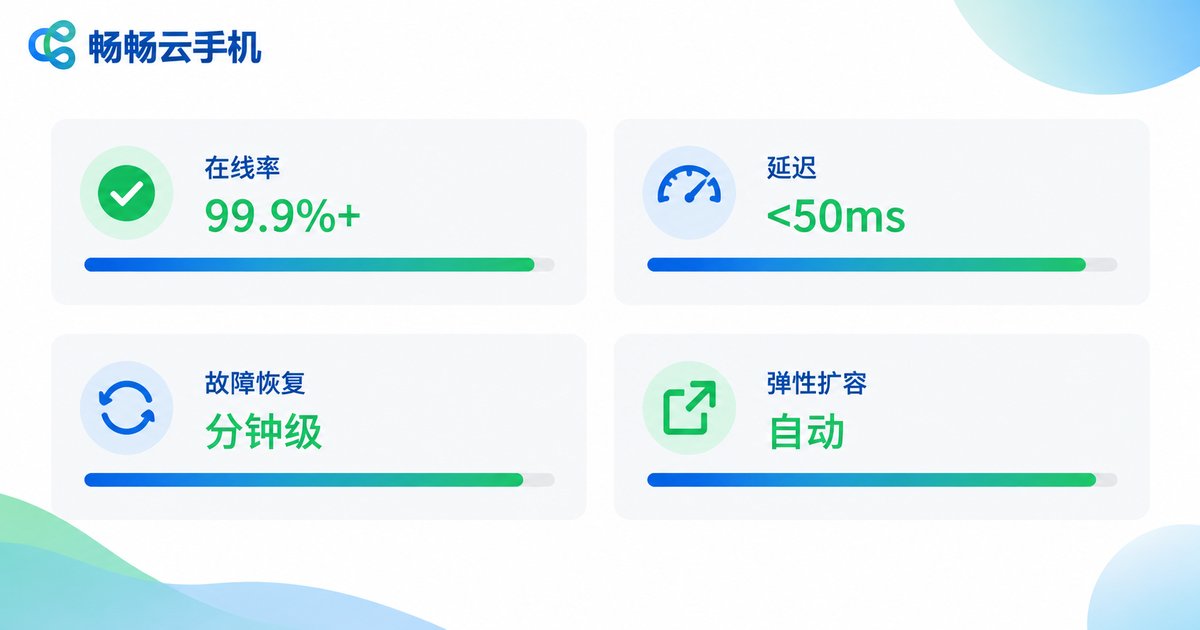
Uptime: The most fundamental metric. A reliable platform should maintain 99.9%+ instance uptime. That means no more than 8.76 hours of downtime across 365 days. If your instance drops offline three or four times a month, the experience will be very poor.
Latency and frame rate: Cloud phone responsiveness depends on network latency. A good service should keep latency under 50ms, with gaming scenarios sustaining 30fps or above. If latency regularly exceeds 100ms, gaming experience takes a significant hit.
Failover recovery time: Server issues are inevitable; what matters is recovery speed. An excellent cloud phone platform should have automatic failover capability, migrating instances to backup nodes during single-point failures, with user-perceived interruption kept to minutes or less.
Elastic scaling: When user demand surges (e.g., a major game update or a popular event), can the platform scale quickly without degrading existing users' experience? This is a key indicator of technical capability.
ccloudphone: What It Does for Reliability
After understanding the risks and stability requirements, many users ask: so which one should I choose?
ccloudphone is a cloud phone service provider with a track record of continuous operation in the industry. It has implemented several noteworthy practices in platform stability and user protection:
Multi-node architecture: ccloudphone deploys across multiple geographic nodes, so instances do not depend on a single physical server. When a node experiences an issue, the system can automatically reschedule instances to healthy nodes, minimizing user-perceived interruptions.
Data snapshots and backup: Users can create snapshots of their cloud phone instances — essentially a "save point." Even in extreme scenarios, data can be restored from a snapshot, reducing the risk of permanent data loss.
Transparent account ownership: Apps and accounts running on ccloudphone belong to the user. The platform provides the "phone" as a vehicle, not your accounts or data. This is clearly stated in the user agreement.
Continuous operation and iteration: ccloudphone maintains ongoing product iteration and operational updates. Client versions, underlying systems, and network optimizations are continuously improved — it is not a "launch and abandon" operation.
Customer support system: Online customer support channels are available, so users can get timely responses for technical issues or account problems rather than being left without anyone to contact.
Naturally, no platform can guarantee "it will never have a problem." But choosing a platform with a clear technical architecture, data protection mechanisms, and a consistent operational track record is the single best hedge against risk.
Practical Tips for Cloud Phone Users
1. Don't put all your eggs in one basket. If your cloud phone runs important accounts (game accounts, social accounts), keep a local device logged in as well, or export your data regularly.
2. Use snapshots regularly. Make it a habit to take a snapshot before critical operations (game updates, account binding changes). It is your best "undo" button.
3. Monitor platform activity. Keep an eye on client update frequency, support responsiveness, and community activity. If updates suddenly stop and support goes silent, prepare to migrate your data.
4. Be rational about pricing. Cloud phones consume compute resources continuously, so prices cannot be infinitely low. Choosing a reasonably priced, transparently specified plan is wiser than chasing the lowest price.
5. Read the user agreement. Especially the sections on data ownership, service termination terms, and balance handling. These clauses are your basis for protecting your rights when things go wrong.
Frequently Asked Questions
Q: Can a cloud phone platform really go out of business?
Yes, it has happened, especially with early small platforms. However, as the industry matures, the operational stability and compliance of major platforms have improved significantly. Choosing a platform with a clear corporate entity and a consistent operational history significantly reduces the risk.
Q: If a platform shuts down, will I lose my game account?
Game account ownership depends on the game publisher's account system, not the cloud phone platform. As long as your account is bound to an email or phone number, you can theoretically log in from another device. However, local data on the cloud phone (like unsaved game progress) may be lost, so regular backups are essential.
Q: How does ccloudphone protect data security?
ccloudphone supports data snapshot functionality, allowing users to create instance snapshots for backup. The platform also uses a multi-node architecture, so instance data is not stored on a single physical server. Users are encouraged to develop the habit of taking regular snapshots as an additional layer of data protection.
Q: What is the biggest reliability difference between a cloud phone and a physical phone?
The biggest difference is that you no longer directly control the hardware. With a physical phone, the storage and processor are in your hands. With a cloud phone, the compute is provided by the platform, meaning your experience and service continuity depend heavily on the platform's operational status. This is why choosing a cloud phone provider with solid technical architecture and stable operations is so important.
Q: How do I judge the network quality of a cloud phone platform?
The most direct way is to actually try it. Most cloud phone platforms offer short-term trials or low-barrier entry plans. During the trial, focus on: operation latency (does typing and swiping feel responsive), gaming frame rate (is it stable), and whether the instance drops offline during extended use. If the trial experience is stable, the full service is likely to be as well.