Cloud Phone Overheating? Cooling Mechanism & Thermal Control Strategy!
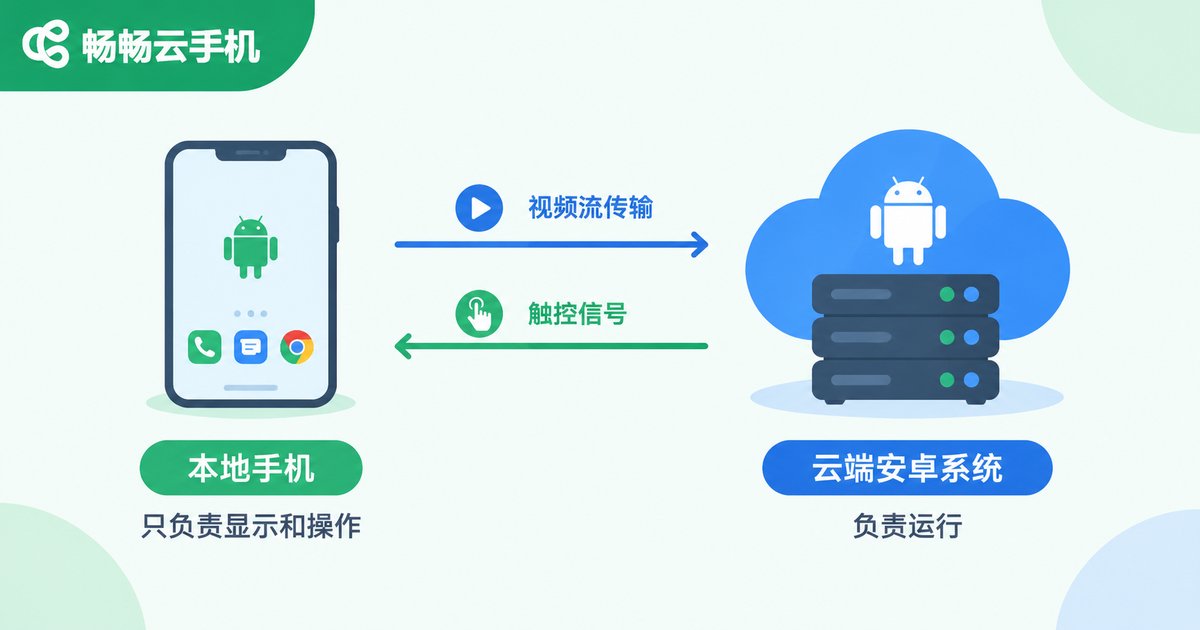
Does a Cloud Phone Overheat? First, Understand Where the Heat Is\n\n"Cloud phone overheating" — this sounds contradictory at first. The cloud phone runs in the cloud, heat is generated on data center servers, so how would your local device get hot?\n\nIn practice, when users say "cloud phone overheating," they usually mean one of two things: the local device heats up while using the cloud phone client, or the cloud phone instance's performance degrades due to resource overload (perceived as "lag and heat"). These two situations have completely different causes and solutions.\n\n## Local Device Heating: The Real "Hot Hand" Source\n\nWhen using the ChangChang Cloud Phone client, your local device continuously does two things: decode video streams and send touch commands. Video decoding is a CPU- and GPU-intensive operation that causes local device heating over extended use.\n\n### Local Device Heat Source Analysis\n\n| Heat Source | Load Type | Heat Level | Optimizable |\n|:---|:---|:---|:---|\n| Video stream decoding | CPU + GPU | ★★★★★ | Lowering quality significantly reduces |\n| Touch command encoding | CPU | ★☆☆☆☆ | Nearly impossible to optimize |\n| Network communication | Modem/NIC | ★★☆☆☆ | Wired connection can reduce |\n| Screen always on | Screen/backlight | ★★★☆☆ | Lowering brightness reduces |\n| Client UI rendering | GPU | ★★☆☆☆ | Simplifying UI reduces |\n\n### Local Device Cooling Solutions\n\n| Solution | Effect | Difficulty | Side Effect |\n|:---|:---|:---:|:---|\n| Lower quality mode | ★★★★★ | ★☆☆ | Reduced image clarity |\n| Lower screen brightness | ★★★☆☆ | ★☆☆ | Reduced outdoor visibility |\n| Use cooling clip | ★★★★☆ | ★★☆ | Adds device weight |\n| Wired network instead of Wi-Fi | ★★☆☆☆ | ★☆☆ | Limits mobility |\n| Remove phone case | ★★☆☆☆ | ★☆☆ | Loses protection |\n| Intermittent use (rest 10 min per hour) | ★★★☆☆ | ★☆☆ | Affects continuity |\n\n> Key data: Dropping from "Ultra-Clear" to "Balanced" mode reduces local device CPU load by about 40% and GPU load by about 50%, significantly reducing heat. This is the simplest and most effective cooling method.\n\n## Cloud Instance "Overheating": Resource Overload Symptoms\n\nThe cloud phone instance itself doesn't "overheat" — it runs in a professional data center cooling environment. But when instance resource usage is too high, the system exhibits "thermal throttling"-like behavior: performance drops, frame rate decreases, response slows. Users perceive this as "lag and heat."\n\n### Typical Cloud Resource Overload Symptoms\n\n| Symptom | Cause | Difference from Local Heating |\n|:---|:---|:---|\n| Sudden frame rate drop | Insufficient CPU/GPU resources | Local device not hot |\n| Screen stuttering | Instance resources limited | Network latency normal |\n| Slow app launch | Insufficient memory causing swapping | Restarting instance fixes |\n| Background apps killed | System memory pressure triggers OOM | Unrelated to local device |\n\n### Cloud Thermal Control Strategy\n\nChangChang Cloud Phone's data center uses a multi-layer cooling system to ensure stable server operation under high load:\n\n| Cooling Layer | Mechanism | Effect |\n|:---|:---|:---|\n| Chip level | CPU/GPU built-in temp sensors, dynamic frequency scaling | Prevents chip overheating |\n| Server level | Air/liquid cooling heatsinks, heat pipes | Maintains chip temp in safe range |\n| Rack level | Hot/cold aisle isolation, directional airflow | Improves cooling efficiency |\n| Room level | Precision AC, temp/humidity control | Maintains constant temp/humidity |\n| Scheduling level | Load balancing, hot spot migration | Prevents single server overload |\n\n## The Cloud Phone's "Virtual Thermal Control" Mechanism\n\nLike the virtual battery, ChangChang Cloud Phone simulates a temperature sensor in the cloud Android system. This virtual temperature sensor tells cloud apps the current device temperature status.\n\n| Virtual Temp State | Meaning | Impact on Apps |\n|:---|:---|:---|\n| Normal (below 35°C) | Instance resources sufficient | All apps run normally |\n| Warm (35–45°C) | Instance load high | Some games may limit frame rate |\n| Overheated (above 45°C) | Instance resources tight | System may limit background activity |\n\n### Why Simulate Temperature?\n\nLike the battery, many Android apps check device temperature to adjust behavior:\n\n- Camera apps lower resolution when overheating\n- Games lower quality and frame rate when overheating\n- Navigation apps lower update frequency when overheating\n\nChangChang Cloud Phone defaults the virtual temperature to "Normal," ensuring all apps run at maximum performance. But when instance resources are tight, the system automatically raises the virtual temperature, triggering apps' throttling mechanisms to prevent instance crashes.\n\n## Heat Comparison Across Use Cases\n\n| Use Case | Local Device Heat | Cloud Instance Load | Overall Experience |\n|:---|:---|:---|:---|\n| High-quality gaming | Severe heating | High load | Needs cooling measures |\n| Medium-quality gaming | Moderate heating | Medium load | Basically comfortable |\n| Video watching | Slight heating | Low load | Comfortable |\n| Daily operations | Almost no heat | Very low load | Imperceptible |\n| Multi-instance running | Moderate heating | High load | Monitor resources |\n\n## Q&A\n\nQ1: My phone gets so hot it auto-throttles while gaming on ChangChang Cloud Phone. What should I do?\n\nA: This is local device heating from video stream decoding. The most effective solution is lowering the quality mode — from "Ultra-Clear" to "Balanced" reduces CPU and GPU load by 40–50%. If it's still hot, consider a cooling clip — the most effective physical cooling solution for phones. Also, removing the phone case helps — many cases trap heat.\n\nQ2: The cloud phone screen suddenly lags, but my local device isn't hot. What's the cause?\n\nA: This is likely cloud instance resource overload. Check if too many apps are running simultaneously or if there are high-load background tasks. Solution: close unnecessary background apps or restart the instance to free resources. If resource shortages happen frequently, consider upgrading to a higher-spec instance plan.\n\nQ3: Does a cooling clip help with cloud phone use?\n\nA: Yes, but the mechanism differs from physical phones. For physical phones, cooling clips cool the chip; for cloud phones, they cool the local device's decoding chip. Video decoding is the main cause of local heating, and cooling clips effectively lower the decoding chip temperature, preventing local device throttling that causes screen stuttering. Semiconductor cooling clips are recommended over fan types.\n\nQ4: Why doesn't my computer heat up with cloud phone but my phone does?\n\nA: Computer cooling systems are far superior to phones — computers have fans, heat pipes, and large heatsink fins, while phones rely on passive cooling (body conduction) and small vapor chambers. The same decoding load is easy for a computer but causes phone heating. For extended cloud phone use, the computer is the better choice.\n\nQ5: Will long-term cloud phone use cause data center servers to overheat?\n\nA: No. Data centers have comprehensive cooling systems and load balancing mechanisms. When a server's load is too high, the scheduling system automatically assigns new instances to other servers, preventing hot spots. Additionally, data center precision AC runs 24/7, maintaining constant room temperature. Your long-term cloud phone use won't cause additional cooling pressure on the data center — servers are designed for 24/7 high-load operation.