
Free vs Paid Cloud Phone: Key Differences, Use Cases and How to Choose
First, Understand: What Actually Differs Between Free and Paid Cloud Phones
A cloud phone is, in simple terms, a virtual Android phone running in a remote data center. It does not consume your physical phone's storage or battery — all apps run in the cloud, and your real phone acts as a remote control. That is why cloud phones are widely used for multi-open gaming, app AFK farming, and bulk account management.
Almost every cloud phone provider uses a free + paid dual model: the free tier lets you try the service at zero cost, while paid plans unlock stronger hardware and more devices. Understanding the differences helps you avoid detours and pick the right version from the start.
Core Differences at a Glance
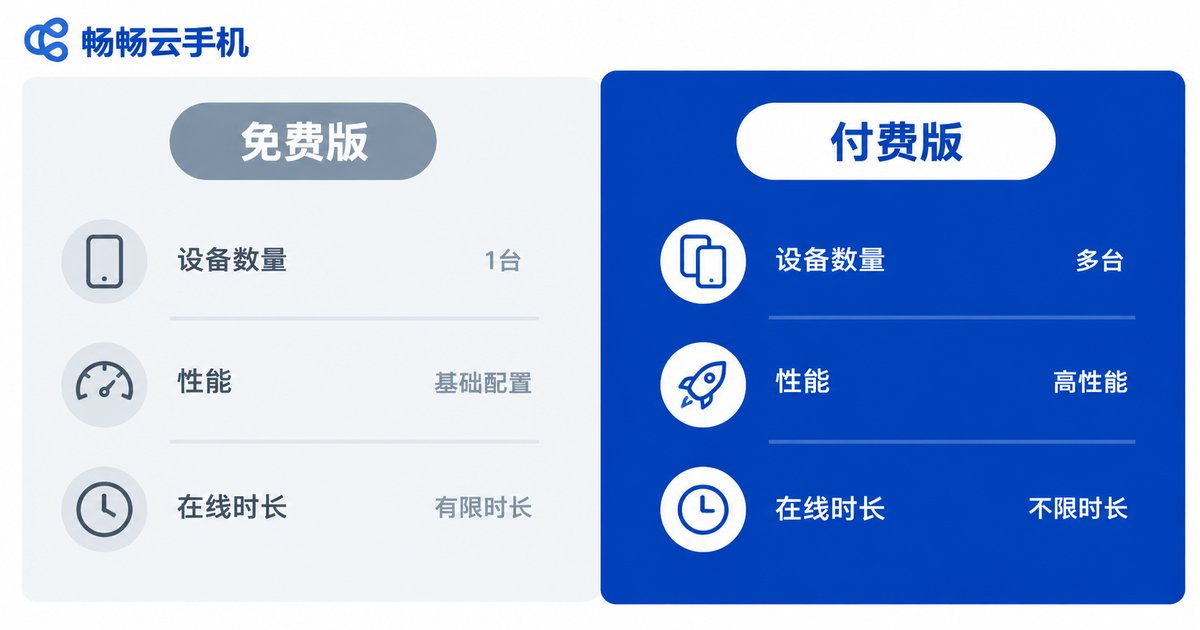
The table below summarizes typical differences across key dimensions (details vary slightly by provider, but the overall pattern is consistent):
| Dimension | Free Version | Paid Version |
|---|---|---|
| Number of devices | Usually 1 device, multi-open limited | Multiple devices, expandable by plan |
| Performance | Basic specs, usable but not powerful | Higher CPU and RAM, runs large games smoothly |
| Online time | Daily limits or queuing may apply | 24/7 stable online with dedicated resources |
| Advanced features | Basic functions only | Group control, multi-sync, virtual location, etc. |
| Network and quality | Standard lines, possible lag at peak hours | Premium lines, sharper image, lower latency |
| Support | Community and self-help | Dedicated support with faster response |
In one sentence: the free version is a trial kit, the paid version is a productivity tool. If you are simply curious about cloud phones, the free tier is enough; once your needs involve multi-open, AFK farming, or gaming, the stability and efficiency of a paid plan become obvious.
Who Is the Free Version For?
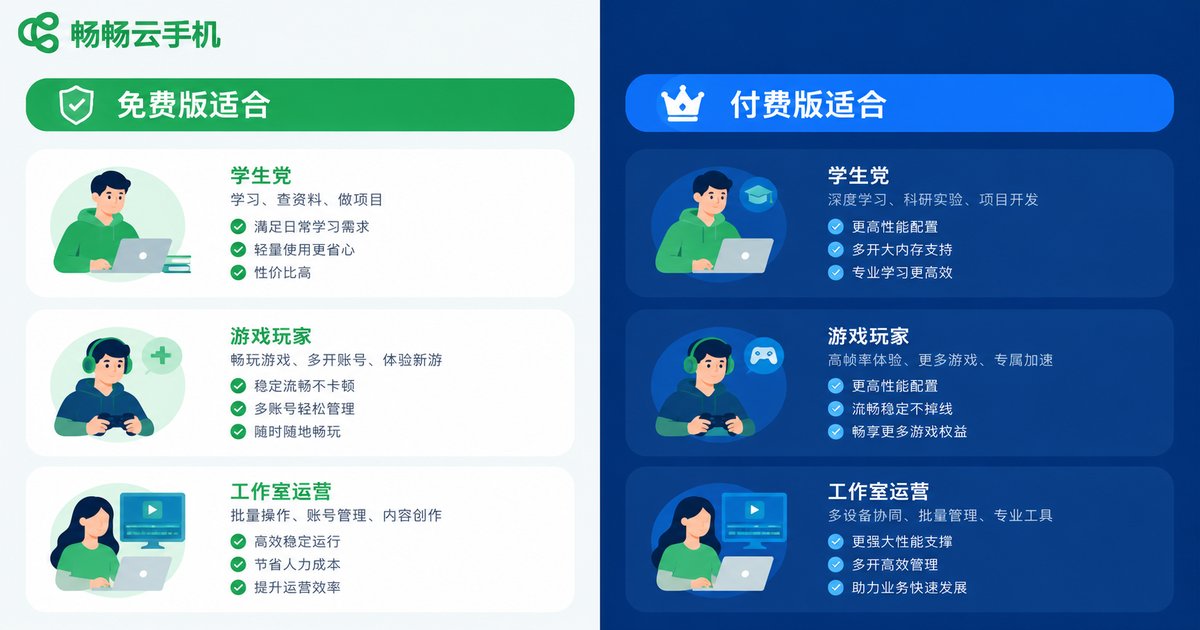
The free version's value is zero-cost trial and error. The following users are perfectly fine with it:
1. First-time explorers. If you want to know what a cloud phone feels like and whether it runs smoothly, try the free tier for a few days — far more useful than reading ten reviews.
2. People who occasionally need a spare phone. For example, temporarily signing into an account on another device to receive messages or verification codes — such low-frequency use is fully covered by the free tier.
3. Casual players with light AFK needs. If you only idle an hour or two a day and are not sensitive to speed, the free specs can cope.
Who Should Pay for a Plan?
If any of the following describes you, a paid plan is basically a must:
1. Multi-account operators. Running e-commerce, social media, or game account matrices requires many cloud phones online at once — the single-device limit of free tiers will directly block your business.
2. Game grinders and multi-boxers. Long AFK sessions fear disconnects and lag. Dedicated resources and stable uptime directly determine your yield.
3. Performance-hungry gamers. To play large mobile games smoothly on a cloud phone, the frame rate and image quality of high-spec plans are something free tiers cannot offer.
4. Efficiency users who need advanced features. Group control, synchronized multi-device operations, and batch management are usually available only in paid versions.
Three Questions to Help You Decide
Still hesitating? Ask yourself three questions:
First, how many devices do I need at once? More than one? Go straight to paid plans.
Second, how long must it stay online every day? The longer the AFK time, the more you need the stability of a paid plan.
Third, light apps or heavy games? Large 3D games demand high specs — choose a high-performance plan to avoid a stuttering experience.
A practical strategy: validate your needs on the free version first, then upgrade to a paid plan as needed. That way you waste no money and never suffer from underpowered devices.
Why We Recommend ChangChang Cloud Phone (ccloudphone) for Paid Plans
Among the many cloud phone products available, ChangChang Cloud Phone (ccloudphone) deserves priority consideration. It offers a complete range from free trial to multiple paid plans: start at zero cost, confirm it fits your scenario, then smoothly upgrade to the plan that matches your needs.
Its strengths come down to three points: stable — 24/7 cloud uptime without disconnects while AFK farming; multi-open — run many cloud phones simultaneously with efficient batch management; easy to use — a clean interface where a single app on your real phone controls multiple cloud devices. Whether you are a casual explorer or a heavy multi-account user, there is a plan for you.
FAQ
Q: Is the free version free forever?
Most products allow long-term free use, but with limits on features, specs, and online hours, plus possible queuing at peak times. Check each provider's official terms for details.
Q: Will my data be kept if I upgrade from the free version to a paid plan?
Within the same account system, cloud data usually carries over. Back up important files before upgrading and confirm migration rules with official support.
Q: Is a paid plan a one-time purchase or a subscription?
Mainstream cloud phones are subscription-based (monthly, quarterly, etc.) and renewable. Buying according to your actual usage cycle offers the best value.
Q: How is a cloud phone different from an emulator?
An emulator runs on your own computer and consumes local resources; a cloud phone runs on remote servers, uses none of your local specs, and keeps running even when your computer is off — the key reason it is ideal for AFK farming.
Q: How many cloud phones can one real phone control?
It depends on the device limit of your paid plan, from a few to dozens. ChangChang Cloud Phone lets you manage multiple cloud phones in one interface with easy switching.