
How Deep Can Cloud Phone Device Parameter Virtualization Go? IMEI, MAC and Sensor Consistency Linkage Explained
Why Device Parameter Virtualization Is the Foundation of Cloud Phone Realism
A cloud phone runs on servers in a data center, yet every app it hosts must see what looks like an ordinary Android device. The translation layer that makes this possible is device parameter virtualization: rewriting dozens of hardware fingerprints—model, OS version, IMEI, MAC address, sensor list—into one self-consistent virtual identity. The shallower the rewrite, the more cracks show; the deeper and more coordinated it is, the harder it is for apps to tell the device actually lives in the cloud.
Many users only ask whether the IMEI can be changed, but what really decides success or failure is consistency: faking any single parameter legally in isolation is easy; the hard part is making dozens of parameters corroborate one another without contradiction. Let's break it down category by category.
IMEI Virtualization: Three Layers of Validation Behind One Number
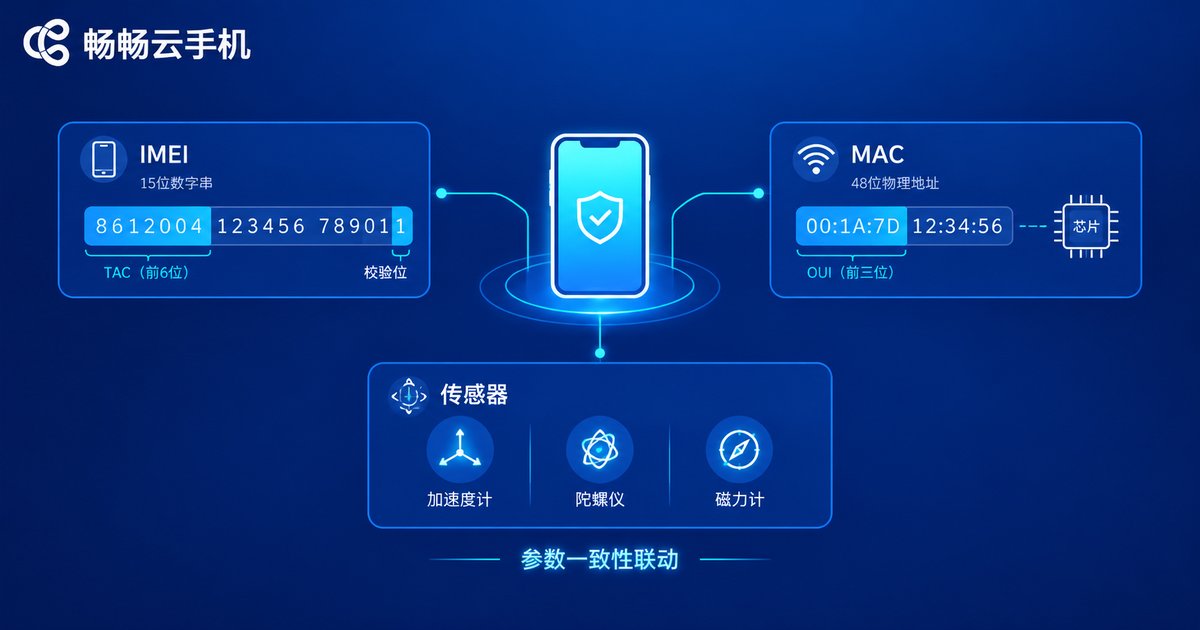
The IMEI is a 15-digit identifier that many apps use to recognize a specific device. Shallow virtualization simply generates 15 random digits, but deep virtualization must pass three gates:
Gate one: the Luhn check digit. The final digit is computed with the Luhn algorithm. Random numbers usually fail this check—one of the easiest tests for detectors to run.
Gate two: TAC aligned with the model. The first 8 digits form the TAC (Type Allocation Code), tied to a specific model and production batch. If the profile claims a certain flagship model but the TAC block does not match that model's real allocation, you have an instant contradiction.
Gate three: linkage with neighboring identifiers. The IMEI must share one coherent persona with the baseband version, carrier configuration, Android ID, and serial number. A new IMEI paired with an old serial number is like new shoes worn with old socks.
MAC Address Virtualization: The OUI Prefix Must Match Its Origin
The MAC address identifies the network hardware, and its first 3 bytes—the OUI—are assigned by the IEEE to chipset vendors. This creates a detail that is often overlooked: the virtual MAC prefix must match the chipset actually used by the claimed model. If the device profile points to one chipset vendor while the virtual MAC carries another vendor's OUI, cross-validation will expose it.
Deeper linkage also means coordinating the MAC with Wi-Fi connection behavior, local IP assignment, and Bluetooth address patterns, and keeping the MAC policy stable across reboots—so the instance does not behave like a phone that swaps network cards every time it reconnects, which no real device does.
Sensor Virtualization: Data That Obeys the Laws of Physics
Sensors are where shallow virtualization breaks most easily, because real sensor streams follow physical laws:
At rest: the combined magnitude of the three accelerometer axes should be about 9.8 m/s², oriented consistently with the device's posture.
While rotating: gyroscope angular velocity must be continuous and smooth, corroborating the accelerometer's trend.
Lists must match the model: flagships normally ship with a gyroscope and magnetometer. A virtual flagship without a gyroscope is an obvious contradiction—and an entry-level model sprouting high-end sensors is just as suspicious.
Deep virtualization generates continuous, noisy, correctly sampled data streams instead of returning the same fixed value on every read—a constant value is itself a scripting fingerprint.
The Consistency Linkage Mechanism: Parameters Must Know One Another
Putting it all together, the core idea of consistency linkage is that no parameter stands alone; each must be corroborated by the others. App-side detection is usually cross-validation, and typical cases look like this:
| Detection Action | Shallow Virtualization Flaw | Deep Linkage Behavior |
|---|---|---|
| Validate IMEI Luhn digit and TAC block | Random digits unrelated to the model | Check passes; TAC matches the virtual model |
| Look up the MAC OUI vendor | OUI inconsistent with the chipset | OUI, chipset, and model all aligned |
| Compare sensor list with model tier | Flagship missing a gyroscope | Sensor set matches the model tier |
| Observe sensor time-series traits | Constant values or sudden jumps | Continuous, noisy, physically coherent |
| Cross-check Build fingerprint with hardware | Fingerprint conflicts with resolution or RAM | One coherent fingerprint from a single source |
In short, shallow virtualization changes a name; deep virtualization issues a complete identity file—name, accent, and history all in agreement.
A Four-Level Depth Model: Where Does Your Cloud Phone Sit?
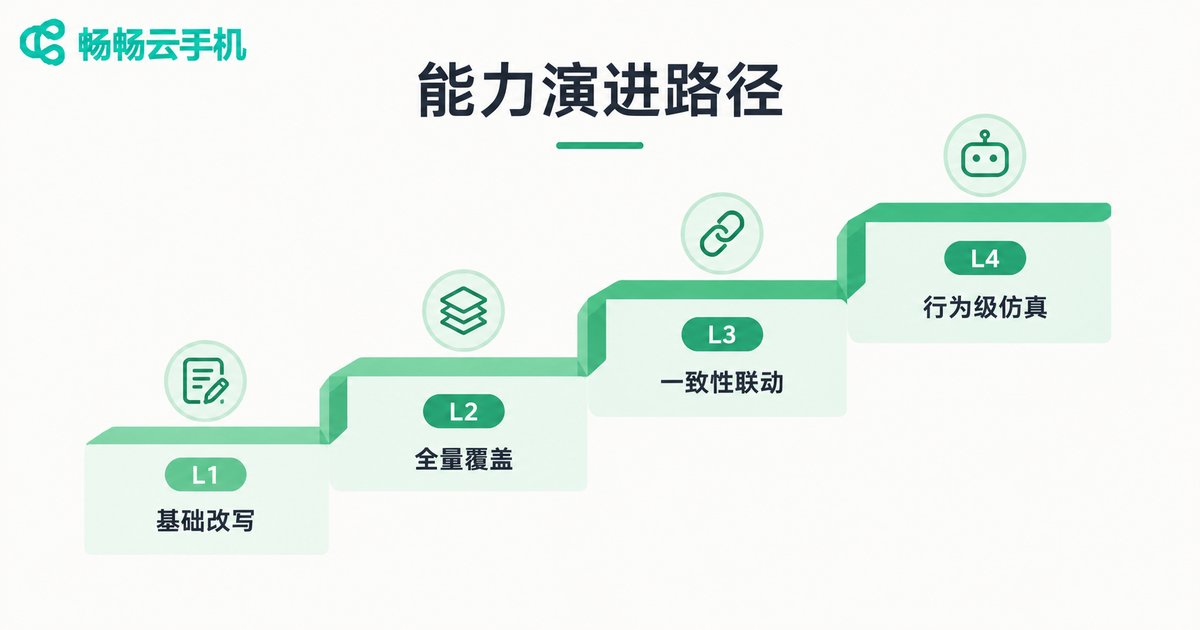
By linkage depth, cloud phone virtualization can be roughly graded into four levels:
L1 Basic rewrite: only a few static strings such as model and manufacturer are changed; parameters are unrelated and easy to expose under cross-validation.
L2 Full coverage: IMEI, MAC, Android ID, serial number and more can all be virtualized, each individually legal (for example, passing the Luhn check), but not necessarily linked to one another.
L3 Consistency linkage: parameters auto-align around a model profile—TAC to model, OUI to chipset, sensors to tier—forming one self-consistent identity. This is the passing grade for a mature cloud phone.
L4 Behavioral simulation: on top of L3, sensor streams, timing traits, and post-reboot parameter stability all match real-device habits, standing up to intensive risk-control checks.
A Three-Step Self-Check for Virtualization Depth
You do not need professional tools to run three simple tests:
Step one, verify the check digit: read the IMEI and validate the last digit with an online Luhn tool; then check whether the TAC block matches the virtual model.
Step two, verify the OUI: note the first 6 hex digits of the MAC, look them up in the IEEE OUI database, and compare the vendor with the model's chipset.
Step three, verify the sensors: install any sensor-testing app and check that the sensor list matches the model tier, and that the accelerometer at rest hovers near 9.8 rather than some odd fixed value.
Pass all three and the service is at least at L3 consistency linkage.
Buying Advice: Leave Parameter Realism to a Professional Service
For most users, hand-tuning parameter linkage is complex and error-prone. The practical choice is a cloud phone service that keeps investing in virtualization depth. ChangChang Cloud Phone (ccloudphone), for example, gives every cloud phone instance an independent, self-consistent Android environment with device parameters maintained uniformly by the platform—no manual assembly of hardware fingerprints—delivering out-of-the-box consistency for multi-account operations, multi-instance gaming, and other scenarios that demand device realism. For current features and plans, please refer to the official ccloudphone website.
FAQ
Q: Is a cloud phone's IMEI a real, existing number?
No—it is a virtually generated but legitimate number: 15-digit format, a Luhn-valid check digit, and a TAC block matching the virtual model, so it behaves like a real device from the app's perspective.
Q: Does deep virtualization guarantee undetectability?
The parameter layer is the foundation, but apps may also weigh network environment and behavior patterns. Deep virtualization sharply reduces parameter-level cracks; it is the base of realism, not the only factor.
Q: Will changing device parameters affect existing accounts?
Frequent changes can themselves trigger risk control. Mature cloud phones keep per-instance parameters stable over the long term; fix the device identity for the life of the account rather than switching constantly.
Q: Can I customize device parameters on ChangChang Cloud Phone?
The platform maintains each instance's virtual device identity uniformly to guarantee consistency and stability, so no manual configuration is required; for adjustable options, refer to the official website.