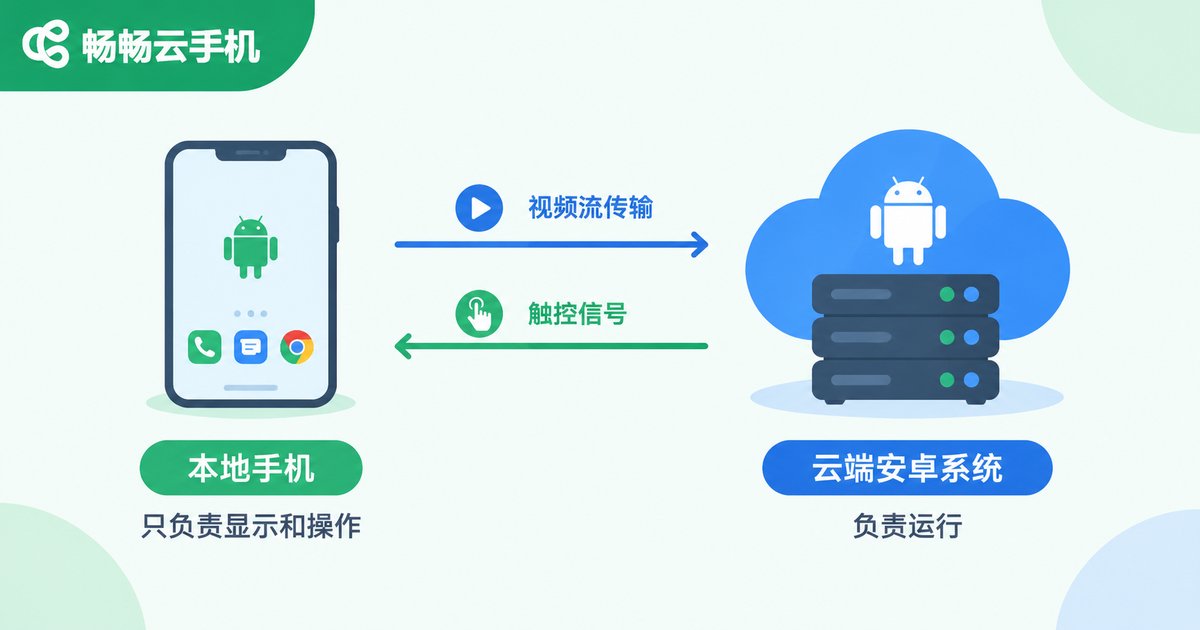
Why Your Cloud Phone Screen Always Looks Blurry\n\nMany users fire up ChangChang Cloud Phone for the first time and immediately think, "Why does this look a bit fuzzy?" It's usually not a product flaw — cloud phone video is streamed in real time over the network, passing through encoding, transmission, and decoding before it reaches your eyes. If any link in that chain is misconfigured, image quality takes a hit.\n\nThere are three distinct types of "blurry": overall haziness like a layer of fog, jagged text edges, and severe motion smearing. Each traces back to a different parameter, so you can't treat them all the same way.\n\n## Four Core Parameters: Resolution, DPI, Bitrate, Frame Rate\n\nCloud phone image quality is governed by four parameters. Understanding how they interact is the first step in tuning:\n\n| Parameter | Role | Raising It | Lowering It | Recommended |\n|:---:|:---|:---|:---|:---:|\n| Resolution | Total pixel count, sets clarity ceiling | Sharper details | Blurry but smoother | 1080P (1920×1080) |\n| DPI | Pixel density, affects text/icon size | Crisper text, finer UI | Larger elements, less info | 320–480 |\n| Bitrate | Data per second, sets information density | Cleaner image, fewer artifacts | Visible compression, color banding | 8–15 Mbps |\n| Frame Rate | Refreshes per second, sets smoothness | Silkier animation | Smearing, stutter | 60 FPS |\n\n> Golden rule: Resolution determines "how sharp it can be," bitrate determines "how clean it arrives," frame rate determines "how smooth it moves," and DPI determines "how big the text is." They must be balanced — maxing out everything isn't the answer.\n\n## Step-by-Step Tuning: From Blurry to Ultra-Clear\n\n### Step 1: Lock In the Right Resolution\n\nGo to ChangChang Cloud Phone's "Settings → Display → Resolution." You'll see several options. Many people leave it at 720P, which is passable on a small phone screen but exposes pixel shortage when cast to a computer monitor.\n\nRecommendation: If your bandwidth is above 20Mbps, go straight to 1080P. If you have ample bandwidth (50Mbps+) and a capable device, try 2K (2560×1440) — but you must raise the bitrate proportionally, otherwise 2K with a low bitrate looks worse than 1080P because the compression blocks are larger.\n\n### Step 2: Adjust DPI to Sharpen Text\n\nDPI (Dots Per Inch) is often overlooked in cloud phones. Too low and text appears tiny with fuzzy edges; too high and UI elements crowd together. ChangChang Cloud Phone defaults to around 320 DPI, suitable for most phone screens. But if you're using it on a large computer monitor, bump it to 400–480 for noticeably crisper text.\n\n| Use Case | Recommended DPI | Notes |\n|:---:|:---:|:---|\n| Phone portrait mode | 320–360 | Default, fits most devices |\n| Phone landscape gaming | 240–280 | Wider field of view |\n| Computer monitor | 400–480 | Large screens need higher density |\n| 4K TV casting | 480–560 | Match high-res display |\n\n### Step 3: Bitrate Is the "Invisible Ceiling" on Quality\n\nThis is the most easily overlooked factor. No matter how high the resolution, insufficient bitrate causes color blocks, mosaic artifacts, and smearing. Bitrate is essentially how much data bandwidth you're willing to allocate per second of video.\n\nTuning guide:\n\n- 1080P / 60FPS: At least 10Mbps, recommended 12–15Mbps\n- 720P / 60FPS: 6–8Mbps is sufficient\n- 2K / 60FPS: Needs 20Mbps or above\n\nChangChang Cloud Phone offers four presets under "Settings → Display → Quality Mode": Smooth, Balanced, HD, and Ultra-Clear. If you don't want to tweak manually, just pick Ultra-Clear and the system auto-matches the optimal resolution-bitrate combination.\n\n### Step 4: Don't Blindly Max Out Frame Rate\n\nFrame rate affects dynamic scene smoothness. 60FPS is the current ceiling for most cloud phones and the recommended value for gaming. But if you mainly watch videos or scroll feeds, 30FPS is perfectly adequate and frees up bandwidth for bitrate.\n\n| Use Case | Recommended FPS | Recommended Bitrate | Notes |\n|:---:|:---:|:---:|:---|\n| Casual / card games | 30 FPS | 8 Mbps | Low frame rate demand |\n| Action / shooter games | 60 FPS | 12–15 Mbps | Needs high frame + high bitrate |\n| Video watching | 30 FPS | 10 Mbps | Quality over frame rate |\n| Daily office tasks | 30 FPS | 6 Mbps | Sufficient |\n\n## Network Environment: The Invisible Quality Killer\n\nNo matter how well you tune parameters, a poor network ruins everything. Cloud phones need stability, not just speed. Latency jitter impacts experience far more than raw bandwidth — a 100Mbps connection with severe jitter can feel worse than a rock-solid 20Mbps dedicated line.\n\nNetwork checklist:\n\n1. Prefer wired connections: Wi-Fi inherently has interference; Ethernet eliminates 90% of fluctuations\n2. Close background downloads: Cloud phones need sustained bandwidth; any background download competes for it\n3. Check router QoS: If your router supports it, set cloud phone traffic to high priority\n4. Test latency, not speed: Ping the cloud phone node — under 30ms is ideal\n\n## Quick Troubleshooting Table\n\n| Symptom | Likely Cause | Solution |\n|:---|:---|:---|\n| Overall haziness, fog-like | Low resolution or DPI mismatch | Raise to 1080P, adjust DPI |\n| Visible color blocks / mosaic | Insufficient bitrate | Switch to Ultra-Clear or raise bitrate manually |\n| Blurry text with jagged edges | DPI too low | Raise DPI to 400+ |\n| Motion smearing | Low frame rate | Set to 60FPS |\n| Quality fluctuates | Network jitter triggers adaptive bitrate drop | Check network stability, disable adaptive bitrate |\n| Color shift / overexposure | Codec incompatibility | Switch between H.265 / H.264 |\n\n## Codec: H.264 or H.265?\n\nChangChang Cloud Phone supports both H.264 and H.265 (HEVC). H.265 requires only about 60% of H.264's bitrate for the same quality, making it an effective way to boost image quality — provided your receiving device supports H.265 hardware decoding, which most devices from 2018 onward do.\n\nRecommendation: Use H.265 first. If you experience screen tearing or stuttering, fall back to H.264.\n\n## Q&A\n\nQ1: I selected "Ultra-Clear" mode but it still doesn't look sharp enough. Why?\n\nA: Ultra-Clear is just a preset combination — actual results are constrained by network bandwidth. First confirm your available bandwidth exceeds 15Mbps. Also check your display's native resolution: if you're viewing 1080P cloud phone output on a 1080P monitor, pixels map 1:1, which is already the sharpest possible state. Your expectations may simply be too high.\n\nQ2: Is 2K always sharper than 1080P?\n\nA: Not necessarily. 2K requires higher bitrate support. If the bitrate can't keep up, 2K compression artifacts are actually more visible than 1080P. With limited bandwidth, 1080P + high bitrate often looks cleaner than 2K + low bitrate.\n\nQ3: Why is the image clear during the day but blurry at night?\n\nA: This is typically caused by network congestion. Evening is peak broadband usage time, and shared neighborhood bandwidth gets squeezed. ChangChang Cloud Phone's adaptive bitrate mechanism automatically reduces bitrate to maintain smoothness, at the cost of image quality. The fix is to manually lock the bitrate or switch to off-peak hours.\n\nQ4: It looks sharp on my phone but blurry when cast to my computer. What's going on?\n\nA: This is a resolution mismatch. Phone screens are typically 5–6 inches, where 1080P has very high pixel density. But a 24–27 inch computer monitor stretches the same 1080P, drastically reducing pixel density — naturally it looks blurry. The fix is to raise the cloud phone resolution to 2K and increase DPI when using it on a computer.\n\nQ5: I maxed out the bitrate but still see color blocks. What now?\n\nA: Color blocks aren't always a bitrate issue — they can also stem from codec format or network packet loss. Try switching to H.265 first. If the problem persists, test packet loss with ping — a loss rate above 1% causes color blocks and mosaic artifacts. In that case, you need to troubleshoot the network link, not adjust parameters.