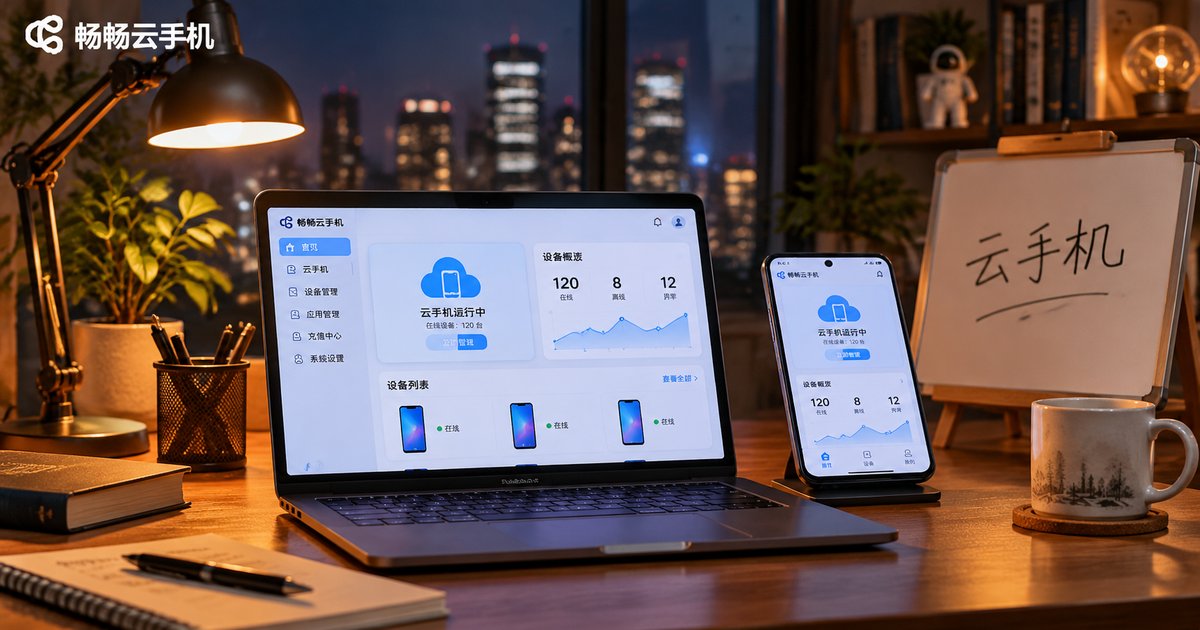

Cloud Phones in Amazon Multi-Store Operations: Compliance Boundaries and What the Platform Explicitly Prohibits
First Things First: Does Amazon Allow Multi-Store Operations?
Many sellers assume Amazon enforces a strict 'one person, one account' rule, but the platform does not blanket-ban multiple accounts. Under Amazon's official policy, sellers may operate multiple seller accounts when there is a legitimate business reason — for example, owning multiple independently registered brands, running separate business lines, or accounting separately for different markets. The key prerequisite is that you must notify Amazon in advance and obtain approval, rather than opening accounts first and asking questions later.
In other words, running multiple stores is not a violation in itself — only non-compliant multi-store setups are. Every account needs its own set of independent, authentic, verifiable business credentials: a separate business license, a separate receiving account, a separate credit card, separate tax information, and a verifiable business address. Overlapping credentials are the root cause of nearly all account-linking problems.
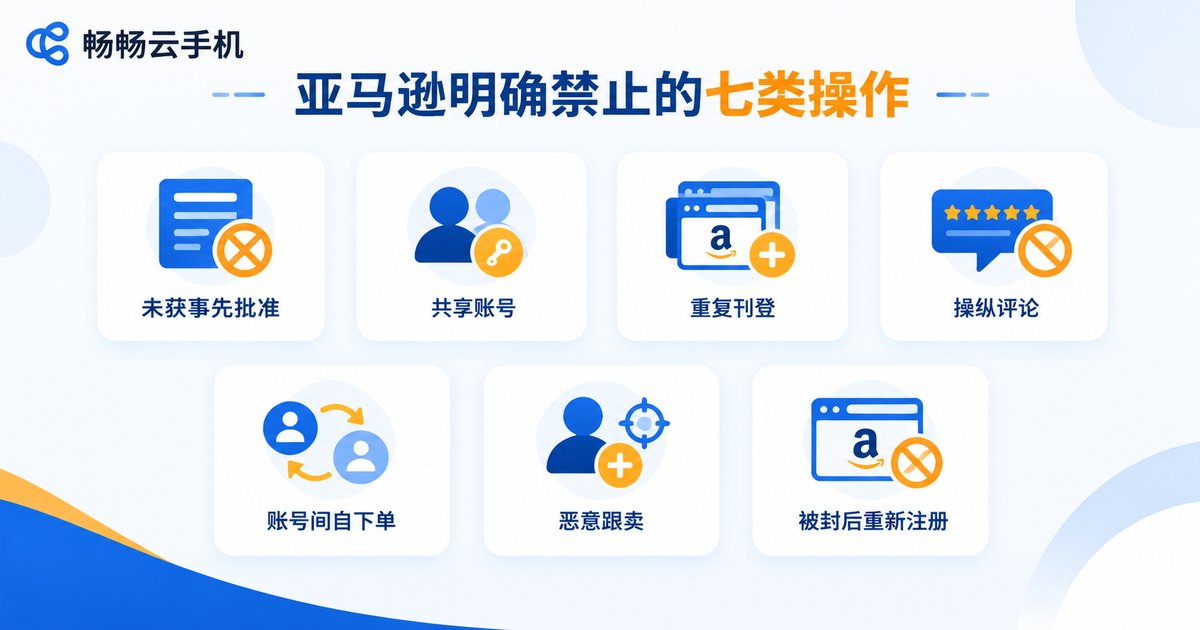
Seven Practices Amazon Explicitly Prohibits
The following behaviors are explicitly prohibited or high-risk under Amazon's rules, and multi-store sellers should steer clear of all of them:
1. Opening multiple accounts without prior approval. Registering several accounts without a legitimate business reason or platform approval; once linked accounts are identified, Amazon may require you to close the extra accounts — or suspend all of them.
2. Sharing one set of credentials across accounts. Using the same business license, the same legal representative, the same credit card, or the same receiving account for multiple stores is a hard indicator Amazon uses to link accounts.
3. Duplicate listings. Listing the same batch of products or the same brand across multiple stores to crowd search results is a prohibited manipulation tactic.
4. Review manipulation. Fake orders, cash-back-for-review schemes, incentivized reviews via buyer-seller messaging, or bulk reviews through 'testing' resources — including accounts reviewing each other — are prime enforcement targets.
5. Self-dealing between accounts. Placing orders on Store B from Store A and shipping them to create fake sales volume and tracking numbers constitutes fraudulent order manipulation.
6. Using secondary accounts to attack primary accounts. Malicious follow-selling through linked secondary accounts, placing fake orders then filing complaints, or dragging down the performance of competing listings (including your own other stores) is classic abuse.
7. Instantly registering a new account after suspension. Skipping the appeal process and re-registering under a new shell right after a suspension is treated as penalty evasion, and the new account will most likely be linked to the ban.
How Does Amazon Judge Account Linking?
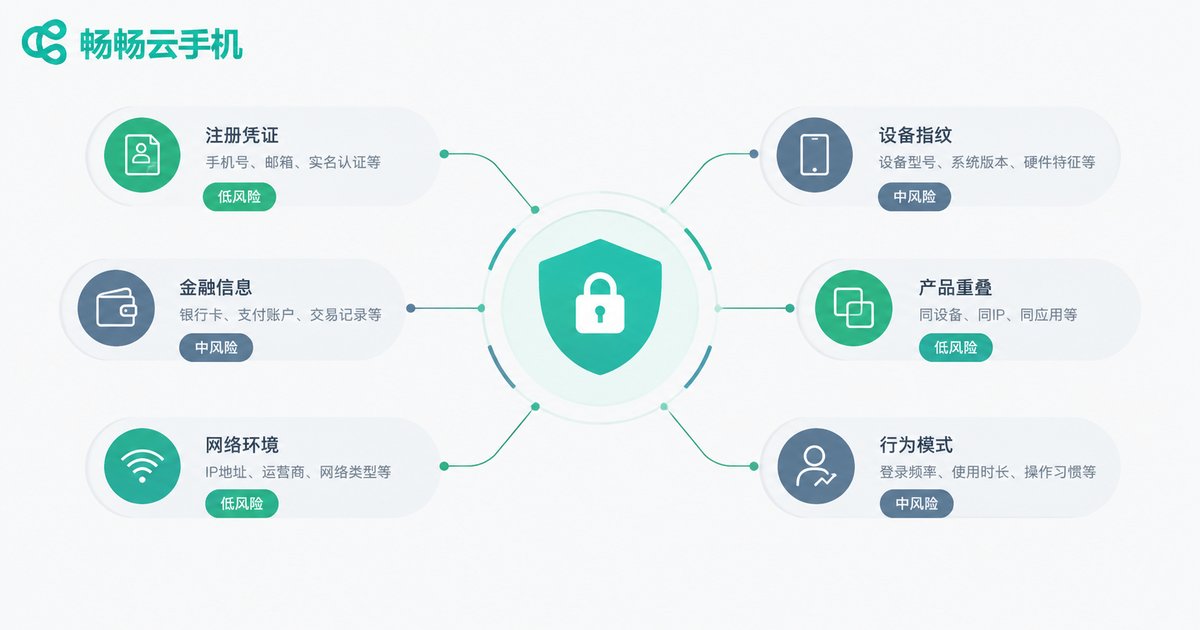
Many sellers believe they 'did nothing wrong' yet still get flagged as linked accounts, because Amazon's linking determination is a weighted combination of multiple factors, not a single metric. Common dimensions include:
| Factor | Details | Risk Level |
|---|---|---|
| Registration credentials | Business license, legal representative, address, phone, email | High |
| Financial information | Receiving account, credit card, tax ID | High |
| Network environment | Login IP addresses and their history | Medium |
| Device environment | Device fingerprint, browser characteristics, system parameters | Medium |
| Product information | Overlap in listings, images, descriptions, brands | High |
| Behavioral patterns | Similarity in login times and operating habits | Low |
Among these, overlapping registration credentials and financial information constitute 'hard linking' that is nearly impossible to argue against; network and device environments are 'soft linking' factors that may not trigger a determination alone but raise risk when stacked with others. This is why the first step of compliance is always credential independence, and environment isolation comes second.
The Right Role for Cloud Phones in Multi-Store Operations
With the rules clear, let's look at what a cloud phone can and cannot do. A cloud phone is not an 'anti-linking magic tool' — it is a device environment management tool. Its value lies in standardizing the practice of 'one independent device environment per store' and making it manageable at scale.
Take ccloudphone as an example: each cloud phone runs in the cloud with its own independent device parameters and system environment. Different stores log in through different cloud phones, avoiding frequent account switching on the same physical device. Cloud phones also stay online around the clock, so buyer messages and order alerts are never interrupted by an after-hours shutdown. With batch management, your team can view and operate all store environments from one console, reducing the chaos caused by multiple people working from multiple locations.
But the boundary must be emphasized: cloud phones solve only the 'device environment' layer. If your stores share a business license, share a receiving account, or were never reported to the platform, no device can change the fact of 'credential linking.' A tool helps you standardize what you can control — it cannot perform compliance on your behalf.
A Compliance Checklist You Can Follow Today
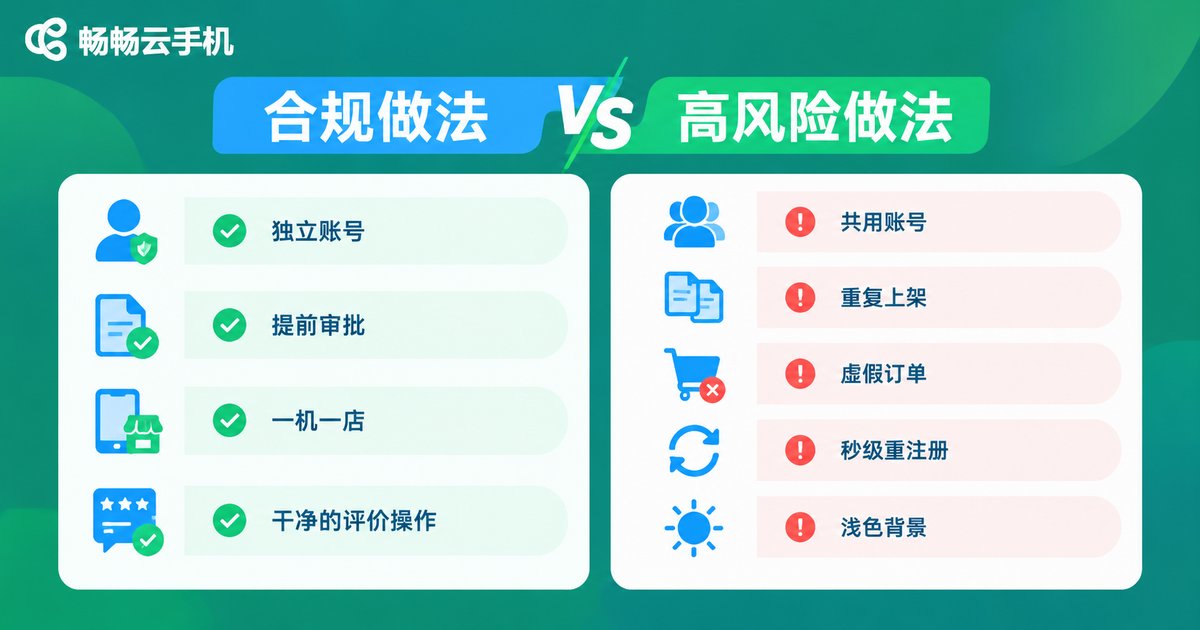
Condensed into an actionable checklist, multi-store sellers can audit themselves item by item:
Before registration: Prepare an independent business license, receiving account, and credit card for each store; confirm a legitimate business reason for multiple accounts; report your multi-account need to Amazon through official channels.
During operations: Assign each store a fixed, independent login environment (including its cloud phone); differentiate products, brands, and creatives substantively across stores; keep all review acquisition practices clean — no fake orders or incentives; divide team responsibilities by store to avoid cross-account confusion.
When issues arise: If an account receives a warning or suspension, go through the official appeal process immediately and keep complete evidence; do not register new accounts while an appeal is pending.

ccloudphone: Turning Environment Management into a Standard Routine
For teams running — or preparing to run — multiple stores, the value of ccloudphone comes down to three points: environment independence — each cloud phone carries its own device parameters, enabling one store, one device, one environment; stable availability — cloud-based and online around the clock, keeping customer support and order monitoring uninterrupted; centralized management — batch operations and unified scheduling across multiple cloud phones, with team collaboration that is traceable. For current features and plans, please refer to the official ccloudphone website.
To return to the boundary in the title: what the platform prohibits is never 'multi-store' itself, but 'non-compliant multi-store operations.' Get these four things right — authentic and independent credentials, prior approval, clean review practices, and environment isolation — and your cloud phone can play its proper role within a compliant system.
FAQ
Q: Can one person legally operate multiple Amazon stores?
Yes, provided there is a legitimate business reason, prior approval from Amazon, and fully independent registration credentials and financial information for each account.
Q: Will logging into Amazon stores via cloud phones trigger account linking?
Linking is a multi-factor determination. Cloud phones provide independent device environments that reduce device-level overlap, but sellers must still keep registration credentials, financial details, and product information independent.
Q: How many Amazon stores can one cloud phone handle?
For compliance, we recommend 'one device, one store' — each cloud phone is dedicated to a single store environment, avoiding frequent switching between stores in the same environment.
Q: After a suspension, can I immediately register a new store using a cloud phone?
Not recommended. Resolve the original account's issue through the official appeal channel first; registering a new account beforehand may be treated as penalty evasion and get the new account linked to the ban.
Q: How is a cloud phone different from switching accounts on a regular phone?
Frequent login and logout of multiple accounts on one physical phone creates highly overlapping device fingerprints; a cloud phone gives each account a long-term, fixed, mutually independent device environment, which suits daily multi-store management far better.