
Is Cloud Phone Account Nurturing Reliable? Practical Experience Sharing: 92% Survival Rate for Douyin/Kuaishou Matrix Accounts
The Short Answer: Is Cloud Phone Account Nurturing Reliable?
Here is the direct answer: yes, but with conditions. A cloud phone is essentially a tool—the tool itself does not determine success; how you use it does. Over the past year, our team has operated more than 300 Douyin and Kuaishou matrix accounts on cloud phones, and long-term tracking shows a stable account survival rate of around 92%. Behind this number is not luck, but a replicable methodology: environment isolation + behavior simulation + rhythm control.
At the same time, let us set realistic expectations: if you think you can simply spin up a cloud phone, leave it idle for seven days, and the account will automatically gain weight, you will probably be disappointed. Platform risk control identifies behavior patterns, not devices. Cloud phones solve the environment problem; the behavior problem still depends on your operational strategy.
Why Do Traditional Multi-Account Methods Get Banned?
Before discussing methods, it helps to understand why platforms ban accounts. Douyin and Kuaishou risk control systems focus on three dimensions:
1. Device fingerprint: Logging multiple accounts into the same physical phone means identical device IDs, IMEI numbers, and other fingerprint data—platforms can easily flag this as a marketing matrix.
2. Network environment: Multiple accounts sharing one IP address, especially batch operations under the same WiFi, almost inevitably trigger risk control.
3. Behavioral characteristics: New accounts immediately posting videos, batch liking and following, and highly regular operation schedules—these bot-like behaviors are prime enforcement targets.
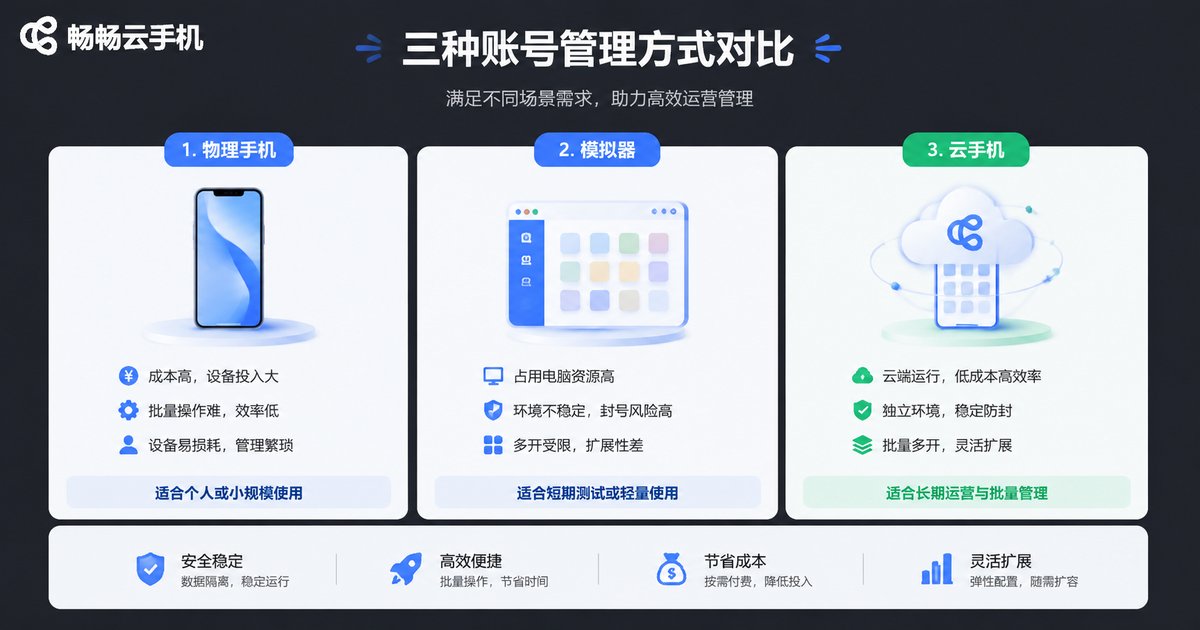
The comparison between traditional approaches and cloud phone matrices is clear:
| Dimension | Physical Multi-Device | Emulator Multi-Open | Cloud Phone Matrix |
|---|---|---|---|
| Device fingerprint | Identical | Easily detected | Independent per unit |
| IP isolation | Hard to achieve | Hard to achieve | Independent IP supported |
| Batch management | Very inefficient | Moderate | Convenient group control |
| Cost | High hardware cost | Low but risky | Pay as you go |
The Three Core Elements Behind a 92% Survival Rate
Element 1: Environment isolation is the foundation. Each account maps to one independent cloud phone with fully isolated device parameters, storage, and app data, eliminating the risk of one banned account taking down the entire matrix. When possible, assign an independent IP to each cloud phone so that every account also looks like a real, standalone phone at the network level.
Element 2: Behavior simulation must look human. The core of account nurturing is not idling—it is making the account look like a real user. Browse videos for 30-60 minutes during fixed time slots each day, with content relevant to the account positioning; like posts occasionally, comment sparingly, and watch videos through before swiping away to simulate real viewing duration; do not follow dozens of accounts right away.
Element 3: Control the pace and do not rush. For the first 7-14 days, post no marketing content at all and only browse and interact normally; around day 15, publish the first piece of vertical content; afterwards maintain a stable publishing rhythm. Never post five videos in one day and then go silent for a week.
A Practical Account Nurturing Schedule
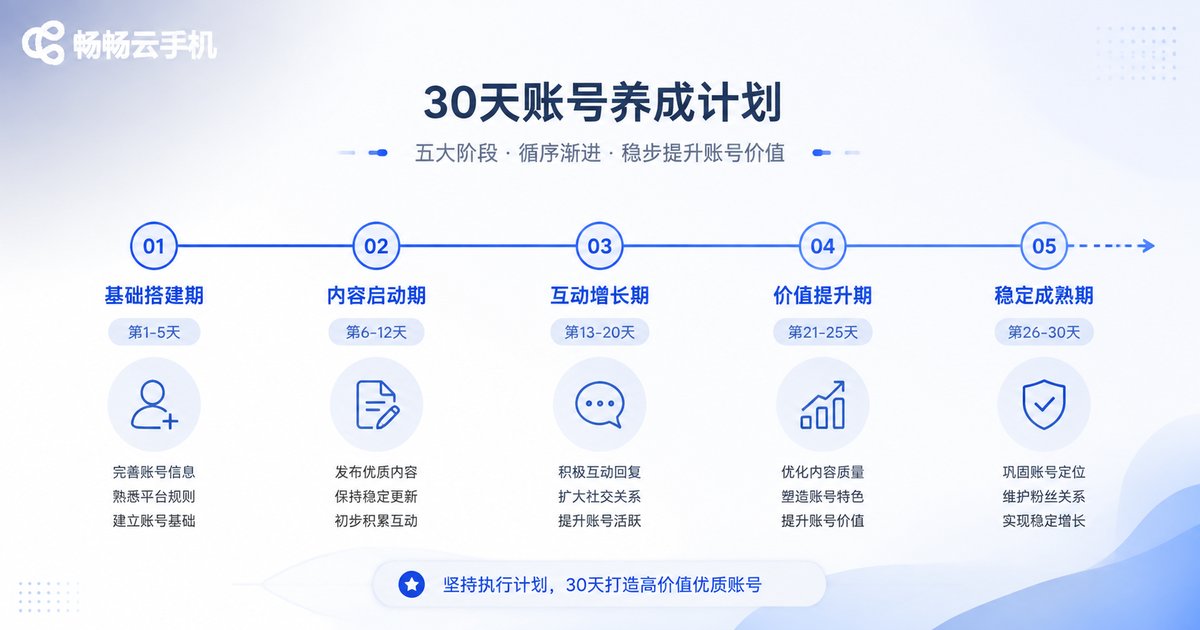
Here is the schedule our team has validated, for reference:
| Phase | Timing | Key Actions | What to Avoid |
|---|---|---|---|
| Cold start | Days 1-3 | Complete profile, browse only | No profile edits, no posting |
| Habit building | Days 4-7 | Browse 40 min daily, like and comment | No batch following |
| Weight accumulation | Days 8-14 | Sustained interaction, watch livestreams | No promotional content |
| Content testing | From day 15 | Publish vertical content, watch traffic | No frequent video deletion |
| Stable operation | After day 30 | Fixed schedule, gradual monetization | No hard-sell spam |
The Four Most Common Pitfalls
Pitfall 1: Mixing accounts and devices. Accounts and cloud phones must map one-to-one. Once mixed, all previous environment isolation is wasted.
Pitfall 2: Batch operations at the same time. No matter how good the environment isolation is, if 10 accounts all come online at exactly 9:00 AM every day, the behavioral pattern is so uniform that risk control will catch it. Staggered scheduling is basic hygiene for matrix operations.
Pitfall 3: Frequently switching IPs during nurturing. An IP in one city today and another city tomorrow is more suspicious than a fixed one. Choose one and stay stable.
Pitfall 4: Reposting without re-creation. Device environment is only the entry ticket; content is the lifeline. Pure reposts with no editing will be throttled no matter how well you nurture the account.
Tool Choice: Why We Use CCloudPhone
There are quite a few cloud phone products on the market. Our team ultimately chose and continues to use CCloudPhone (Changchang Cloud Phone), based on several points of real-world experience:
1. Real device environment in the cloud: Accounts run in a real phone environment in the cloud, with better compatibility and stability for short video apps such as Douyin and Kuaishou, and a daily experience close to a physical phone.
2. Independent device information: Each cloud phone has its own device parameters. Combined with independent IPs, the environment isolation is solid.
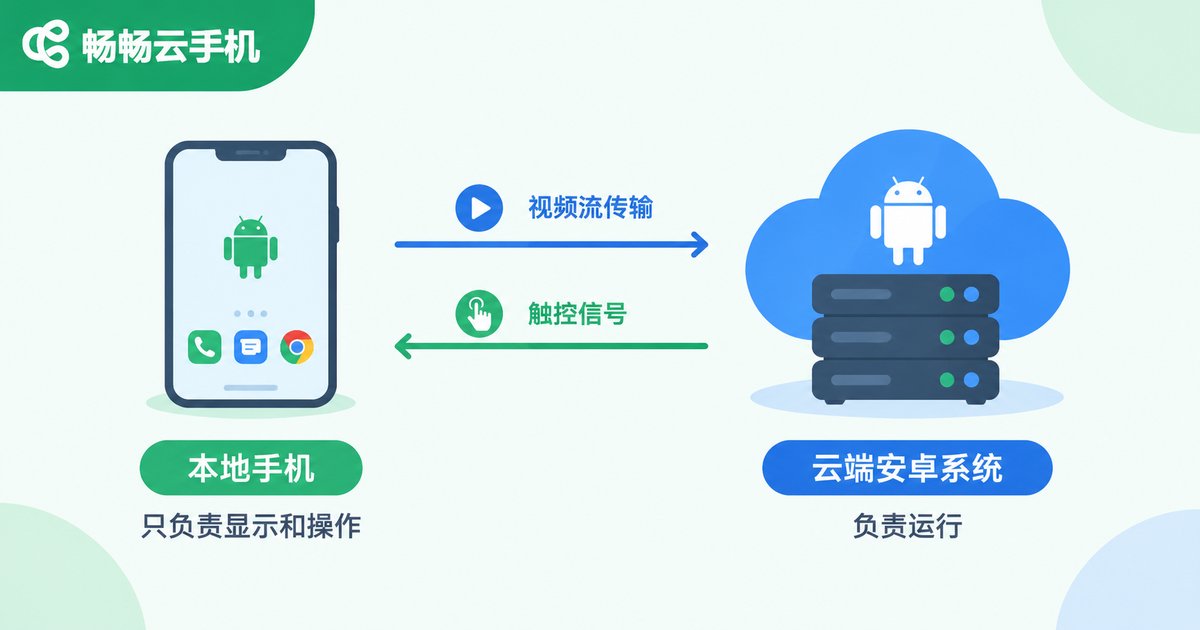
3. 24/7 online: Cloud phones run continuously in the cloud without occupying local resources. Idle browsing and livestream watching during the nurturing period can all happen in the cloud—even with your local device shut down.
4. Batch management efficiency: Multiple cloud phones can be managed uniformly, saving time and effort on batch operations—especially suitable for daily matrix account maintenance.
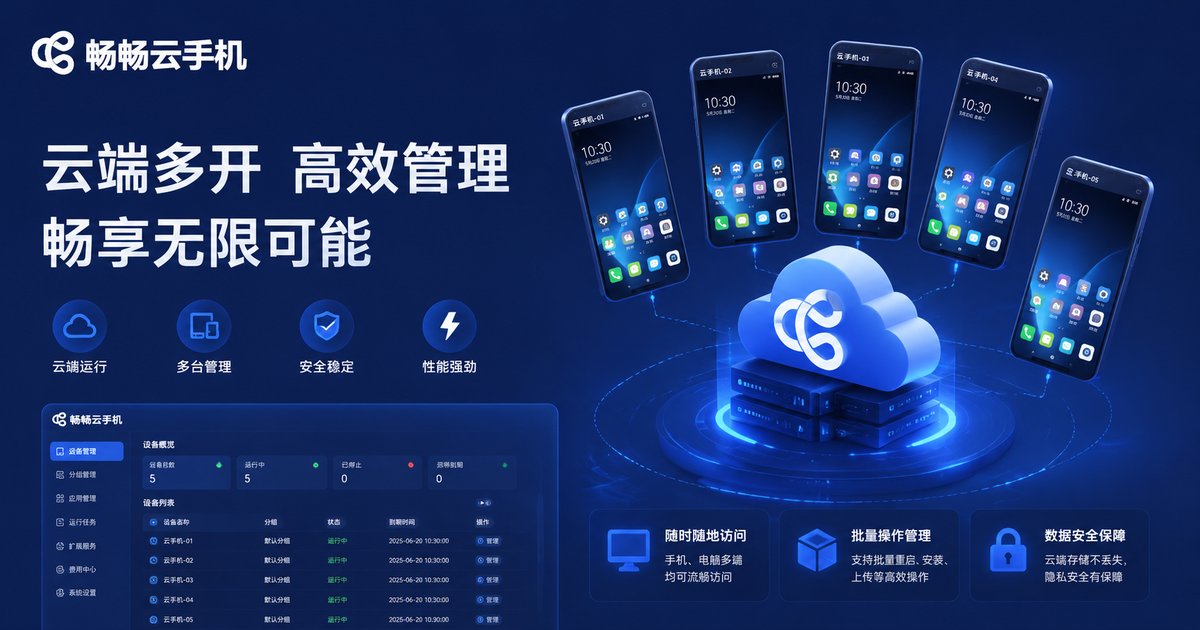
Of course, the tool is only an amplifier. With the same cloud phone, some build refined matrices with 92% survival rates, while others blast out spam and lose everything. The difference lies in methodology.
FAQ
Q: How long does cloud phone account nurturing usually take?
The standard rhythm is a 7-14 day pure interaction period, first content around day 15, and stable operation after 30 days. For highly competitive verticals, extend the pure interaction period to about 20 days.
Q: Can one cloud phone host multiple accounts?
Technically yes, but it is strongly discouraged. One account per cloud phone is the basic guarantee of matrix survival—mixing them means voluntarily giving up environment isolation.
Q: How long should the account stay active each day during nurturing?
30-60 minutes of browsing and interaction per day is enough. What matters is authentic behavior and distributed timing, not accumulated hours. One three-hour binge is worse than two half-hour sessions.
Q: Can a throttled account be saved?
Mild throttling can recover. Stop posting promotional content first, return to pure browsing and interaction for 7-10 days, and watch whether traffic recovers. If there is no improvement after two consecutive weeks, it is better to abandon the account and start over—sunk costs are not worth clinging to.
Q: Is there a big gap between cloud phone and physical phone nurturing?
With environment isolation done properly, the gap is small. The advantage of cloud phones lies in cost and batch management efficiency—the price of one physical phone can run multiple cloud phones, which is clearly better value for matrix operations.