What Is a Cloud Phone? The Ultimate Beginner's Guide
Understanding Cloud Phones in Plain Language
Imagine a phone that isn't in your pocket but in a data center thousands of miles away. You control it remotely through your screen, like flying a drone with a remote control.
That "remote phone" is a cloud phone.
Its essence is an Android virtual machine running on cloud servers. Though you can't see or touch it, it has a complete Android system, an independent IMEI, and a dedicated IP address. You can install apps, log into accounts, send messages — almost identical to a real phone.
How Cloud Phones Work
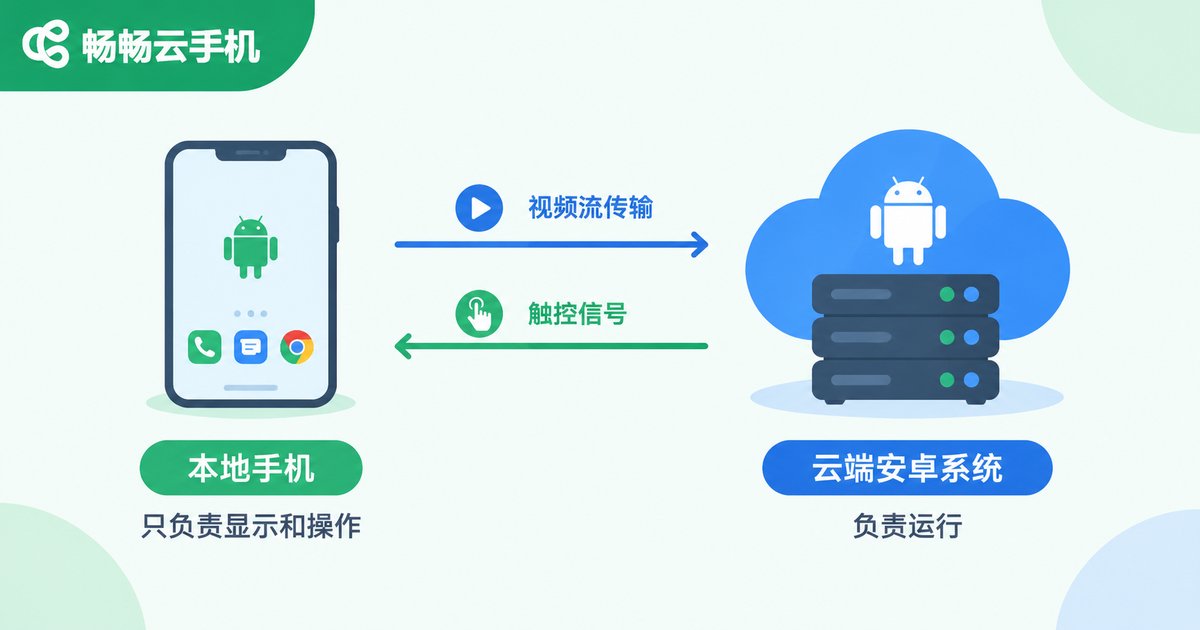
The workflow can be simplified into three steps:
- Cloud operation: Your cloud phone runs on servers in a data center; CPU, memory, and storage are all provided by servers
- Screen streaming: The cloud phone's screen is transmitted in real time over the internet to your device
- Remote control: Your taps and swipes are sent back over the internet to be executed in the cloud
In one sentence: Cloud phone = Remotely running Android system + real-time screen streaming + remote control
Cloud Phone vs. Real Phone Comparison
| Dimension | Cloud Phone | Real Phone |
|---|---|---|
| Hardware location | Cloud servers | In your hand |
| Boot time | Seconds | Seconds |
| Continuous running | 24/7 no shutdown | Needs charging |
| Device fingerprint | Independently generated | Fixed at factory |
| IP address | Configurable dedicated IP | Depends on network |
| Storage | Cloud (usually 20-200GB) | Local (usually 128GB+) |
| Multi-instance | Dozens or more | 1-2 |
| Hardware features | No NFC/Bluetooth/camera | Full features |
What Can Cloud Phones Do? Quick Reference
| Use Case | Specific Scenarios | Why Cloud Phones |
|---|---|---|
| Multi-account ops | WeChat multi-instance, social matrix | One cloud phone per account, no correlation |
| Game idling | Mobile games online 24/7 | No battery drain, doesn't occupy real phone |
| Overseas business | Cross-border social, e-commerce | Dedicated IPs, simulate overseas environment |
| Remote work | Handle work while traveling | Portable office environment |
| App testing | Compatibility testing | Quickly create multiple test environments |
| Privacy protection | Install untrusted apps | Fully isolated from personal phone |
5 Common Misconceptions for Beginners
1. Cloud phone = controlling someone else's phone?
No. A cloud phone is a virtual phone created specifically for you. Only you can access it, and data is fully isolated.
2. Cloud phone = phone emulator?
No. Emulators run on your computer and share the computer's device fingerprint. Cloud phones run in the cloud, each with an independent device fingerprint and IP.
3. Will apps detect cloud phones as virtual machines?
Reputable cloud phones are optimized at the device fingerprint level — most apps cannot distinguish cloud phones from real phones. However, apps with extremely high security requirements (like banking apps) may impose restrictions.
4. Do cloud phones need extra data plans?
No. Cloud phones use the server's network connection, not your phone's data. However, remotely controlling a cloud phone from your device does consume some data (for screen streaming).
5. Are cloud phones for everyone?
No. If you just need one phone for daily use, cloud phones aren't the best choice. But if you need multi-account, multi-instance, idling, or remote access, cloud phones are a game-changer.
How to Choose a Cloud Phone Platform
- Check configuration: CPU cores, memory, storage meeting your needs
- Check network: Are there nodes near you? Is latency acceptable?
- Check service: Response speed, technical support, fault compensation
- Check pricing: Pay-as-you-go or monthly plans, reasonable pricing
- Try first: Use free hours to experience before paying
FAQ
Q: What devices can I use to access cloud phones?
A: Any internet-connected device — phones, tablets, computers. Larger screens are recommended for better operation experience.
Q: Do I need to reinstall apps on cloud phones?
A: Yes. A cloud phone is a brand new Android system; you need to reinstall apps and log into accounts.
Q: Will cloud phones leak my privacy?
A: Reputable platforms have strict data isolation and security measures. Choose trusted platforms; your data belongs only to you.
Q: Is cloud phone network speed fast?
A: Depends on the data center's network. Under normal home broadband, video playback and app usage work fine.
Q: Can a cloud phone run 24/7?
A: Yes. Cloud phones are designed for continuous 24-hour operation — that's one of their core advantages.