What Is a Cloud Phone? How Virtual Phones Work in 2026
Where Does a Cloud Phone Actually Run?
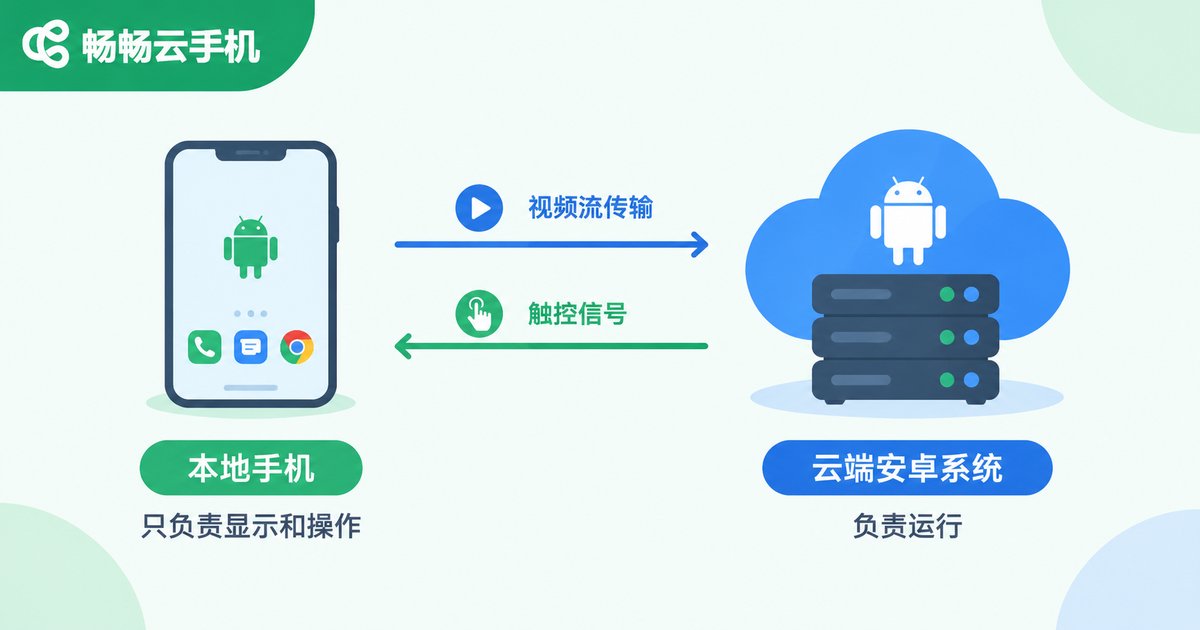
A cloud phone's "body" lives in a data center server room. The Android home screen you see on your phone is actually the display of a virtual Android instance running on a server.
In simple terms, a cloud phone is a "cloud-run + remote-control" system: computing happens in the cloud, the screen is streamed to you over the network, and your input is sent back to the cloud.
A Complete Workflow
When you open an app on a cloud phone, here's what happens behind the scenes:
| Stage | What happens |
|---|---|
| Initiate action | You tap the screen on your local device |
| Upload input | The touch input travels over the network to the cloud server |
| Cloud execution | The Android instance on the server executes the action |
| Screen encoding | The cloud encodes the screen into a video stream |
| Return display | The video stream is sent back to your device and displayed |
The entire loop completes within tens of milliseconds, so it feels like operating a local phone.
Why Can a Cloud Phone Stay Online 24/7?
Because a cloud phone's operation doesn't depend on your local device. Your phone, tablet, or computer is just the "remote control"—the real computing and storage are in the cloud.
- Turn off your phone, and the cloud phone keeps running
- Disconnect, and the processes inside the cloud phone are unaffected
- Log in from another device, and you see the same cloud phone
How Cloud Phones Have Evolved in 2026
After years of development, cloud phones have improved in several ways:
- Lower latency: Edge node deployment speeds up screen transmission for snappier control
- Higher quality: Higher bitrates produce clearer images
- Stronger specs: Cloud hardware keeps upgrading to run heavier apps
- Better cost: Economies of scale make prices more affordable
The Three-Layer Architecture
Cloud phone architecture can be simplified into three layers:
- Access layer: Your phone, tablet, or computer, responsible for display and input capture
- Transport layer: The network link, responsible for two-way transmission of input and video
- Compute layer: Cloud servers, responsible for running Android instances and storing data
Each layer has its own role, together forming the complete cloud phone experience.
Q&A
Q: Will the cloud phone screen look blurry? A: With a good network the picture is clear; under weak networks it automatically lowers quality to stay smooth. Use a stable network environment.
Q: Is cloud phone latency noticeable? A: Daily operations are basically imperceptible, and AFK and office use work fine. Competitive games may show slight latency.
Q: Does the cloud phone keep running after a disconnect? A: Yes. It runs in the cloud; a local disconnect only affects the connection, not the cloud processes.
Q: Where is cloud phone data stored? A: In cloud storage, isolated from your local device. Data remains intact after logging in from another device.