What Are Cloud Scripts? Differences and Connections with Cloud Phone Scripts
The Essence of Cloud Scripts: Automation Programs Running on Remote Servers
If you've worked with automation tools, the term "script" isn't new to you. But what makes "cloud scripts" special is that their execution environment isn't on your local computer — it's on remote cloud servers.
Here's an analogy: when you write a Python script on your local machine, it consumes your computer's CPU and memory. A cloud script, on the other hand, is like running code on a cloud provider's server. The key difference? You don't need to worry about server configuration, networking, or power — the cloud platform handles all of that.
The core value of cloud scripts lies in continuous operation and environment isolation. Turn off your local computer, and the cloud script keeps working diligently on the server. Your IP gets blocked or your network goes down — the cloud script continues running unaffected.
Typical Use Cases for Cloud Scripts
Cloud scripts have become quite mature in the following areas:
| Use Case | Specific Applications | Technical Features |
|---|---|---|
| Data Collection | Scheduled e-commerce price scraping, sentiment monitoring | Multi-IP rotation, anti-anti-crawling strategies |
| Automated Ops | Server inspection, log rotation, backups | Scheduled task scheduling, anomaly alerts |
| API Services | Webhook endpoints, message push | Persistent HTTP service, concurrent processing |
| Batch Processing | Video transcoding, image compression, data cleaning | Elastic computing resources, task queues |
| Monitoring & Alerting | Website availability checks, competitor tracking | 24/7 uninterrupted polling |
Cloud Phone Scripts: A More "Grounded" Variant
If cloud scripts are "programs running on servers," then cloud phone scripts are "programs running on cloud-based phones."
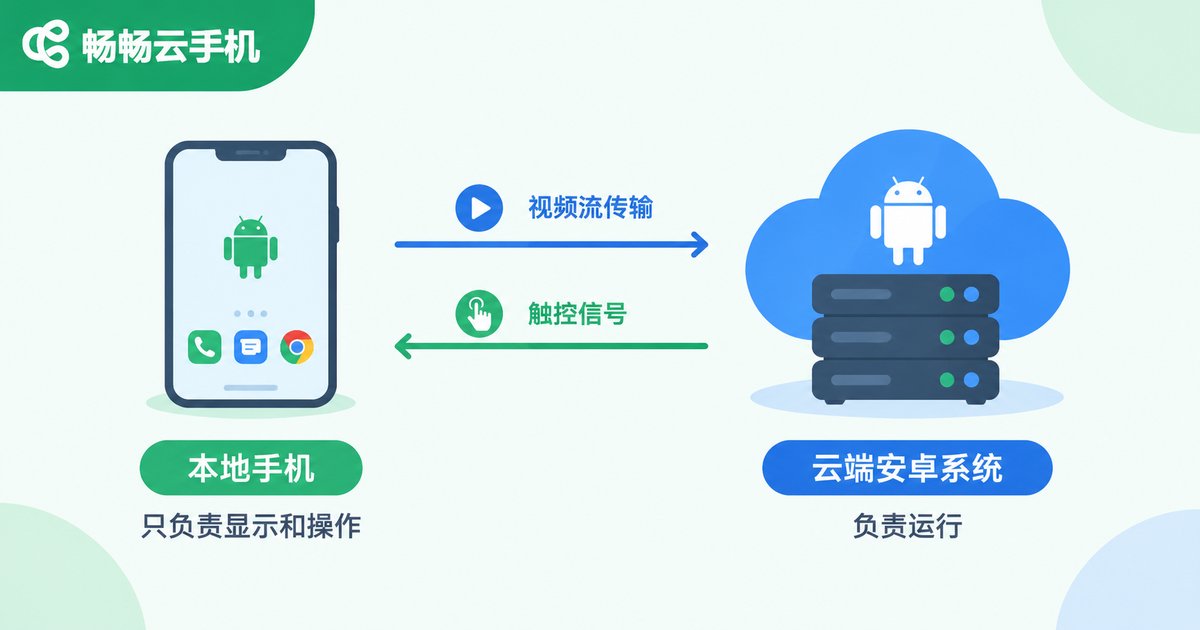
A cloud phone is essentially a virtual Android device running in a data center — it has a complete Android system, an independent IMEI, and a dedicated IP address. A cloud phone script is an automation tool that runs on this virtual phone.
Here's a critical distinction to understand:
- Cloud scripts run on Linux/Windows servers, targeting Web APIs, command lines, and file systems
- Cloud phone scripts run on the Android system, targeting app interfaces, touch operations, and sensor data
This means cloud phone scripts can do many things cloud scripts cannot — such as automatically scrolling through short videos, posting to social media, or nurturing accounts. These operations require a real app runtime environment and full phone sensor simulation — something ordinary servers simply cannot provide.
Technical Architecture Comparison
| Dimension | Cloud Scripts | Cloud Phone Scripts |
|---|---|---|
| Runtime Environment | Linux/Windows Server | Android Virtual Machine |
| Programming Languages | Python/Go/Node.js | Python(ADB)/Auto.js/Lua |
| Operation Targets | HTTP APIs, Databases, Files | App UI, Touch Events, Sensors |
| Resource Consumption | Low (billed by compute) | High (full system runs continuously) |
| Anti-Detection Capability | Relies on proxy IP pools | Independent device fingerprint + dedicated IP |
| Suitable Scenarios | Data processing, API calls | Social media ops, game farming, account nurturing |
Differences and Connections: Complementary, Not Replacements
Many assume cloud phone scripts will replace traditional cloud scripts, but in reality, they solve completely different problems.
Cloud scripts excel at "backend logic." For example, building a price monitoring system that scrapes product prices from 100 e-commerce platforms hourly, stores them in a database, and serves them via API. In this scenario, cloud scripts are the optimal solution — fast, low-cost, and highly stable.
Cloud phone scripts excel at "frontend interaction." For example, automatically posting videos on TikTok, auto-replying to comments, or auto-following users — these operations must be performed in a real app environment. Regular scripts cannot simulate app touch gestures or pass app risk-control checks. This is where cloud phone scripts become essential.
In real-world operations, the two often work together:
- Cloud scripts handle data collection and task scheduling — reading task lists from databases and distributing them to different cloud phone instances
- Cloud phone scripts execute specific app operations — opening TikTok, posting videos, filling in captions
- After execution, cloud phone scripts relay results back to cloud scripts for data aggregation and analysis
This "cloud script orchestration + cloud phone script execution" architecture is the mainstream approach for automated operations today. ChangChang Cloud Phone provides comprehensive API interfaces, supporting remote control of cloud phone instances via Python scripts for batch automation.
Selection Guide: Which One Should You Use?
- If you need data collection, API calls, or file processing → use cloud scripts directly for lower costs
- If you need app automation, social media operations, or account matrices → you must use cloud phone scripts
- If your business requires both → build a hybrid architecture with an orchestration layer (cloud scripts) and an execution layer (cloud phone scripts)
ChangChang Cloud Phone supports remote control through both ADB and API interfaces, allowing developers to write automation scripts in Python for batch management and task execution on cloud phones.
FAQ
Q: Can cloud scripts run on cloud phones?
A: Partially. Pure Python logic (not dependent on Android-specific features) can run through the cloud phone's ADB debugging interface or Termux terminal. However, if you need to call Android APIs or interact with app interfaces, specialized cloud phone script frameworks are required.
Q: Are cloud phone scripts more expensive than cloud scripts?
A: Yes. Cloud phone scripts require maintaining a complete Android virtual machine running continuously, consuming far more resources than lightweight cloud scripts. However, cloud phone scripts can do what cloud scripts cannot — such as authentic app interaction and independent device fingerprinting.
Q: Can a single cloud phone run multiple scripts simultaneously?
A: Theoretically yes, but not recommended. Multiple scripts operating on the same cloud phone simultaneously can cause conflicts (e.g., clicking different screen positions at the same time). Best practice is "one cloud phone, one script task."
Q: What scripting languages does ChangChang Cloud Phone support?
A: It supports writing control scripts in Python, Java, and other languages via the ADB interface, and also supports installing automation tools like Auto.js inside cloud phones. The platform provides complete API documentation for quick developer onboarding.