Is Cloud Phone a Scam? Deep Analysis of Pros, Cons & Target Users
The Verdict: Cloud Phones Aren't a Scam, But They're Not Magic Either
"Is cloud phone a scam?" — this question has been asked countless times on every major forum. The answer depends on who you are and what you're doing.
If you just want to replace your daily phone for browsing WeChat and watching videos, there's no need. But if you have needs like game AFK, multi-instance, app testing, or social media matrix operations, cloud phones are a tool that genuinely saves you money and effort.
The key isn't whether cloud phones are good or bad — it's whether your use case matches. Let's break down the pros and cons clearly.
Core Advantages of Cloud Phones
| Advantage | What It Means | Practical Value |
|---|---|---|
| Zero Hardware Investment | No physical phones to buy, pay-as-you-go | Save thousands in device costs |
| Elastic Scaling | Spin up dozens of instances in a minute | Handle sudden demand instantly |
| 24/7 Operation | No heat, no battery drain, non-stop | AFK and streaming with zero stress |
| Environment Isolation | Each instance has independent device info | Multi-account anti-association |
| Centralized Management | Dashboard controls all instances | One person manages dozens |
| Data Security | Data stays in the cloud, never on devices | Lose a device, don't lose data |
These advantages are irreplaceable by physical phones in specific scenarios. Need to run 20 game accounts simultaneously? Buying 20 phones costs tens of thousands; ChangChang Cloud Phone might cost a few hundred per month.
The Downsides
Let's be honest about the limitations.
1. Network-Dependent — No Internet, No Cloud Phone
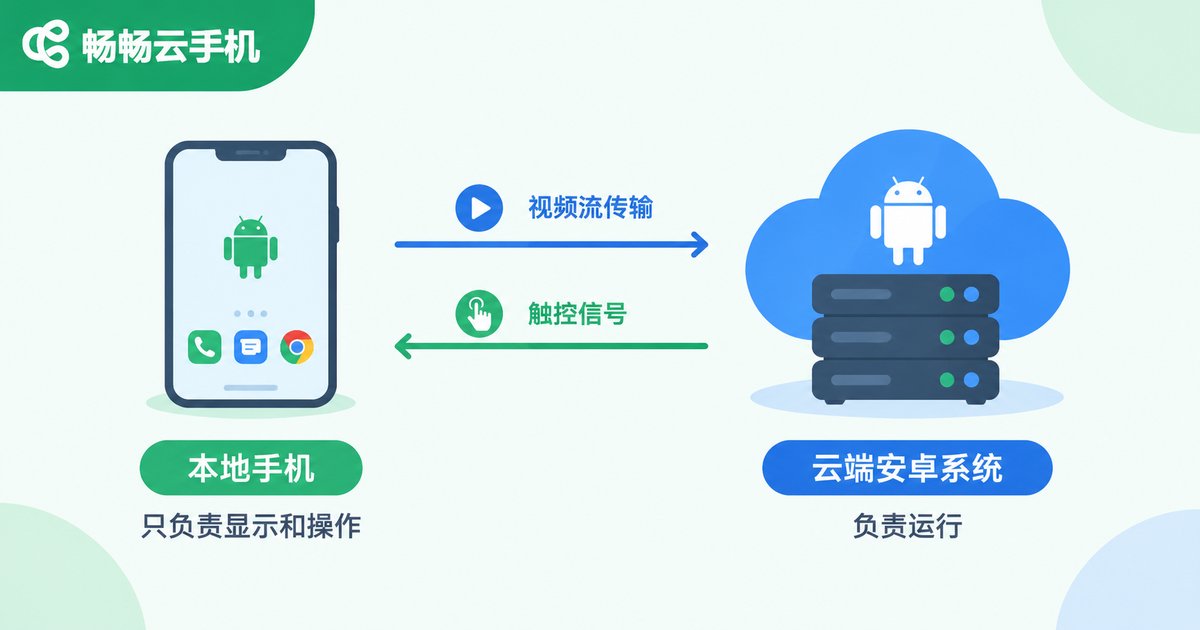
All computing happens in the cloud. If your network drops, you can't operate. ChangChang Cloud Phone keeps latency at 30-50ms through edge nodes, but poor local network infrastructure will affect the experience.
2. Not for Latency-Critical Scenarios
FPS shooters, rhythm games — these need millisecond-level response. Cloud phone latency is noticeable for precise operations, even if daily use feels fine.
3. Long-Term Single-Device Use May Cost More
If you only need one phone for over a year, buying a physical phone may be cheaper than monthly cloud phone fees. The cost advantage shines in "multiple devices" and "short-term" scenarios.
4. No Physical SIM Card
Cloud phones don't have physical SIM cards, so no carrier voice or SMS services directly. Calls require VoIP apps.
Who Should Use Cloud Phones?
| User Type | Recommended? | Why |
|---|---|---|
| Game AFK Players | ✅ Highly | Multi-instance, 24/7, no device tie-up |
| Social Media Teams | ✅ Highly | One device per account, group control |
| App Developers/QA | ✅ Highly | Multi-version parallel testing, far cheaper |
| E-Commerce Sellers | ✅ Yes | Multi-store management, anti-risk-control |
| Streamers | ✅ Yes | No heat/throttling, stable long streams |
| Enterprise IT | ✅ Yes | Data never touches local devices |
| Daily Users | ❌ No | Physical phones are more convenient |
| FPS Competitors | ❌ No | Latency-sensitive, real device better |
The Math: Cloud Phone vs. Physical Phones
Assume you need to manage 10 accounts simultaneously:
| Cost Item | 10 Physical Phones | 10 ChangChang Cloud Phones |
|---|---|---|
| Initial Investment | 10 × ¥1,500 = ¥15,000 | ¥0 |
| Monthly Cost | ~¥50 electricity | ~¥300-500 (Standard tier) |
| Maintenance | Charging, networking, repairs | ¥0 (cloud-managed) |
| Space | Dedicated storage area | 0 (pure cloud) |
| 6-Month Total | ~¥15,300 | ~¥1,800-3,000 |
| 12-Month Total | ~¥15,600 | ~¥3,600-6,000 |
In multi-device scenarios, cloud phones' cost advantage is overwhelming. But for a single phone over a year, buying physical is more economical.
FAQ
Q: What's the difference between cloud phones and emulators?
Emulators simulate a phone environment on your computer, consuming local resources and easily detected by platforms. Cloud phones run real Android on cloud servers with independent device info — better compatibility and security. For multi-instance and anti-association needs, cloud phones win decisively.
Q: What if the cloud phone service shuts down?
Choose established brands like ChangChang Cloud Phone, pay as you go, and don't prepay too much. Start with day or week passes to verify stability before committing to monthly plans.
Q: Are free cloud phones reliable?
There's no free lunch. Free cloud phones have limitations (low specs, short duration, ads) — fine for testing, not for long-term use. Paid plans are recommended for serious use.
Q: Can cloud phones completely replace physical phones?
No. Cloud phones excel in specific scenarios (multi-instance, AFK, testing), but daily communication, photography, and mobile payments are better on physical phones. They complement each other, not replace.
Final Thoughts
Cloud phones aren't a scam, nor are they a panacea. They're a tool whose value depends on the use case. Match the scenario, and they're a money-saver; mismatch, and you're wasting money.
The test is simple: if you need multiple phones, 24/7 operation, or environment isolation, cloud phones are for you. If you just need one phone for daily use, stick with a physical device.