Cloud Phone vs Real Device vs Virtual Machine: Hardware Comparison
First, Clarify Three Concepts
Before discussing the differences between cloud phones, real devices, and virtual machines, let's define three concepts:
- Real Device: The physical phone in your hand, with its own physical CPU, RAM, and storage
- Virtual Machine: A software-simulated phone environment on your computer (like an Android emulator)
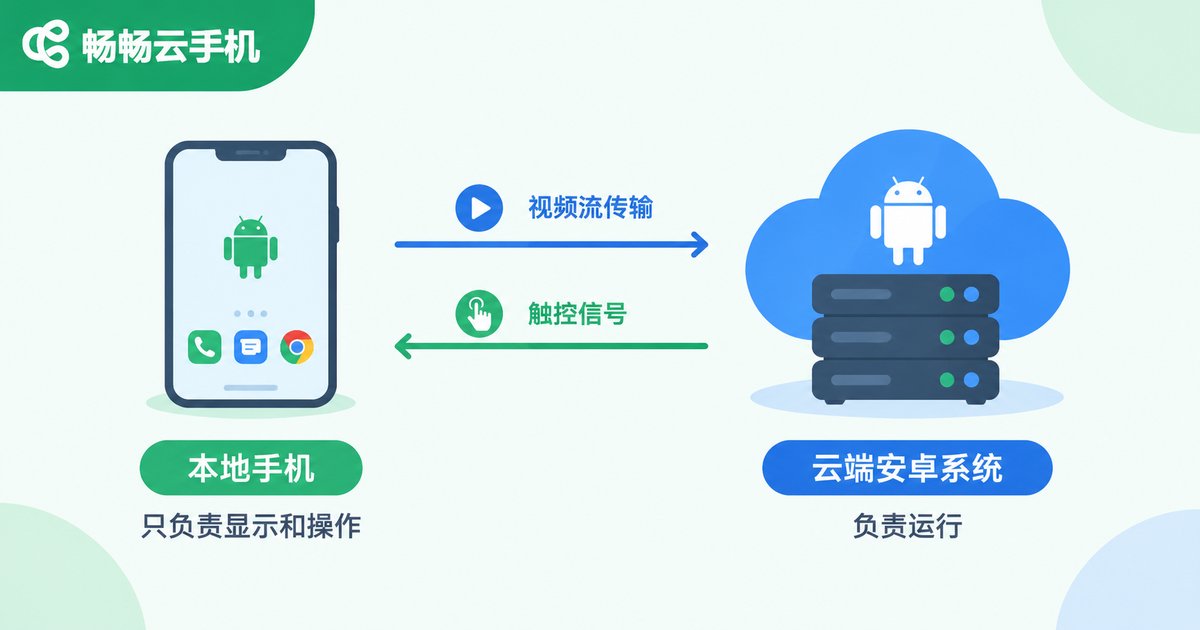
- Cloud Phone: A complete Android system running on cloud servers, controlled remotely via network
All three can run Android apps, but their underlying architectures are completely different.
Hardware-Level Architecture Comparison
| Dimension | Real Device | Virtual Machine (Emulator) | ChangChang Cloud Phone |
|---|---|---|---|
| CPU Architecture | ARM physical chip | x86 translating ARM | ARM native execution |
| Location | Local hardware | Local computer | Cloud servers |
| Resource Usage | Dedicated hardware | Consumes computer CPU/RAM | No local resource usage |
| Device Info | Real IMEI/MAC | Simulated device info | Independent real device info |
| App Compatibility | 100% | Frequent compatibility issues | Near real device |
| Multi-Instance | Limited by physical devices | Limited by computer performance | Dozens to hundreds |
| Network | Local network | Local network | Data center dedicated line |
| 24/7 Operation | Battery-limited | Computer must stay on | Naturally supported |
Performance Differences: Which Is Faster?
CPU Performance
Real devices use physical ARM chips — performance depends on the phone model. Virtual machines run ARM code through instruction translation on x86 computers, incurring 20-40% performance loss. ChangChang Cloud Phone runs natively on ARM cloud servers — high-spec configurations can outperform most mid-range real devices.
Graphics Rendering
Real device GPUs are physical hardware with the highest rendering efficiency. Virtual machines rely on computer graphics card emulation — complex 3D scenes easily stutter. ChangChang Cloud Phone uses cloud GPU rendering, then transmits via video stream — rendering itself is fine, but there's slight transmission latency.
Network Latency
| Scenario | Real Device | Virtual Machine | ChangChang Cloud Phone |
|---|---|---|---|
| Operation Response | 0ms | 0ms | 30-50ms |
| Network Requests | Depends on local network | Depends on local network | Data center line, faster |
Real devices and VMs have zero operation latency since computing is local. Cloud phones have 30-50ms network latency — imperceptible for daily use, but noticeable for precision operations like FPS gaming.
Independence Comparison: Anti-Association Capability
This is a core concern — which solution has the strongest anti-association capability for matrix operations?
| Independence Dimension | Real Device | Virtual Machine | ChangChang Cloud Phone |
|---|---|---|---|
| IMEI | Real, unique | Simulated, detectable | Independent real IMEI |
| MAC Address | Real, unique | Same as host machine | Independent MAC |
| IP Address | Local IP | Local IP | Switchable different IPs |
| Device Fingerprint | Real hardware fingerprint | Simulated, easily identified | Independent device fingerprint |
| Platform Detection | Cannot be detected as non-real | Easily detected as emulator | Hard to detect as cloud phone |
The conclusion is clear: anti-association capability ranks Real Device > Cloud Phone > Virtual Machine. But real devices are too expensive — cloud phones offer the best cost-performance ratio for anti-association.
Cost Comparison
| Cost Item | Real Device | Virtual Machine | ChangChang Cloud Phone |
|---|---|---|---|
| Per-Unit Cost | ¥1,500-5,000 | ¥0 (uses existing computer) | A few yuan/day |
| 10-Unit Monthly | ¥15,000+ | ¥0 (but computer can't handle it) | ¥300-500 |
| Maintenance | High | Medium | 0 |
FAQ
Q: Which is better — cloud phone or virtual machine?
Depends on needs. For temporary app testing, VMs are sufficient and free. For multi-instance, anti-association, and 24/7 operation, cloud phones win decisively. The biggest problem with VMs is being easily detected as emulators by platforms, leading to account bans.
Q: Can cloud phones completely replace real devices?
No. Daily communication, photography, NFC, and other functions are more convenient on real devices. Cloud phones suit specific scenarios (multi-instance, AFK, testing) — they complement real devices.
Q: Why are virtual machines easily detected?
VMs run on x86 architecture, translating ARM code. Many apps detect CPU architecture, sensor data, and hardware fingerprints — any anomaly flags an emulator environment.
Q: Is cloud phone performance sufficient?
ChangChang Cloud Phone's high-spec version (8 cores, 8GB) can smoothly run most mainstream mobile games and apps. For heavy 3D games, choose the high-spec version.
Final Thoughts
Real devices, virtual machines, and cloud phones each have their use cases. Real devices for daily use, VMs for temporary testing, cloud phones for multi-instance operations and anti-association.
The key is your needs: zero latency → real device; free testing → VM; multi-instance anti-association → ChangChang Cloud Phone. The three aren't replacements — they're tools with different strengths.