What is Cloud Phone? Understanding Its Principles and Real Use Cases
From "Phone in Your Pocket" to "Phone in the Cloud"
You've probably heard the term "cloud phone" by now, but what exactly is it? How is it different from the smartphone sitting in your hand right now?
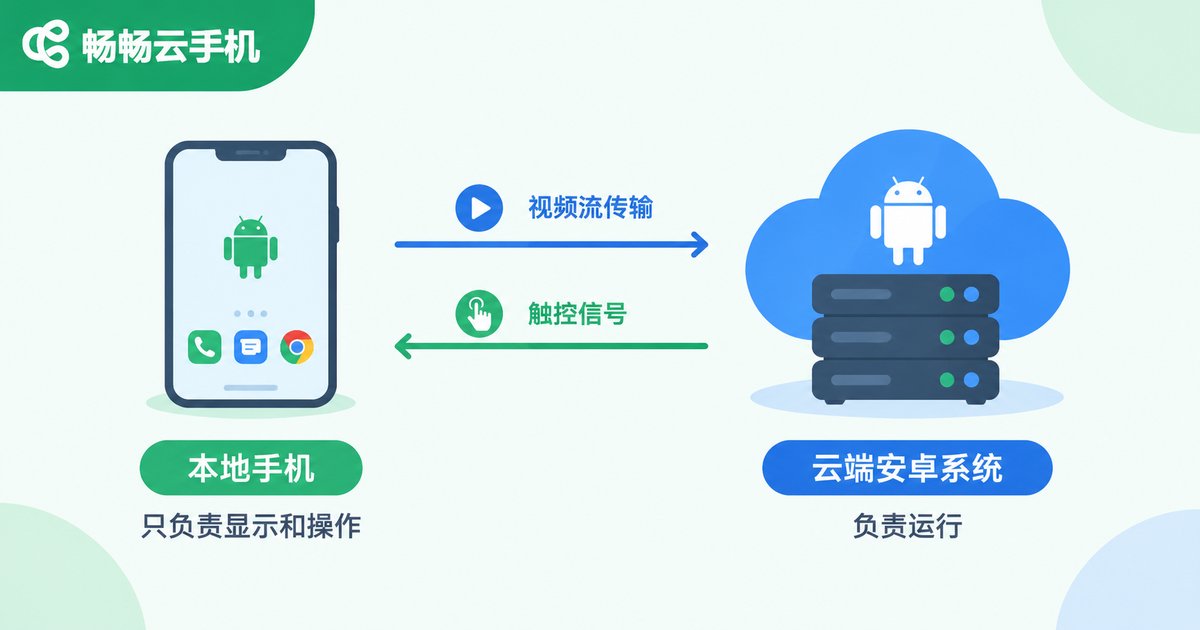
Simply put, a cloud phone runs a complete mobile operating system on remote cloud servers. You control it from your local device — phone, computer, or tablet — and the experience feels nearly identical to a physical phone.
This isn't science fiction. Cloud phone technology has been deployed in real-world scenarios like game automation and app testing since around 2019. Fast forward to 2026, with 5G networks and edge computing nodes widely deployed, latency has dropped to levels virtually imperceptible to the human eye.
ChangChang Cloud Phone is a prime example of this technology — what you see on your screen is a full Android system interface, but its CPU, memory, and storage all run in a remote data center.
How Does a Cloud Phone Actually Work?
To understand the underlying principle, think of it in three layers:
| Layer | Function | Analogy |
|---|---|---|
| Cloud Compute Layer | Runs ARM-based Android OS on servers, providing CPU/GPU power | Like a phone's "motherboard + chipset" |
| Network Transport Layer | Transmits screen output and touch input in real-time over low-latency network | Like a phone's "display ribbon cable" |
| Client Interaction Layer | User views the screen and performs touch operations on local device | Like a phone's "screen + touch panel" |
The core logic is straightforward: a complete Android system instance runs on a cloud server (typically using containerization or virtualization). The system's screen output is encoded into a video stream and pushed to your device over the network. Every tap and swipe you make is sent back to the cloud as an input command, which the server executes before refreshing the display.
Sounds like there'd be lag? There is, but the key question is how much. ChangChang Cloud Phone deploys edge nodes across multiple regions, keeping round-trip latency within 30-50 milliseconds. For most use cases, this delay is imperceptible.
Technical Architecture: More Than Just "Remote Desktop"
Many people's first reaction is: "Isn't this just remote desktop?" On the surface, yes — but the underlying technology is fundamentally different.
Traditional remote desktop protocols (like RDP or VNC) share the screen of an existing computer. A cloud phone, on the other hand, virtualizes an entire mobile hardware environment on the server — including the ARM CPU instruction set, GPU rendering pipeline, and sensor emulation. This means each cloud phone instance is an independent "virtual device" with its own IMEI, Android ID, and system settings, fully isolated from every other instance.
ChangChang Cloud Phone's tech stack looks roughly like this:
┌─────────────────────────────────┐
│     User Terminal (Phone/PC/Tablet)  │
│   Screen rendering + touch capture + audio │
└──────────────┬──────────────────┘
               │ WebRTC / Proprietary protocol
┌──────────────▼──────────────────┐
│      Edge Acceleration Node (nearest)   │
│      Smart routing + latency optimization │
└──────────────┬──────────────────┘
               │ Internal dedicated line
┌──────────────▼──────────────────┐
│      Cloud Phone Cluster (ARM servers)  │
│  Android container/VM + hardware accel  │
│  GPU rendering + H.265 video encoding   │
└─────────────────────────────────┘
A few key technical points deserve elaboration:
Native ARM Execution, Not Emulation
Cloud phone servers use ARM-architecture chips (or ARM instruction set translation), so Android runs natively without x86-to-ARM instruction translation. This means all apps have the same compatibility as on a real device — no crashes or stuttering common with emulators.
Video Stream Encoding Optimization
Screen transmission uses H.265/HEVC encoding, which saves about 40% bandwidth compared to H.264. ChangChang Cloud Phone also implements dynamic bitrate adjustment — lowering the bitrate when the screen is static and instantly ramping it up during interaction, ensuring smoothness while controlling data usage.
Multi-Instance Isolation
A single physical server can run dozens or even hundreds of cloud phones simultaneously, each isolated at the container level so they don't interfere with each other. This is the key reason cloud phone costs can be kept low — hardware resources are shared and distributed across multiple virtual devices.
Cloud Phone vs. Physical Phone: What's the Difference?
| Dimension | ChangChang Cloud Phone | Traditional Physical Phone |
|---|---|---|
| Hardware Cost | Pay-as-you-go, no device purchase needed | One-time purchase, thousands to tens of thousands |
| Compute Scalability | Upgrade/downgrade anytime, instant switching | Fixed configuration, no upgrades |
| Scaling | Spin up dozens in a minute | Buy and activate one by one |
| Network Dependency | Requires internet connection | Works offline |
| Latency | 30-50ms, near-real-device | 0ms, native experience |
| Data Security | Data in cloud, centrally managed | Data on device, high loss risk |
| Battery/Heat | Non-issue | Limited by battery and thermal design |
| 24/7 Operation | Naturally supported, no heat or drain | Overheating and battery drain over time |
Bottom line: cloud phones aren't meant to replace your daily driver. They provide a more efficient, more economical solution for scenarios that require "multiple phones, 24/7 operation, or elastic computing power."
Real-World Use Cases: Who Uses It and What For?
Scenario 1: Game Automation and Multi-Instance
This is the most classic cloud phone use case. Many mobile games have daily tasks, stamina recovery, and auto-farming mechanics. Leaving a physical phone running drains the battery and ties up the device. ChangChang Cloud Phone can run multiple instances simultaneously, each on a separate game account, 24/7 — no heat, no battery drain, and your personal phone stays free.
Scenario 2: Batch App Testing
Developers need to test app compatibility across different Android versions and screen resolutions before release. Buying dozens of physical test devices is expensive and hard to maintain. With cloud phones, you can create instances with different configurations on demand and delete them when done — a quantum leap in efficiency.
Scenario 3: Social Media Matrix Operations
Content operation teams often manage multiple platform accounts, each ideally on an independent device environment to prevent association. Cloud phones naturally provide isolated environments — each instance has its own device information, with zero interference between them.
Scenario 4: Enterprise Mobile Office
Some enterprises require employees to use specific apps for business operations but don't want those apps installed on personal phones (for data security reasons). Through cloud phones, companies can centrally deploy business apps, and employees access them remotely via a client — data never touches personal devices.
Scenario 5: Live Streaming and Screen Recording
Cloud phones can run streaming apps directly in the cloud, pushing the video feed from the cloud to the streaming platform without consuming local device performance. For long-duration streaming scenarios (like game streaming or e-commerce live streaming), this is far more stable than using a physical phone.
FAQ
Q: Is the cloud phone laggy? How big is the gap with a real device?
For everyday operations (scrolling feeds, chatting, watching videos), you'll barely notice a difference. ChangChang Cloud Phone keeps latency at 30-50ms through edge nodes — virtually imperceptible. However, for latency-critical scenarios (like precise FPS gaming), a local device is still recommended.
Q: Does a cloud phone need to be online all the time? What happens if the connection drops?
Yes, cloud phones require an internet connection since the system runs in the cloud. If you lose connection, you can't operate the phone — but the cloud instance won't shut down. Once your connection is restored, you can continue right where you left off, with all previous state preserved.
Q: Is the data secure? Could it leak from the cloud?
ChangChang Cloud Phone uses container-level isolation, with each instance's data kept independent. The enterprise edition also supports encrypted data storage and operation audit logs. Compared to physical phones that can be lost or stolen, cloud data is actually more controllable.
Q: How many apps can one cloud phone hold?
It depends on the configuration tier you choose. ChangChang Cloud Phone offers different CPU/memory/storage combinations — the entry-level can hold a dozen common apps, while the high-end can fit dozens. You can clean up or rebuild instances at any time.
Q: Can a cloud phone make calls and send texts?
A cloud phone is an Android system environment, so you can install VoIP apps for internet-based calls. However, it doesn't have a physical SIM card, so it can't directly use carrier voice and SMS services. For receiving verification codes, you can use virtual number features within apps.
Final Thoughts
The essence of a cloud phone is transforming the mobile phone from "hardware in your hand" to "computing power in the cloud." It's not here to replace your iPhone or Android flagship — it's about providing a more flexible option for scenarios that demand scale, continuous operation, and elastic configuration.
If you have needs in game automation, app testing, multi-account operations, or enterprise mobility, ChangChang Cloud Phone is worth trying. After all, not having to buy dozens of phones to stack on your desk is progress in itself.