
Is Cloud Phone Reliable? These Red Flags of Shady Platforms You Should Avoid
You sign up for a cloud phone service to run a game bot, test an app, or manage multiple accounts. Two months later the platform goes dark, and your balance and your data disappear with it. In the cloud phone market, this story is far too common. The technology itself is solid, but not every provider behind it is. The good news is that platforms about to vanish usually leave clues. This guide breaks down the shared traits of shady providers and shows you how to verify a platform before you commit.
1. Separate the Technology from the Provider
A cloud phone is simply an Android device running in a data center that you control remotely over the network. The technology is mature, and carriers, game studios, and automation teams use it every day.
But running cloud phones is a capital-intensive business: servers, rack space, bandwidth, and an operations team all cost real money, every hour of every day. So when a provider offers prices that seem too good to be true, ask yourself one simple question: where does the money come from?
2. Seven Shared Traits of Platforms That Disappear
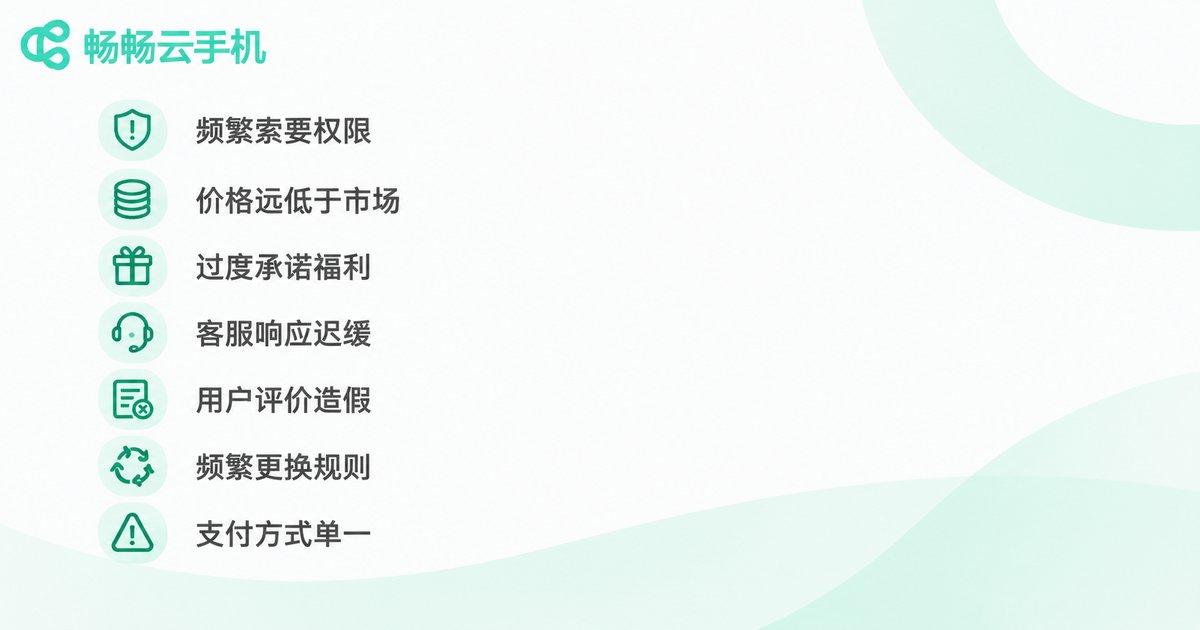
Trait 1: Absurdly low prices plus a lifetime promise. Cloud phone costs are fixed and predictable. A provider charging one third of the market rate while promising pay once and use forever is probably funding old users with new users money. When the flow stops, everyone loses.
Trait 2: No company behind the website. No business name at the bottom of the page, no registration number, no office address, and the only contact channel is a chat group. A legitimate company does not hide who it is.
Trait 3: Payments go to a personal account. At checkout the payee is a private individual rather than a company, and there is no proper payment gateway. If something goes wrong, you have nobody to file a claim against.
Trait 4: Support can sell plans but cannot answer technical questions. Ask which region the data center is in, how the network routes, or what specs the instance runs, and the only reply is a prompt to top up. That usually means there is no technical team at all.
Trait 5: Marketing claims that defy common sense. Never disconnects, unlimited instances, guaranteed ban-proof. A cloud phone runs on real networks and real hardware, and no responsible vendor makes absolute promises like these.
Trait 6: Communities that look too lively to be real. The group is full of short five-star comments, but you cannot find a single detailed usage report, and nobody discusses specs, latency, or compatibility. Real user communities always include complaints and debate.
Trait 7: Every problem is your fault. Disconnects are your bad network, lag is your bad script, lost data is your own mistake. A platform that never admits a problem of its own is not planning to be accountable long term.
3. A Side-by-Side Comparison
| Dimension | Reliable provider | Shady provider |
|---|---|---|
| Company info | Business name and registration number published on site | Only a chat group, no verifiable entity |
| Payment | Official gateway, payee is the company | Personal transfers only |
| Pricing logic | Transparent, explainable by real costs | Below cost, plus lifetime promises |
| Support skill | Answers questions on specs and routing | Only pushes you to top up |
| Stability disclosure | Publishes data center regions and network info | Constant drops blamed on your network |
| Reputation | Long-term users with detailed feedback | Short bursts of generic praise |
| Data safety | Clear data and account terms | Vague terms or none at all |
4. A Five-Step Check You Can Run in Three Minutes

Step one: check the entity. Scroll to the bottom of the website and look for a business name and registration number, then search that company in the official business registry to confirm it exists and is active.
Step two: check the payee. Before you order, confirm that the payment page shows a corporate recipient. If the only option is scanning a code to a personal account, walk away.
Step three: check the documentation. A serious provider publishes product descriptions, configuration details, service terms, and a help center. The more specific the docs, the more serious the team.
Step four: ask one concrete question. For example, which Android version does the instance run, which region is the data center in, which resolutions and root permissions are supported. A provider with real engineers answers accurately within minutes.
Step five: run a small test. Start with the smallest configuration and watch three things: does it stay online without dropping, is your data still there after a restart, and how fast does support respond. If all three pass, consider a longer commitment.
5. Why ccloudphone Deserves a Place on Your Shortlist
ccloudphone is a provider focused on cloud Android instances, and its official site ccloudphone.com publishes full product documentation and service terms. It belongs to the category of providers that can actually be checked.
Its capabilities are practical rather than exaggerated: cloud Android instances that run 24/7, so tasks keep going even when your local device is off; multi-instance and batch management for game idling, app testing, and multi-account operations; and access from both the web and a desktop client, so switching devices does not mean rebuilding your setup.
What matters just as much is how it operates: real documentation, a support channel you can reach, and public service terms. These look like the basics, yet they are exactly what disappearing platforms refuse to provide. For users, being verifiable matters more than any slogan.
If you are comparing cloud phone providers right now, start by reading their documentation and terms, then run a small configuration for a couple of weeks. That process will tell you more than any advertisement.
Frequently Asked Questions
Q: Is cloud phone reliable in general?
The technology is reliable. Cloud Android instances are used at scale for gaming, testing, and marketing. What is unreliable is the small provider with no registered company and personal-account payments. Choosing the provider matters more than choosing the specs.
Q: How can I quickly tell if a cloud phone platform will disappear?
Check three things: whether the site publishes a business entity and registration number, whether the payee is a company account, and whether support can answer a real technical question. If all three pass, the risk drops sharply.
Q: Are cheaper cloud phones always riskier?
Not always, but a price well below the industry cost line is a warning sign. Servers, bandwidth, and operations are hard costs, and a provider selling below cost for a long time can only end by shutting down.
Q: Is my data safe on a cloud phone?
It depends on the provider. Choose one with clear data terms, account isolation, and the ability to export your data at any time. Keep a local backup of anything important.
Q: Can a small test really reveal problems?
It reveals most of them. Watch continuous uptime, whether data survives a restart, and how quickly support replies. After one or two weeks, a provider shows its true level of service.
Q: Who is ccloudphone suitable for?
Users who need long-running online tasks, multi-account management, or app testing. Visit the official site first to review the available configurations and service terms, then match them to your own use case.