Does a Cloud Phone Drain Your Battery Fast? The Zero-Load Truth
A Real Phone Farming Overnight Loses 40% Battery. What About a Cloud Phone?
Anyone who has farmed games on a physical phone knows the routine: plugged in, the device gets too hot to hold; unplugged, the battery is dead by morning. So the natural worry is: does switching to a cloud phone drain just as much power?
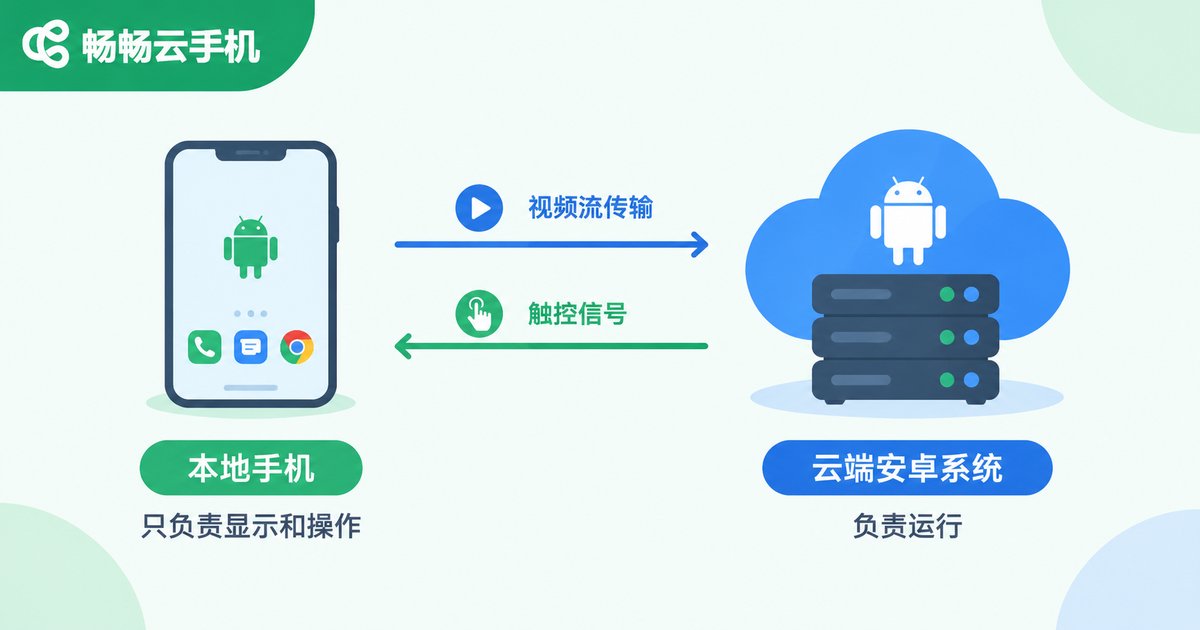
The answer is the opposite: a cloud phone's drain on your local battery is so small it is negligible, because the power-hungry computing never happens on your phone. Your device does exactly one thing — decode a video stream while you watch — roughly the same load as scrolling short videos, and an order of magnitude lighter than running a heavy game.
Why a Cloud Phone Is "Zero-Load" for Your Device
The three biggest battery killers on a phone are heavy CPU/GPU computation, a constantly lit screen, and continuous radio communication. A cloud phone moves all three away:
- Computing happens in the cloud: game rendering and script execution run on data-center servers, leaving your local processor nearly idle.
- Your screen stays off: while farming, you can lock the screen, pocket the phone, or even power it down — the cloud keeps working.
- Networking is featherweight: with no video stream open, only a tiny keep-alive heartbeat remains — lighter than a messaging app in standby.
Head-to-Head Test: Physical Phone vs Cloud Phone Farming
We ran the same idle game for 8 hours overnight, once on a physical phone and once on ChangChang Cloud Phone, and measured the local battery change:
| Metric | Physical phone farming | ChangChang Cloud Phone farming |
|---|---|---|
| Battery lost in 8 hours | ≈ 42% | ≈ 3% (pure standby loss) |
| Device temperature | Noticeably hot, ≈ 41°C | Room temperature |
| Screen | Must stay on or wake often | Locked the whole time |
| CPU load | Sustained high load | Near zero |
| Kill risk | Background process may be reaped by the OS | None — runs independently in the cloud |
The takeaway is clear: farming on a physical phone trades your device's lifespan for game progress, while a cloud phone shifts that wear to servers built for 24/7 operation.
Does Live Control Drain Battery Fast?
The only scenario with meaningful power draw is live control while the viewer is open. We tested that too:
| Usage | Local battery per hour | Comparable to |
|---|---|---|
| Cloud phone live control (SD) | ≈ 8% | 1 hour of short videos |
| Cloud phone live control (HD) | ≈ 12% | 1 hour of online video |
| Playing the same heavy game locally | ≈ 25% | Noticeable heat |
Even live control costs about half the battery of local gaming, because your device decodes video instead of rendering graphics.
Five Ways to Push Power Use to the Limit
- Lock the screen or quit the app while farming: the cloud phone does not need your display.
- Check progress from the PC web client: reviewing on a computer uses zero phone battery.
- Choose SD quality: video decoding is the only local power draw, and lower bitrates cost less.
- Skip background residency: ChangChang Cloud Phone supports cloud push notifications, so the app does not need to stay alive in the background.
- Use an old phone as a remote: a five-year-old device decodes video streams just fine — no gaming horsepower required.
FAQ
Q1: Can I fully power off my phone while farming overnight? Yes. The cloud phone runs on remote servers, independent of your local device. Powering off or using airplane mode changes nothing in the cloud.
Q2: Will watching the cloud phone screen for a long time make my phone hot? Basically no. Video decoding is far lighter than game rendering; after one hour of continuous control, the device was only slightly warm.
Q3: Does the cloud phone app secretly drain battery in the background? No. Without an open video stream, only a featherweight keep-alive connection remains — comparable to a social app on standby — and you can fully quit it anytime.
Q4: Does an old phone consume more power with a cloud phone? Quite the opposite. An old phone struggles to run heavy games but handles video decoding easily, so a cloud phone actually sidesteps its weakest, most power-hungry point.