How Does Cloud Phone AFK Work? A Cloud Virtualization Primer
You close the app on your phone, yet the "phone" in the cloud keeps gaming and completing tasks for you — it sounds like science fiction, but the technology behind it is remarkably mature. This article explains in plain language how cloud phone AFK actually works. Spoiler: it's neither magic nor a scam — just solid cloud virtualization.
In One Sentence: The Phone Moved Into a Data Center
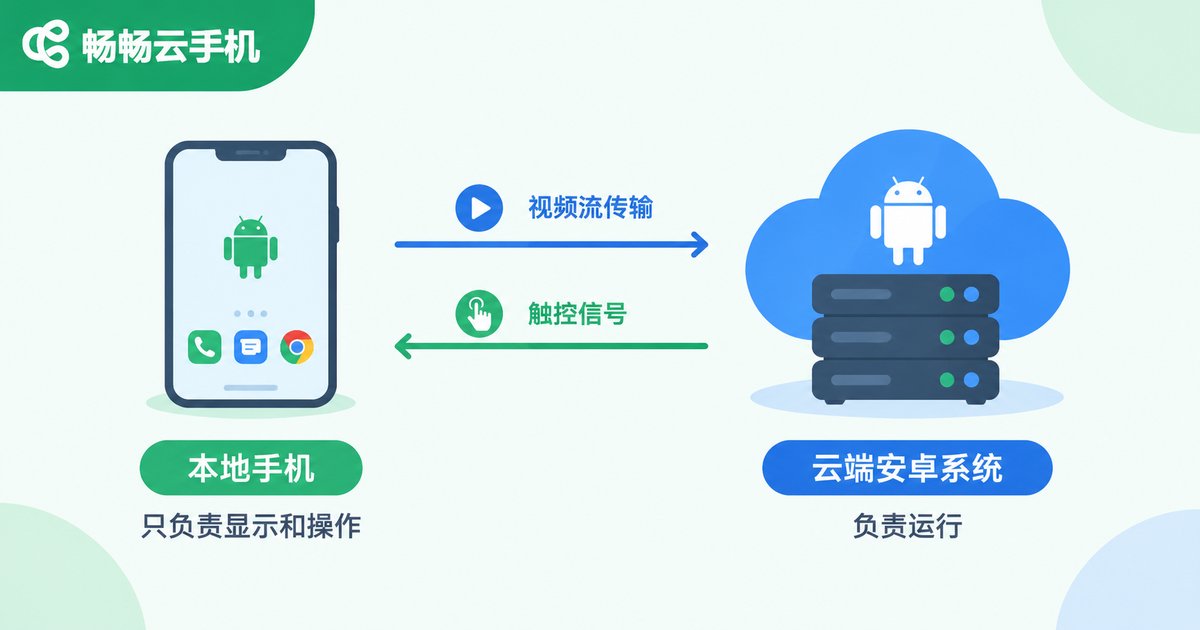
A normal phone computes on the chip in your palm. A cloud phone moves that job to servers in a data center. What you see is essentially a live video stream; your taps are essentially touch commands sent back to the server.
Think of it like using a remote control on a TV a thousand miles away — the TV keeps playing, and changing channels or volume is just remote instructions.
Core Tech 1: Virtualization — One Server Becomes Hundreds of "Phones"
Cloud phones are built on virtualization. High-performance servers create phone environments through two mainstream routes:
| Approach | How It Works | Characteristics |
|---|---|---|
| Virtual machines | Virtualize a complete hardware environment, then install Android | Strong isolation, great compatibility |
| Containers | Multiple cloud phones share the OS kernel with separate app spaces | High density, fast startup, low cost |
Either way, the result is identical: each cloud phone gets its own CPU, memory, and storage quota, fully isolated. What you install or run is invisible to neighboring instances. ChangChang Cloud Phone uses exactly this kind of multi-instance isolation architecture — every device is an independent environment.
Core Tech 2: Streaming — How the Screen Reaches Your Phone
How does the picture travel from the server to you? Real-time streaming, in three steps:
- Capture and encode: the server grabs the cloud phone's screen and compresses it with H.264/H.265
- Network transport: the compressed stream travels over backbone networks to your client
- Command return: your tap coordinates are sent back instantly, and the cloud phone executes the action
The round trip usually completes within tens of milliseconds — which is why it feels like a local phone. Quality and frame rate are adjustable; on weak networks, lowering the bitrate keeps things smooth. That's the principle behind the "quality" setting.
Core Tech 3: Why It Stays Alive When You Power Off
The single most important point for AFK: the cloud phone's operation has zero dependency on your client.
- The cloud phone process runs on the server, backed by data center power and networking
- Your app is just a "viewing window" — closing it doesn't affect the cloud process
- Even if your phone dies for three days, the game in the cloud stays online for three days
Grinding on a real phone means using your own device as the server — power or network loss stops everything. With a cloud phone, the server works 7×24 on your behalf; you just check in occasionally.
How It Differs from an Emulator
People often confuse cloud phones with PC Android emulators. The differences are fundamental:
- Where it runs: an emulator runs on your computer and dies when it shuts down; a cloud phone lives in a data center, always online
- Resource usage: emulators eat your PC's CPU and RAM — three instances and it crawls; cloud phones use none of your local computing power
- Mobility: an emulator is chained to that computer; a cloud phone can be taken over from any device where you log in
In short: an emulator is "faking a phone in your own house"; a cloud phone is "renting a real environment in someone's data center."
Why Is This Only Mainstream Now?
Virtualization has existed for decades, but cloud phones only took off recently because three supporting conditions matured:
- Faster networks: 4G/5G and broadband made real-time streaming latency usable
- Better video codecs: efficient encoding like H.265 squeezed HD video into tiny bandwidth
- Mature ARM servers: running Android natively on ARM servers eliminated slow translation layers, massively boosting cloud phone performance
With all three in place, cloud phones went from "technically possible" to "genuinely good" — at prices ordinary users can afford.
Q&A
Q: Is a cloud phone real phone hardware? A: It depends on the platform. Some use arrays of real phone mainboards; others use server virtualization. ChangChang Cloud Phone uses server virtualization with deep simulation of real phone environments — indistinguishable from physical devices in daily use.
Q: Could data center maintenance interrupt my AFK session? A: Proper facilities have redundant power and networking, far more stable than home setups. Rare maintenance windows are announced in advance.
Q: What latency should I expect? A: It depends on your connection to the data center — typically 30–80ms on home broadband. Imperceptible for AFK and video; competitive gamers should pick the nearest node.
Q: Where is my data stored? Is it safe? A: On cloud servers, with instances isolated from each other. ChangChang Cloud Phone's devices are fully isolated — no other user can access your data.
Q: If my network drops, what happens to running tasks? A: Your disconnection only interrupts the video stream — the cloud phone keeps running in the data center. Reconnect when your network returns and everything is exactly where it was.