Cloud Phone Scripts: How to Run Automation Programs in the Cloud
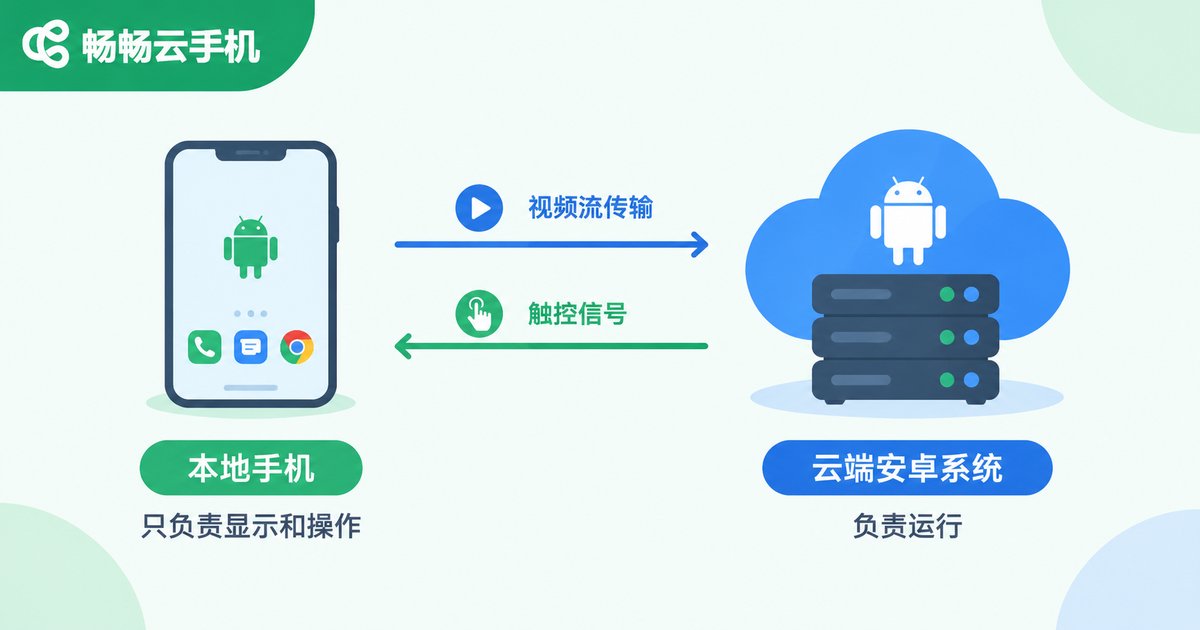
The essence of cloud phone scripts is running automation programs on cloud Android instances. They don't require root access or system modification — instead, they simulate user actions (taps, swipes, text input) to achieve automation. This article provides a deep technical analysis of ChangChang Cloud Phone's complete script operation mechanism.\n\n## How Cloud Automation Programs Work\n\nCloud phone scripts work similarly to local automation tools (like Auto.js or macro recorders), but the runtime environment is completely different:\n\n| Dimension | Local Automation Tools | ChangChang Cloud Phone Scripts |\n|-----------|----------------------|-------------------------------|\n| Runtime location | Local phone/PC | Cloud servers |\n| Device dependency | Requires local device online | Independent of local devices |\n| Runtime | Limited by device usage | 24/7 uninterrupted |\n| Resource usage | Occupies local CPU/RAM | Uses cloud resources |\n| Network | Local IP | Cloud independent IP |\n\n### Script Engine Architecture\n\nChangChang Cloud Phone's script engine has three layers:\n\n\nUser Layer: Script Management UI / Task Scheduler\n ↓\nEngine Layer: Script Parser / API Interface / Exception Handler\n ↓\nExecution Layer: Android Accessibility / InputManager / WindowManager\n\n\nUser Layer handles script import, editing, management, and task scheduling.\n\nEngine Layer is the core — parsing script code, calling system APIs, and handling exceptions.\n\nExecution Layer interacts directly with the Android system, simulating user actions through Accessibility Service and InputManager.\n\n## How Scripts Simulate User Actions\n\nChangChang Cloud Phone scripts simulate user actions in two ways:\n\n### Method 1: Coordinate Operations\n\nDirectly specify screen coordinates for taps, swipes, and other actions. This is the most basic method, used by default in recorded scripts.\n\n\ntap(540, 1200) → System simulates a tap event at coordinates (540, 1200)\nswipe(540, 1800, 540, 600) → System simulates a swipe from (540, 1800) to (540, 600)\n\n\nPros: Fast, simple implementation\nCons: Resolution-dependent, requires coordinate adjustment for different devices\n\n### Method 2: Image Recognition\n\nLocates elements by screenshot comparison, independent of fixed coordinates.\n\n\nfindImage("login_button.png") → Screenshot and search for matching region\nIf found → Return center coordinates of match\ntap at those coordinates → Execute tap\n\n\nPros: Resolution-independent, strong adaptability\nCons: Slower, consumes more CPU\n\n### Comparison\n\n| Aspect | Coordinate Operations | Image Recognition |\n|--------|----------------------|-------------------|\n| Execution speed | Fast (<10ms) | Slow (100-500ms) |\n| Resolution adaptability | Poor | Good |\n| CPU usage | Low | Medium-high |\n| Implementation difficulty | Simple | Medium |\n| Best for | Fixed interfaces | Dynamic interfaces |\n\n## Script Execution Lifecycle\n\nA script goes through these phases from start to finish:\n\n| Phase | Description | Duration |\n|-------|-------------|----------|\n| 1. Load | Read script file, parse syntax | <100ms |\n| 2. Initialize | Set parameters, check environment | <500ms |\n| 3. Execute | Perform actions step by step | Depends on script |\n| 4. Monitor | Real-time status and exception monitoring | Continuous |\n| 5. Exception handling | Execute preset strategy on errors | Instant |\n| 6. Loop | Return to step 3 and repeat | Depends on settings |\n| 7. End | Clean up resources, output logs | <100ms |\n\n## Task Scheduling System Deep Dive\n\nChangChang Cloud Phone's task scheduling system is the core of cloud automation — it determines when scripts run, for how long, and what happens on errors.\n\n### Scheduling Strategies\n\n| Strategy | Trigger | Execution | Use Case |\n|-----------|---------|-----------|----------|\n| Immediate | Manual trigger | Single run | Testing/debugging |\n| Scheduled | Specified time | Single run | Daily check-ins |\n| Loop | Repeat at intervals | Infinite loop | Game idling |\n| Conditional | Preset conditions met | Single run | Monitoring response |\n| Orchestration | Previous script completes | Sequential | Complex workflows |\n\n### Exception Handling Mechanism\n\nScripts may encounter various exceptions during runtime. ChangChang Cloud Phone provides multi-level exception handling:\n\n| Exception Type | Detection | Default Action | Optional Action |\n|---------------|-----------|---------------|----------------|\n| Script error | Syntax/runtime exception | Stop and report | Retry N times |\n| Operation timeout | Step execution timeout | Skip step | Retry/stop |\n| Network disconnect | Heartbeat failure | Pause and wait | Resume after reconnect |\n| App crash | Process monitoring | Restart app | Notify user |\n| Insufficient resources | CPU/RAM monitoring | Degrade performance | Alert notification |\n\n## Script Performance Optimization Tips\n\n### 1. Minimize Unnecessary Screenshots\n\nScreenshots are the most resource-intensive operation in scripts. If coordinate operations can solve the problem, don't use image recognition.\n\n### 2. Set Reasonable Delays\n\nToo-short delays cause operations to miss their target; too-long delays waste time. Recommendations:\n\n| Operation Type | Recommended Delay | Notes |\n|---------------|------------------|-------|\n| Page transition | 2000-3000ms | Wait for loading |\n| Button tap | 500-1000ms | Wait for response |\n| List scroll | 1000-2000ms | Wait for scroll to stop |\n| Text input | 500ms/character | Simulate typing speed |\n\n### 3. Use Conditional Logic to Avoid Invalid Operations\n\nAdd condition checks before key steps to avoid executing invalid operations:\n\nlua\n-- Check if on the correct page\nif findImage("home_page.png") then\n -- Execute operation\n tap(540, 1200)\nelse\n -- Not on home page, go back first\n pressBack()\n sleep(2000)\nend\n\n\n### 4. Batch Operation Optimization\n\nWhen running the same script across multiple instances, use ChangChang Cloud Phone's batch operation feature to send commands to all instances at once, rather than operating one by one.\n\n## FAQ\n\nQ: How much cloud phone resources do scripts consume?\n\nA: Normal scripts use about 5-15% CPU and 20-50MB RAM. Scripts with heavy image recognition may use 20-30% CPU. The impact on overall cloud phone performance is minimal.\n\nQ: Can scripts be detected by games?\n\nA: ChangChang Cloud Phone scripts simulate operations through standard Android system APIs — they don't modify game files or inject code. Combined with random delays and independent device fingerprints, detection probability is low. However, 100% undetectability cannot be guaranteed.\n\nQ: Can scripts access the cloud phone's camera and microphone?\n\nA: Yes. ChangChang Cloud Phone instances support virtual cameras and microphones, accessible via API. However, practical use cases are limited, mainly for live streaming assistance.\n\nQ: Can scripts access the network?\n\nA: Yes. Scripts can make standard HTTP requests for data reporting, API calls, and more. ChangChang Cloud Phone instances have independent network environments, unaffected by local network conditions.\n\nQ: How do I debug scripts?\n\nA: ChangChang Cloud Phone provides a script debug mode: 1) Step execution — execute script instructions one by one for easy problem identification; 2) Log output — use print() to output debug info; 3) Screenshot snapshots — auto-screenshot at key steps for review.